.png) 3 months ago
49
3 months ago
49
Every summer, people descend on the wildflower capital of Colorado to see grasslands flush with corn lilies, aspen sunflowers and sub-alpine larkspur. In January 1991, scientists set up a unique experiment in these Rocky Mountain meadows. It was one of the first (and longest running) to work out how the changing climate would affect an ecosystem.
At the time, it was believed a temperature increase could lead to longer, lusher grasses. But instead of flourishing, the grasses and wildflowers started to disappear, replaced by sage brush. The experimental meadows morphed into a desert-like scrubland. Even the fungi in the soils were transformed by heat.
The experiment provided a window into the future. These meadows will disappear in the coming decades if warming reaches 2C above preindustrial levels, according to the resulting article published in the Proceedings of the National Academy of Sciences. The findings are alarming, not just for Colorado, but for mountains across the planet as “shrubification” takes over.
The experiment
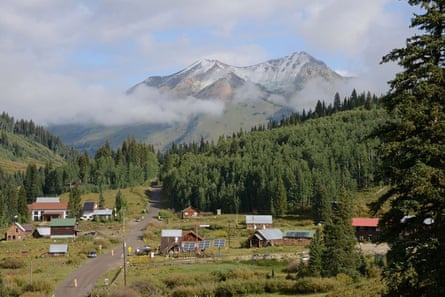
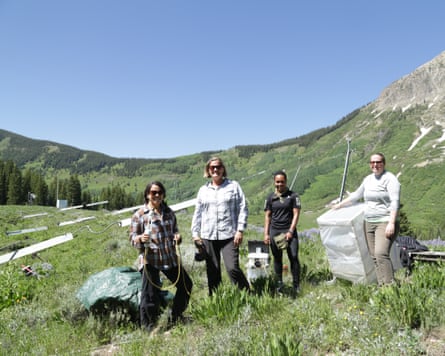
The Rocky Mountain Biological Laboratory is in the former ghost town of Gothic, abandoned after the closure of its silver mines. Over winter, the landscape lies quietly under a bed of snow. In early spring, the only way for researchers to get to experimental sites – at an altitude of 10,000ft – is by skiing across country.
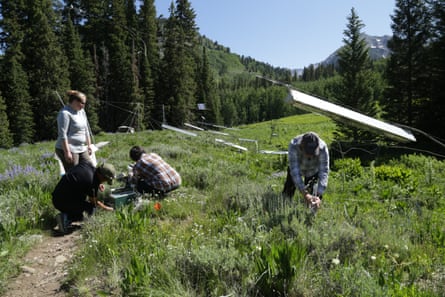
Electric infrared radiators warmed five experimental plots of 30 sq metres year-round. Head-height heaters were on day and night over a patch of meadow, keeping it 2C above normal temperatures with an annual electricity bill of $6,000 (£4,450). They warmed the top six inches of soil. Animals could come and graze and the natural system was preserved as much as possible.
Over 29 years, researchers found that shrubs increased by 150% in warmed plots compared with those without warming. The surface of the soil was dried by up to 20%, and shallow-rooted plants became stressed. Some wildflowers went extinct in heated plots. “It’s a sign of things to come,” says lead researcher Lara Souza from the University of Oklahoma.
Scientists also noted big changes in the invisible world of soil fungi and microbes. Shrubs and sage brush don’t rely on fungi in the same way as grasses. They found a decline in fungi that help plants acquire nutrients, and an increase in fungi that decompose organic matter. “This highlights that when you have a big change above ground, you’ve likely got a big change below ground,” says Souza. “Turning back is very unlikely.”
Alpine grasslands are often overlooked in terms of their species richness. Europe’s alpine grasslands host 50% of European flora on just 3% of land. They are home to many plant species found nowhere else on the planet. “They’ve been here for thousands of years,” says Dr Patrick Möhl from Lancaster University who studies pristine alpine grasslands in Austria and their disappearance due to climate breakdown.
“It is very species diverse, we will lose so much of that. It will just be forest, the same kind of forest we have lower down,” he says.
Möhl has observed species of trees – often pine – moving uphill as the climate warms. “It’s a profound change in the ecosystem – the life form is changing, from grassland to a woody ecosystem,” he says.
Arctic ‘shrubification’
This is not just being observed in mountain environments.
The expansion of shrub cover is one of the most significant ways Arctic landscapes are changing, with polar “greening” trends even visible on satellites. Increasing summer temperatures are the key driver. Shrub cover expanded by 2.2% each decade in the western Canadian Arctic, according to data recorded between 1984 and 2020.
In cold places, plants tend to stay small. Larger plants can get damaged through wind and cold exposure, the weight of snow, or face difficulties growing leaf and stem tissue in a very short growing season. As the climate becomes less cold and less stressful, shrub and tree species can move in.
“Global heating is lifting some of the restrictions to plant growth that were associated with cold conditions in high latitude and high-altitude ecosystems,” says Sarah Dalrymple, a conservation ecologist at Liverpool John Moores University, who has been studying changes in Iceland. “There is a transition from grasslands, or heath, through to shrubs, and eventually through to trees.”
Grass and soil ecosystems that have been kept in a delicate balance for thousands of years are likely to be irrevocably changed in the coming decades. “Shrubification in itself isn’t necessarily a problem, but the fact we are losing Arctic ecosystems is a problem,” says Dalrymple.
Some people welcome shrubs and trees – they bring shelter for wildlife, livestock and people. “But at a global level, the afforestation of cold environments is worrying because it is associated with permafrost melting and the acceleration of subsequent carbon emissions,” adds Dalrymple.
“It is alarming to see this process of shrubification happening so quickly. The speed of change, and the knock-on impacts on things like the carbon cycle, are really very worrying. It’s not just about whether the individual tree is good or bad.
“What is ‘bad’ is our inability to control our own carbon emissions. Shrubification is a symptom of this, not the cause, and we need to treat it as such.”
The way we manage the planet and where we live is based on the fact we assume that the planet is going to be there for ever, and is going to be unchanged. But these changes are global, not localised to Colorado. “It’s all happening so much faster than the projections would have said,” says Dalrymple.
Souza is still captivated by the insect-rich meadows around the research centre. She has been coming since 2012 and the magic is unchanged.
“It’s like flowers on steroids,” she says. “It’s surreal to me, every time I come.” But this vision is tinged with sadness at what the future might hold. This fragile landscape – like so many across our planet – is on the brink of huge change.
Find more age of extinction coverage here, and follow the biodiversity reporters Phoebe Weston and Patrick Greenfield in the Guardian app for more nature coverage