.png) 1 week ago
22
1 week ago
22
Hanging at the entrance of the new Margaret Preston exhibition at the National Gallery of Victoria are three of her instantly recognisable still lifes. Each depicts a vase brimming with native flora: bell-shaped gumnuts, silvery eucalyptus leaves and bristly banksias. These are identifiably Australian plants, painted in what might be described as an Australian style, reflecting Preston’s lifelong ambition to define a national aesthetic. Look more closely, though, and this simplistic story begins to unravel.
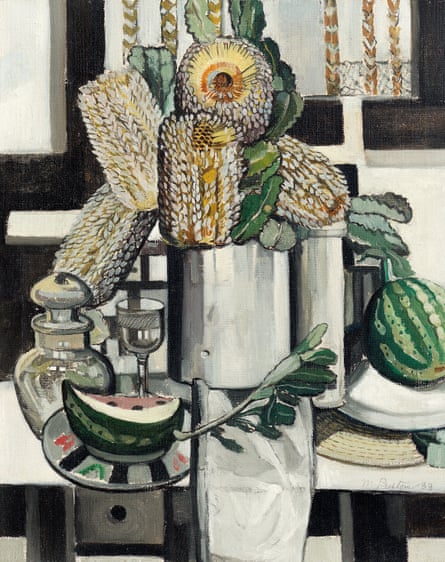
Her 1928 painting Western Australian Gum Blossom features a blocky background of creamy rectangles that gesture to the modernist and abstract movements that were flourishing in Europe at the time, as well as the flattened forms of Japanese woodblock prints. The black and white geometry of the second work, Native Honeysuckle, echoes cubist paintings by the French artist Fernand Léger. And all three point to Preston’s interest in Indigeneity, a fascination intertwined with her appreciation and appropriation of Aboriginal art.
“Preston was working towards a unified art for Australia,” says Michael Gentle, the NGV’s former curator of Australian and First Nations art, who co-curated the exhibition alongside Beckett Rozentals, the gallery’s senior curator of Australian art.
“That was her mandate, yet it was saturated with contradictions because she’s actively pulling from multiple sources.”
This paradox lies at the heart of this retrospective, the first dedicated to Preston in more than 20 years. Featuring more than 200 of her works – including three long-lost paintings the NGV tracked down through a public appeal – as well as pieces by her peers and contemporary artists responding to her, the show takes you on a loosely chronological journey through the artist’s life.
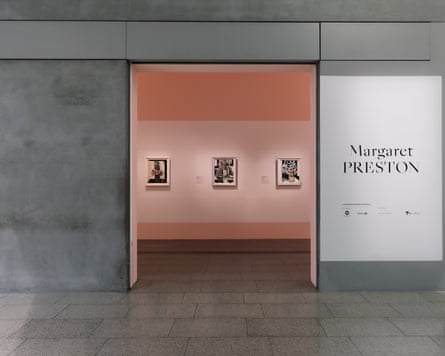
Along the way, it navigates the tangled web of what she wanted her work to be, what it actually became and why it remains both beloved and contested as a symbol of Australian identity today.
Preston was born in Port Adelaide in 1875. Her family later moved to Sydney, then, as Preston’s talent became apparent, to Melbourne so she could enrol in the National Gallery of Victoria Art School in her late teens. Stories of her student days reveal the confidence that would characterise her throughout her life; the artist Hans Heysen remembered Preston positioning herself right in front of a model in a life-drawing class, irritating her peers, most of whom were men.
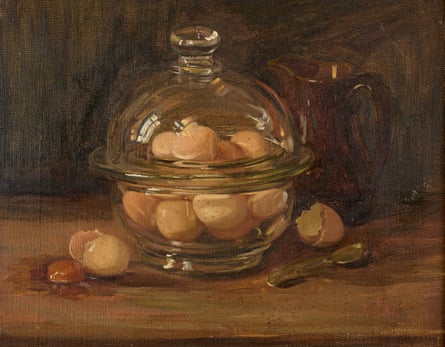
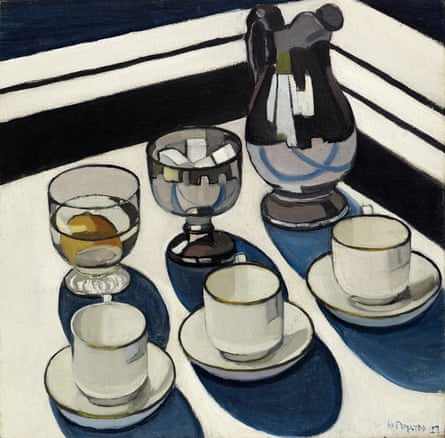
Her devotion to still life painting also set her apart at a time when landscape painting was considered the pinnacle of artistic achievement in Australia. Several early paintings demonstrate Preston’s skill at bringing sedate scenes to life. A gleaming glass bowl full of unblemished eggs sits next to a cracked shell oozing a sticky yolk. Milk pools from an upended jug. Onions appear to dance across a kitchen surface, as though they have just been poured out of a bag. “One of our art handlers said, ‘I love this one. You can almost smell the onions cooking,’” Rozentals says.
The following rooms trace how Preston’s style developed during two formative trips to Europe, the first from 1904 to 1906 and the second from 1912 to 1919. In London, Paris and the many other cities she visited, she encountered the latest developments in modernism, Fauvism, post-impressionism and the Arts and Crafts movement, among others.
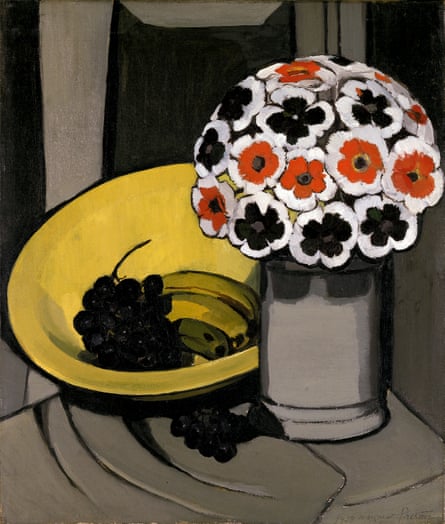
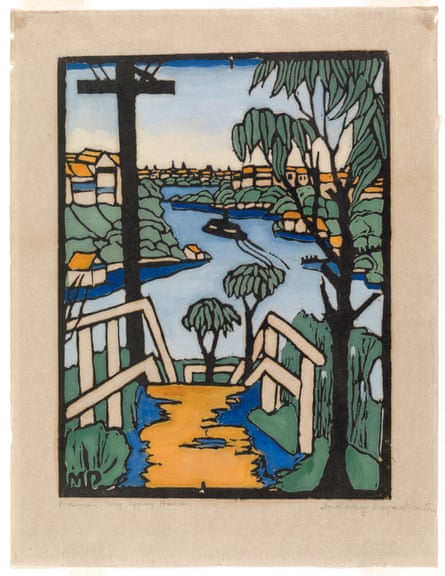
These discoveries transformed Preston’s art. Upon returning home, she began incorporating techniques she’d learnt overseas into her work, becoming a local authority on woodblock printmaking. At the same time, she started publishing essays that articulated her desire to create a unique Australian style. She shifted her focus to capturing local flora and, less famously, urban scenes, shown here in a selection of striking Sydney cityscapes.
As she strove to create a singular Australian aesthetic, Preston embarked on what is now her most contentious practice: her appropriation of Indigenous art. Her vocal admiration of Aboriginal and Torres Strait Islander art was unusual in a period when it was often dismissed as a curio for tourists, or exhibited in ethnographic museums rather than galleries. But “she specifically asked people not to consider the spiritual, cultural or ceremonial significance”, Gentle says. Having divorced Aboriginal art from its context, Preston inserted elements from it into her work, flattening and assimilating hundreds of Indigenous cultures into her nationalist project.
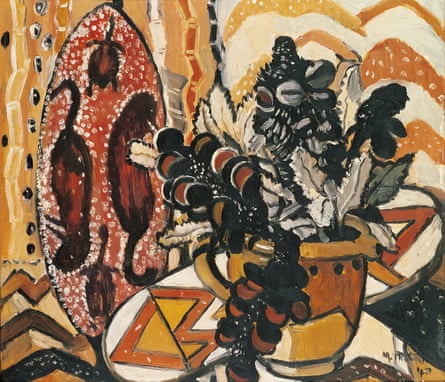
Here, the chronological journey is interrupted by the restaging of a display from the Documenta 13 exhibition in Germany in 2012, where the Birri Gubba and Darumbal artist Gordon Bennett showed paintings from his series Home Décor (After M Preston). These were dramatic enlargements of small gouaches by Preston that featured Indigenous designs she had taken from an Aboriginal shield with the intention of using them to decorate household items. Bennett’s reproductions tower over Preston’s paintings, exposing a chain of appropriation that runs through Australian art history to the present.
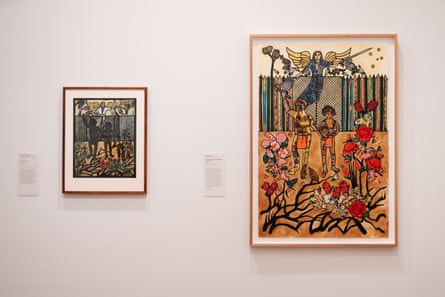
Conversations between Preston’s work and that of First Nations artists continue throughout the rest of the exhibition, which includes pieces by Trevor Nickolls, Deanne Gilson and Tony Albert, as well as new works commissioned from Marilyn Russell, Kaye Brown, Raelene Kerinauia Lampuwatu, Mary Elizabeth Moreen and Jimmy Frank. These artists rarely solely condemn or celebrate Preston but instead illuminate the complexity of her legacy as an advocate for Aboriginal art whose actions still have consequences today: Indigenous art continues to be used as visual shorthand to represent Australia across culture, entertainment and advertising.
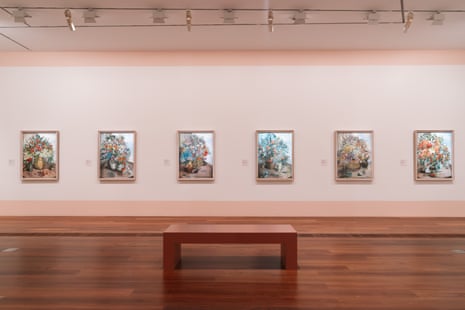
The exhibition embraces this multiplicity of viewpoints, rather than declaring a definitive conclusion about Preston and her art. One of the few certainties that emerges is that Preston was intensely driven, which is palpable from her early still lifes right through to her late landscapes, and in painting after painting after painting of lush Australian flora. “She believed in herself and her vision and her art,” Rozentals says. “There were a lot more male artists at the time getting their moment in the sun. She was successful in her lifetime.”
Preston’s works do not provide, however, the unified vision of Australia she hoped for. Ultimately, they tell a more interesting story: that Australian art and identity are rich and ever-changing tapestries of influences from across the country and around the world. That is even more true today than it was when Preston died in 1963, leaving behind a body of work that, more than 60 years later, prompts difficult questions but remains full of beauty.
-
Margaret Preston is at the Ian Potter Centre: NGV Australia until 31 January 2027