.png) 2 months ago
59
2 months ago
59
Earlier this year, 62-year-old Karla Wagner placed second in the 100-mile division of the Grandmaster Ultras, an Arizona trail-running event designed for 50-and-over runners in the age group known as “grandmaster”.
For most of her adult life, Wagner, who is from Lander, Wyoming, avoided running because it triggered her asthma. But when asthma meds improved, she added trail running to her fitness mix and became completely hooked in her early fifties.
The elation of running through natural beauty combined with the sport’s supportive community motivated her to build up to 100-mile ultramarathons in her fifties. When she turned 60, she finished the Moab 240-mile ultra, a race through the canyons and deserts of south-east Utah.
“It’s just amazing to me how far you can travel on foot,” says Wagner. “And it’s fun!”
I have been ultrarunning for two decades and professionally coached long-distance runners for eight of those years. Over that time, I witnessed trail running mushroom from a once extreme niche to a more mainstream branch of running.
Here’s what you need to know about the sport – and how to get started in midlife and beyond.
What is trail running, and what’s an ultra?
Trail running takes place on dirt trails as opposed to paved roads or measured flat tracks. Races longer than marathon distance (26.2 miles) are called ultramarathons, or “ultras” for short. While some ultras are held on tracks or paved surfaces, most follow trail routes. Hence, “ultrarunning” typically refers to extra-long-distance trail running.
Trail running, especially at ultra distances, differs significantly in practice and culture from traditional road-and-track running. Trail races tend to be smaller and more intimate than metropolitan road races.

Trails lead runners through less-developed environments, often up mountains or across deserts, where the terrain grows more rugged and hilly. Walking on difficult-to-run stretches of trail is an integral part of trail running, considered a lower gear that sustains longer outings.
According to consumer research from 2025, trail running is growing faster than road running. UltraRunning magazine shows the number of runners who finished an ultra in North America had nearly doubled since 2015, to 102,714 individuals last year.
The appeal of trail running in the second half of life
I increasingly meet other runners in the grandmaster division who, like Wagner, found trail running relatively late in life. They’re reaping the health benefits – including improved cardiovascular health, greater bone density and social connections – along with the enjoyment and variety of running in nature. The slow-and-steady pace makes them feel energetic, strong and accomplished.
Wagner, a retired OBGYN doctor, believes that running and strength workouts have prevented the weakness and arthritis that her mother suffered.
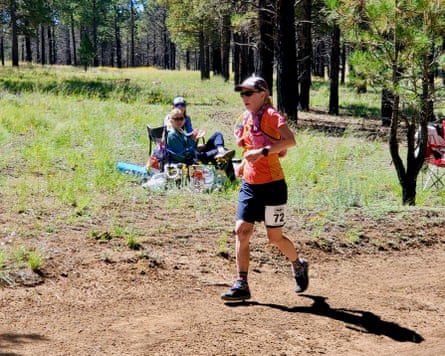
“I’m kind of a poster child for osteoporosis, because I’m small, have a family history and haven’t done hormone replacement, so it’s important to me to get weight-bearing exercise,” she says.
“Trail running in midlife is wonderful,” agrees Dr Howard Luks, a New York-based orthopedic surgeon and trail runner who writes a newsletter about exercise physiology and the science of ageing well, “and the balance and coordination demands [of running trails] are exactly what our ageing neuromuscular systems need”.
At races, grandmasters may be significantly slower than younger frontrunners, but it’s a robust category. In 2025, runners aged 50 to 70+ comprised 22% of the North American ultra finishes, according to UltraRunning.
Trail running – especially on outings that go a half day or longer – rewards character traits developed through life experience, such as patience, adaptability and resiliency.
“You’re going to have to deal with things not going as planned,” says longtime ultrarunner Andy Jones-Wilkins, 58, of Corvallis, Oregon, who coaches several late-blooming midlife athletes. “I see a lot of younger runners who are fast but may not have the tools or experience to manage that kind of disappointment.”
How to safely start running trails
Begin with a base level of fitness: While anyone with full-range mobility can try trail running, it’s advisable to develop fitness at a lower-impact activity such as walking first. You should be able to hike briskly and break a sweat without significant discomfort before attempting to trail run.
Anyone with a history of medical issues, particularly cardiovascular or orthopedic, should check with their doctor first. A recent review of research concluded that extreme distance running can expose some individuals to cardiac risks.
Gradually add slow-pace running: Many would-be runners feel haunted by school coaches who put pressure on them to run a fast mile, or remember hyperventilating when they tried to run too fast, too soon. To avoid a repeat, start by hiking on a relatively flat and gentle route and run segments slowly, for only as long as it feels manageable.
“Try running in tiny little bites, like, ‘I’m going to run to that tree,’” says Jones-Wilkins. “You might go out for an hour and only cover four miles, and that’s fine!”
“Run slowly enough to hold a conversation,” advises Luks. This will keep your heart rate and respiration low enough to establish a sustainable pace. “For many starting in their fifties, that’s barely faster than a walk. Walk-run intervals are the smartest entry point, and trails help naturally because the terrain forces you to slow down.”
Dan Rague, a retired calculus teacher from Phoenix, Arizona, started running a decade ago in his fifties by going on hikes with his dog. “I wanted more of a workout,” he recalls, “so I’d say, ‘I’m going to run 100ft and then walk until I get my wind back.’”

Now 62, Rague runs trails three times a week, with training runs up to about 13 miles.
Start with shorter distances and get to know the community: Dedicated ultrarunner Andre Lee, 55, of Tempe, Arizona, encourages new runners to join a trail-running group, explore their local trails, and volunteer at a trail event.
The next step is to sign up for a shorter-distance trail race, such as a half marathon. “Most events have generous cutoff times, so newbies can enjoy the trails without worry,” he says.
Lee has finished over 200 ultras, some longer than 200 miles. “I’ve learned a lot about myself and gained confidence with each event,” he says.

But Luks cautions new trail runners to “pump the brakes on the ultra goal”, explaining that an extra-long distance goal may sabotage the process of developing consistency and adapting to the sport.
“The risk at any distance is the same: ramping up faster than tissues can adapt. The real danger is that injury or failure takes a runner out of exercising entirely. I’d rather see someone become a lifelong trail runner at comfortable distances than chase an ultra and end up on my surgical schedule or, worse, on the couch.”
Train your body and brain to prevent falls: Tripping and falling on natural hazards such as rocks and tree roots may be the greatest risk, especially for older people. “Falling is a legitimate fear, but you can do a lot about it,” says Jones-Wilkins. Practice carefully on the trail and supplement with exercises to improve balance and proprioception.
Gym workouts to improve agility, responsiveness and power will help your body react and recover quickly if you trip on the trail. These include one-legged poses and lateral hops that develop balance and ankle conditioning, plyometric moves that involve jumping, and lower-body exercises such as squats and lunges. Consult a qualified trainer for assistance with targeted routines.
Lightweight trekking poles can assist on steep technical terrain. While running downhill, you can plant them like ski poles to avoid a fall.
Invest in trail-running shoes and a hydration system: You don’t need trail-specific shoes when you start running, nor do you need pricey carbon-plated shoes (AKA “super shoes”) that marginally boost speed. However, trail-running shoes can provide greater traction and support if you run on a variety of terrain – through mud and scree, for example.
Older feet may feel better in more cushioned trail shoes that absorb impact. Avoid a too-snug fit because feet can swell on arduous outings, triggering blisters and bruised toenails.
Trail running usually takes longer than road running, and takes runners into remote areas, so it’s important to carry what you’ll need. For longer outings, you’ll benefit from a light runner-specific pack or belt that won’t bounce; stock it with hydration, snacks, sun protection, basic first aid, and extra clothing layers in case of inclement weather.
Hydration and fueling needs vary based on body size, sweat rate and climate. A general guideline is about 500ml of water per hour mixed with 500mg sodium (from an electrolyte mix), and about 60 grams of carbohydrate per hour after the first hour of running.
Be mindful and respectful on the trail: Being attuned to the landscape while unplugged from devices heightens the experience of trail running. Keep your ears and eyes open, and minimize amplified music or loud conversations in order to be respectful and hear other trail users approaching. Practice the Leave No Trace principles for trail stewardship.
“There’s something about running in nature that’s kind of primal,” says Rague. “I feel a part of it when I’m out there.”
-
Sarah Lavender Smith is a Colorado ultrarunner and author of The Trail Runner’s Companion: A Step-by-Step Guide to Trail Running and Racing, from 5Ks to Ultras. She writes Mountain Running & Living, a newsletter aimed at midlife athletes.