.png) 3 months ago
88
3 months ago
88
A pair of rare native New Zealand takahē birds who were believed infertile have stunned staff at the world’s largest urban eco-sanctuary, after hatching a “miracle” chick.
The roughly seven-week old chick was discovered inside Zealandia, a fully fenced eco-sanctuary 10 minutes from Wellington’s city centre, in November, but its arrival has been a closely guarded secret to ensure its safety.
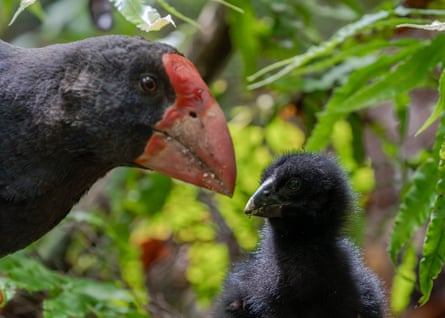
The Guardian has been given first access to the photographs and footage of the chick, which sports a shock of fuzzy black down, comically large white legs and claws, and a black beak with a tiny white tip.
Takahē are a unique and unusual bird. They are the world’s largest living rail – a family of small to medium sized ground-dwelling birds with short wings, large feet and long toes. They breed just once a year. While they resemble Australasian swamp hens, or pūkeko in New Zealand, they are in fact their chunkier, flightless, mountain-dwelling cousin.
The birds once roamed the South Island, but were thought extinct at the turn of the 20th century, until they were rediscovered in 1948. Since then they have been part of New Zealand’s longest running endangered species programme, which has slowly rebuilt their population to 500.
The chick’s father Bendigo and mother Waitaa arrived at the sanctuary two years ago as a non-breeding pair. After an unsuccessful nesting attempt in 2024, staff did not expect the couple to breed.
But in October, Waitaa disappeared – a clue she may be nesting. Some weeks later staff heard cheeping in a dense patch of bush and set up a trail camera. Its footage confirmed the chick’s existence.
“I was gobsmacked,” Jo Ledington, Zealandia’s conservation and restoration manager, told the Guardian. “It’s a miracle, we just weren’t expecting it at all.”
The parents were “textbook model parents”, and were doting on their new chick, whose sex is not yet known. Meanwhile, the chick had entered its “dinosaur phase”, Ledington said.
“Its legs are really quite long and chunky and its beak is getting that more adult shape, which on its small downy body looks a bit dinosaur-ish.”
At three months old the chick will start to look more like an adult takahē, which stand at roughly 50cm tall. The adults are rotund, with red legs and a large beak, and are covered in green and blue feathers. When viewed from the front, takahē look like a model of planet Earth on stilts.
The chick’s arrival is significant for the threatened takahē population. Like many New Zealand birds, takahē evolved without land mammals, and are vulnerable to attacks from introduced predators.
“Any chick that we can add to that population is just incredibly valuable,” Ledington said.
Native species thrive within Zealandia’s fences and the sanctuary is credited with creating a bird-life boom in Wellington. The sanctuary does not typically house breeding takahē pairs because it does not have grassland habitat the birds like to nest in.
Bendigo, Waitaa and their chick are Zealandia’s only takahē residents but they are not the only takahē to surprise staff with a chick. A former pair were thought to be past breeding age when staff discovered they too had hatched a surprise chick in 2018.
When asked if there was something in the sanctuary’s water, Ledington laughed.
“Zealandia is a pretty special place, so yes, maybe.”