.png) 2 hours ago
4
2 hours ago
4
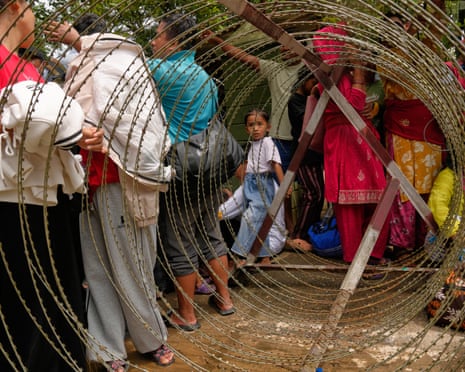
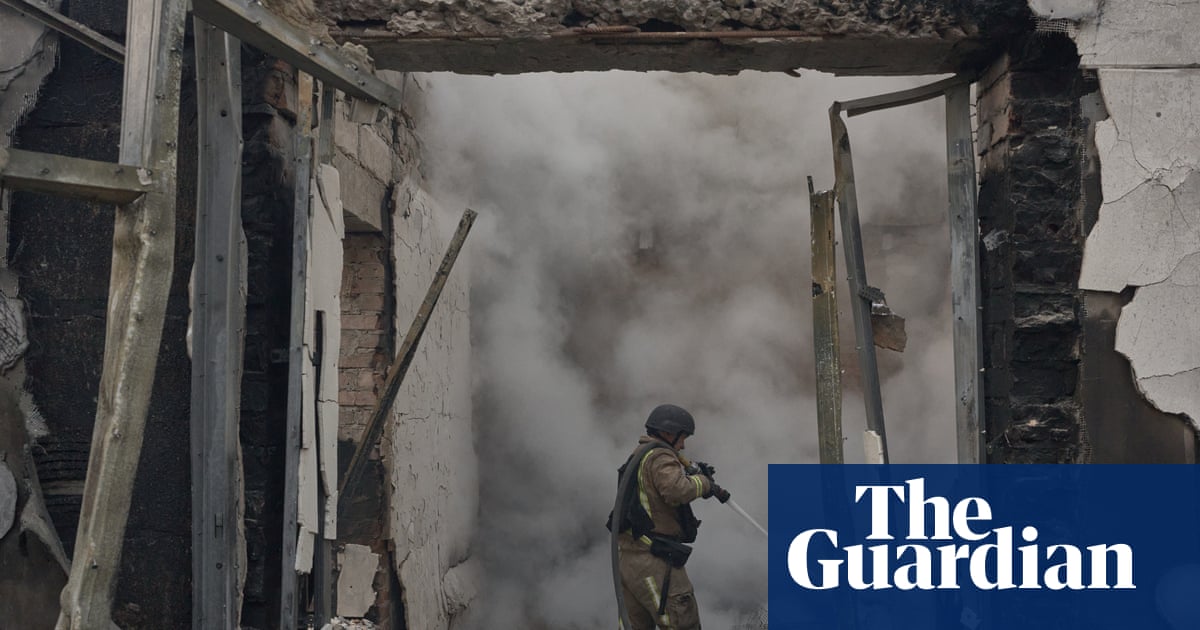
Rescued people wait at an army camp in Nepal's Nuwakot district. Photograph: Dar Yasin/AP
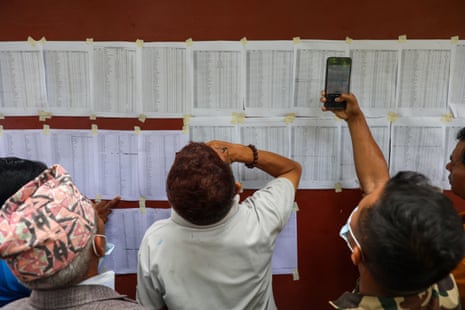
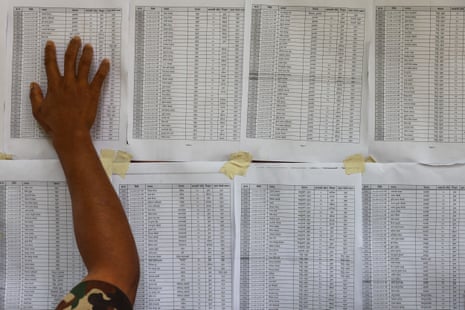
Outside the army camp in the Nuwakot district of Nepal, people run their fingers down the sheets of paper pinned to the wall, scanning the growing list of those reported missing for news of loved ones. Nepali authorities said nearly 3,000 people are missing, while China reported more than 550 people unaccounted for.
Key events
Death toll in Nepal rises to 669
The Nepali disaster agency has given an update on the number of those killed in Nepal, which has risen to 669, the Associated Press reports. With the seven people confirmed as having lost their lives in Tibet – where information is under the strict control of Chinese authorities – that brings the death toll for the disaster to 676. The number of people missing was revised up to nearly 3,000 on Saturday: 2,426 in Nepal and 554 in Tibet.
AP has reported some comments from Nepali army spokesperson Brig Gen Raja Ram Basnet about the rescue efforts at the Trishuli-1 hydropower tunnel in the Rasuwa district (see post at 9:27). Authorities believe more than 100 people are trapped in the tunnel filled with thick mud.
Basnet said rescuers had used baskets and ropes to reach some people, but the operation remained difficult because of about 1.2 to 1.5 metres (4-5ft) of mud and the limited number of places where helicopters could land.
He said rescue teams had also been forced to relocate temporarily when authorities issued warnings about possible further flooding.
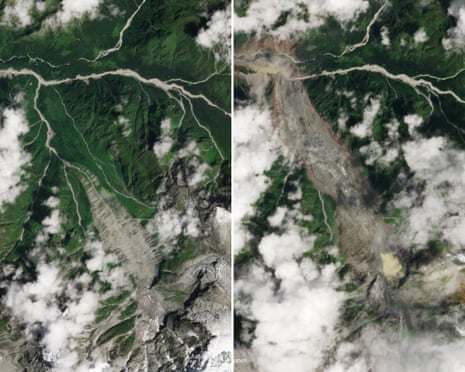
This extraordinary composite satellite image captured by Planet Labs shows the glacier on Mount Langtang Lirung in Nepal before and after its collapse on Wednesday, with the left image taken on Tuesday 25 August and the right on Friday 28 August:
The Britons believed to be among the thousands missing in Nepal
PA has put together a list of some of the Britons believed to be missing in Nepal, including a 13-year-old girl, NHS workers and a priest:
-
Hema Amin, from Croydon, south London, who started a pilgrimage to Gosainkunda lake on Monday that was supposed to last until 4 September. The 63-year-old’s husband, Sunil Amin, told Sky News: “I keep trying to call her. I’ve been trying, trying, trying.”
-
Hemangini Patel, 65, who had been with Amin on an Alpine Eco Trek tour when the flooding hit, her daughter told the BBC. She said her mother’s last known location is from a video from TikTok which was shared as she crossed into Tibet.
-
Bipin, 66, and Mala Patel, 60, from Coventry, went missing after travelling to Nepal and Tibet on a pilgrimage to the sacred Hindu site of Mount Kailash. Their son, Deepesh Patel, told PA the family last heard from the couple on Tuesday and their last known location was in the Gyirong area of the Nepal-Tibet border.

-
Spandan Sahu, 18, his father, Santosh Sahu, 46, his mother, Surabhi Manmath Padhy, 44, and sister Syna Kumari Sahu, 13, from the Surrey village of Cobham, are thought to be among the missing. A neighbour described them as a “lovely family”.
-
Nabhi Nandan Das, a Hindu priest from south London, was leading a group on a tour to Mount Kailash and Lake Mansarovar. The Telegraph reported that the 64-year-old priest, who lives in Streatham and works at the Sanatan Mandir and Community Centre in Coulsdon, Surrey, was leading 11 Britons, including the missing 13-year-old girl, on the tour.
-
Pavan and Kavita Haldia were sightseeing in Kathmandu before setting out on a pilgrimage with the Sanatan Mandir group, their 22-year-old son Prajval told BBC Radio 4’s Today programme. He said he last spoke to them on Tuesday on the phone and had a message from his parents on Wednesday morning, around an hour before the flood is believed to have hit.
-
Leena Bector, 53, a director of a care agency from Slough, west London, is among 27 travellers associated with the Fishtail Tours and Travels group currently unaccounted for. Her husband, Bhupesh Bector, told The Times: “I know that she’s in Nepal for sure … so even if they find her today or tomorrow, I need to be there.”
-
Sarada Simkhada, a senior nurse at Darent Valley hospital in Kent, was in Nepal making a pilgrimage to Mount Kailash. Her brother Shambhu wrote on social media: “My dear sister, wherever you are, please stay strong. We are praying for your safety every moment and waiting desperately for you to return home.”
-
Pravin Atmakur, a 54-year-old NHS psychiatry consultant, was leading a pilgrimage of 77 people to Mount Kailash when the flood hit, according to the Telegraph. His wife, Manjula, has travelled to Kathmandu from the UK to search for her husband, the newspaper said.
-
Sumitra Sapkota is believed to missing, her husband, Pramod Poudel, 24, said. He flew to Nepal on Thursday to search for her as well as his mother, uncle and brother. Poudel, who runs a Nepalese street food company in Sussex, told The Telegraph: “I haven’t heard from them because there’s no power or anything. I am very sad.”
-
Neetu Goyal Tiwari, 51, had been travelling with a group from the spiritual organisation Isha Foundation and was expected to travel to India on Thursday and meet her brother and parents. Her brother, Naresh Goyal, told the BBC his sister has not been seen since Wednesday and that completing the pilgrimage was “her dream”.
-
Geetha Reddy’s husband, Vikram Kolagatla, from London, told the BBC he has not heard from his wife since the flooding hit. She has two daughters aged 12 and 14. “The kids still don’t believe it,” Kolagatla said. “They think she’s stuck in the flood and that she’ll come back.”
Authorities in Nepal have said 33 UK citizens are among the thousands missing after Wednesday’s devastating flash flood.
A Chinese rescue team has reached the all-but-obliterated Gyirong border crossing complex for the first time and found “nothing but ruins” as Nepal and China continue their arduous rescue operations in the flood-hit Himalayas.
Surveillance camera footage from the worst-hit Gyirong border crossing complex showed huge torrents of water and debris on Wednesday engulfing buildings and people trying to flee. Only on Friday were rescuers able to reach the area.
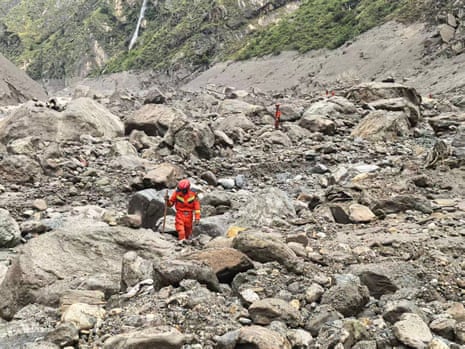
State media reported that the Chinese team of 21 rescuers and a search-and-rescue dog crossed mountains and valleys and used ropes to navigate forests and cliffs after roads to the complex, hemmed in by steep Himalayan slopes, were destroyed.
Zou Mingqi, a rescue worker, said: “There was no road … it was all virgin forest and sheer cliffs.” At the complex, “as far as the eye could see, there was nothing but ruins”.
Read more:
Outside the army camp in the Nuwakot district of Nepal, people run their fingers down the sheets of paper pinned to the wall, scanning the growing list of those reported missing for news of loved ones. Nepali authorities said nearly 3,000 people are missing, while China reported more than 550 people unaccounted for.
Nepal official says reconstruction efforts could total 'billions of dollars'
Nepal’s foreign minister, Shisir Khanal, has appealed for international support to help rebuild the country after the floods, saying reconstruction efforts could run into “billions of dollars” AFP reports.
We reported earlier that Nepal’s finance minister, Swarnim Wagle, said the country could need up to $5bn to rebuild, while stressing that the figure was “just an estimate” as “loss and damage is being assessed”.
Khanal told reporters in Kathmandu that reconstruction and rehabilitation “would entail perhaps billions of dollars”, adding: “We will do loss and damage research and then we plan, but I am reaching out to our international community for support.”
Authorities in Nepal’s Chitwan district are preparing to bury the bodies recovered from riverbanks after being swept downstream by devastating floods three days ago.
Officials said 229 unidentified bodies were “in a state of decomposition and no longer identifiable”, raising concerns about the health risks posed by the remains as they are prepared for burial.
“DNA samples will be collected, and the bodies will be buried in an open space,” the Chitwan district administration said in a notice, according to local media.
Nepal’s foreign minister, Shisir Khanal, said yesterday that more bodies are likely to be recovered from Chitwan and nearby Nawalparasi district, where hospitals “have been overwhelmed with dead bodies and lack refrigerators to store them”.
This is an interesting piece in the Conversation by Dibyesh Anand, professor of international relations and deputy vice-chancellor at the University of Westminster, about how China’s control over Tibet can make it harder for Nepal and other countries downstream to prepare for sudden Himalayan disasters, such as glacial lake outburst floods.
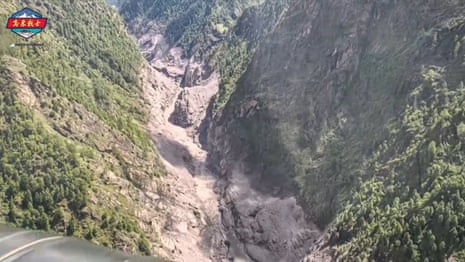
Tibet is governed by China, which took control of the previously self-governing region by force in the early 1950s. Nepal shares a long, mountainous border with Tibet, and the two regions are closely connected by their geography, rivers and trade, making events on the Tibetan plateau particularly significant for communities downstream in Nepal.
Anand writes:
Despite warm relations with Beijing, and the Nepalese government’s assurances that it follows the “One China” principle and permits no support for Tibetans, China’s tight control over Tibet creates complications.
The region is administered as a militarised frontier. Access runs on permits and clearances, the area is closely watched by armed police and the military and outsiders – foreign journalists, independent researchers, at times even diplomats – are routinely kept out. Tibet is an information black hole.
Beijing’s anxiety extends across the border as Nepal is home to more than 10,000 Tibetan refugees and has long been the main escape route out of Tibet. China pressurises Nepal to police Tibetan activism, seal crossings and fold border management into a security partnership meant to insulate the plateau from the outside world.
The glacial and hydrological data from the Tibetan plateau, the information often needed to anticipate flooding, is also treated as strategically sensitive by China and is closely held. Nepal has no mechanism to receive real-time glacial lake and river data from the Chinese side and its officials have sometimes gone further, accusing Beijing of withholding it.
When a disaster in the Nepal-Tibet border region demands that rescuers cross quickly or that a warning travel downstream from an upstream lake, it runs into a system built for control rather than speed.
The Guardian’s senior China correspondent Amy Hawkins also writes about how China’s tight control over information and restrictions on journalists in Tibet have made it difficult to independently assess the full extent of the flooding and damage on the Chinese side of the border. You can read her report here:
Search and rescue efforts intensify to locate people trapped inside mud-filled tunnel
The Nepalese government said the army is digging through the thick mud that has filled a hydropower tunnel where people are believed to be trapped inside.
“The work to open the tunnel’s entrance has been intensified since early on Saturday morning,” the Nepalese prime minister’s office said in a post on Facebook.
A team of 82 personnel from the Nepalese army and police “has been continuously working since last night to excavate the tunnel entrance and accelerate the search operation”, it added.
“The rescue efforts, however, have been made extremely challenging by the persistently adverse weather in the area.”
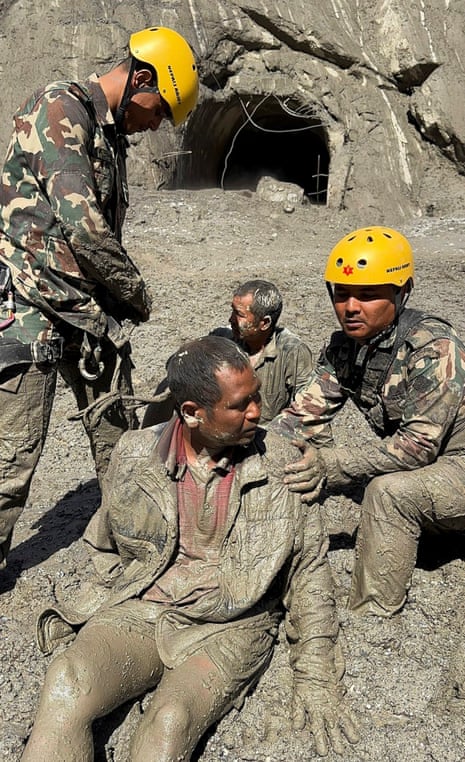
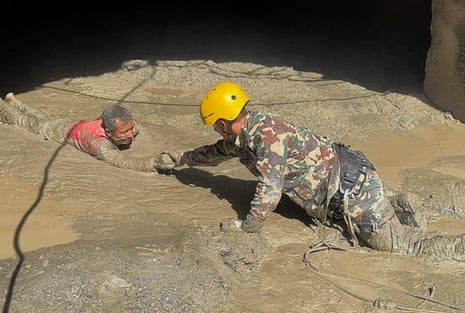
It was not immediately clear how many people remain trapped inside the tunnel. The Nepalese government said two people were pulled from the mud yesterday, with footage of the dramatic rescue operation shared on social media. You can watch that here:
India said it is increasing surveillance of glaciers and glacial lakes in its Himalayan regions bordering Nepal and China.
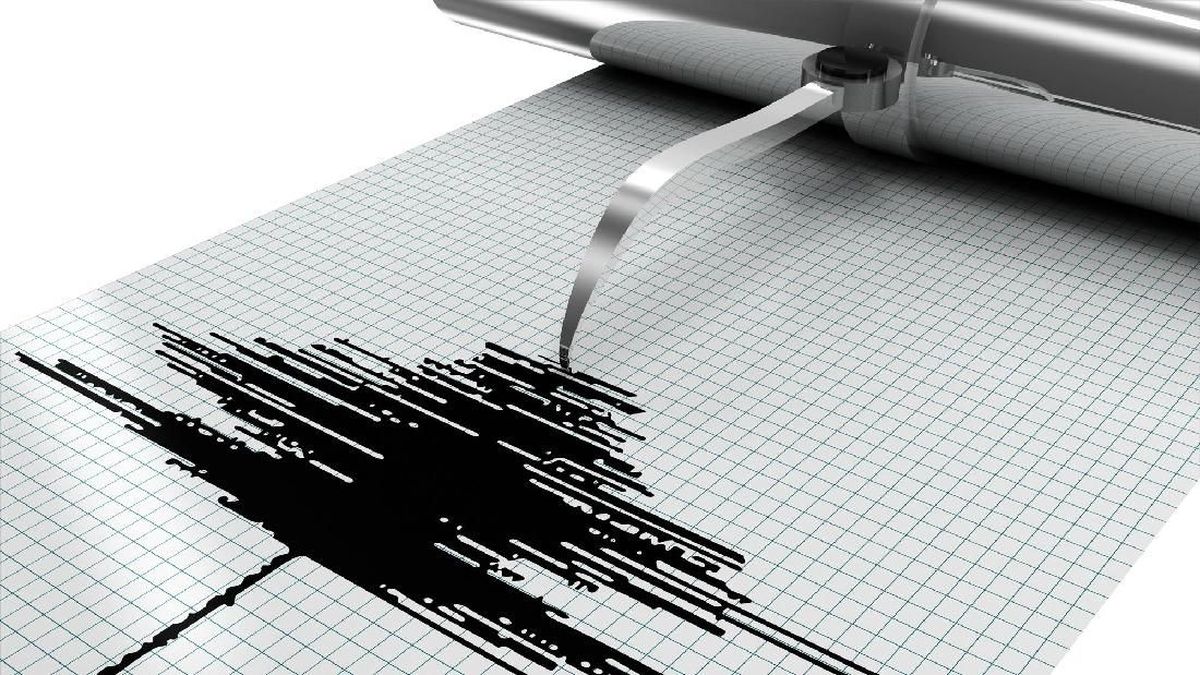
The deadly floods on the Nepal-Tibet border were believed to have been triggered by a glacial collapse that was detected as a magnitude 5.2 seismic event by geologists. You can read this explainer to find out more about how a collapsing glacier can generate a powerful flood, and whether the climate crisis is contributing to the risk.
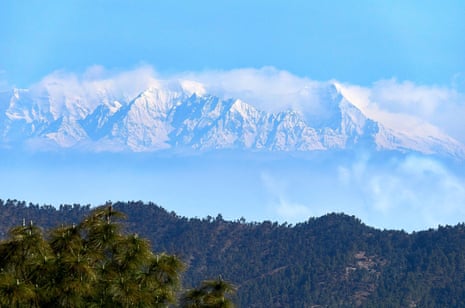
Madan Kaushik, state disaster management minister in India’s Himalayan state of Uttarakhand, said: “Since we share a border with Nepal, as a neighbour, and also have a similar geographic situation … we have asked our department to monitor all the glaciers and known glacial lakes in the region.”
Uttarakhand is one of the most ecologically sensitive regions of India, with 1,266 glacial lakes. As glaciers melt, water can accumulate in lakes held back by natural barriers. If those barriers fail, vast volumes of water can be released suddenly, triggering devastating floods.
“We have asked our teams to be vigilant and monitor if a similar situation is emerging anywhere in the state,” Kaushik told AFP.
‘The flood took everything I have’: survivors grieve for relatives and homes swept away in Nepal
The Guardian’s south Asia correspondent Hannah Ellis-Petersen and journalist Gaurav Pokharel report from the Nepalese town of Bidur, where rescue efforts are being coordinated. They spoke to survivors mourning loved ones and confronting the loss of their homes and livelihoods after devastating floods swept through their communities.
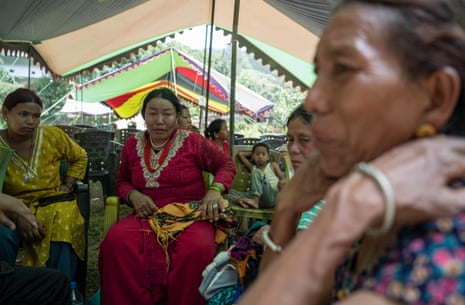
Among those caught in the floods was Sangke Dolma Tamang, who described the moment she watched her husband being swept away and returned to find her home and village destroyed:
Sangke Dolma Tamang, 61, had been cheerily cooking snacks in her village of Mailung in the Rasuwa district when the floods came without warning. The whole family ran uphill for safety, but as she grabbed for her husband, he slipped from her grip and was washed into the dark, fast-moving waters.
“Others tried to pull him to safety, but the flood swept him away,” she said, tears rolling down her weathered cheeks. There was, she said, nothing left of her village now. She had spent a night sheltering on higher ground, until an army helicopter arrived and brought to her safety at the barracks. Her son too was missing since the disaster, and she waited anxiously for any news.
“Now I have nothing left to live for,” said Tamang. “The whole house is gone. We couldn’t salvage anything.”
Read more:
Nepal’s government has appealed for financial help as it faces the daunting task of recovering from the devastating flash floods and braces for the possibility of more flooding.
Entire communities have been swept away, leaving families homeless or sheltering in temporary facilities.
“Multiple bridges have been washed away and major roads disrupted, leaving some of the worst-affected communities extremely difficult to reach,” the Red Cross says.
At least 18 schools have been destroyed and another 20 damaged, leaving about 10,000 school-age children affected, according to the UN Children’s Fund.
The disaster comes just ahead of the anniversary of last year’s 8-9 September mass anti-corruption protests that toppled the government.
Nepal is now led by prime minister Balendra Shah, a 36-year-old rapper turned politician widely known as “Balen”. The former Kathmandu mayor swept March elections on a wave of euphoria calling for political change.
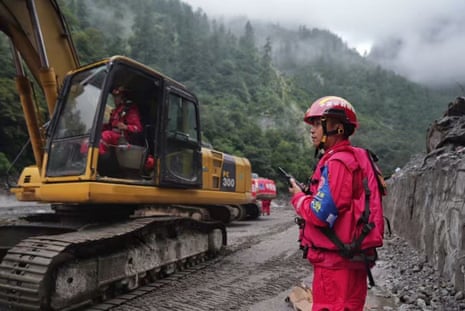
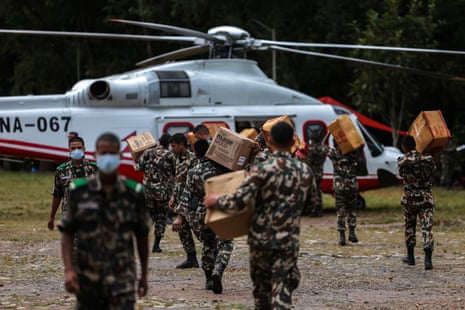
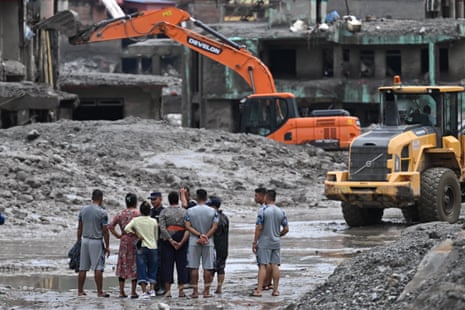
The risk of a lake formed after the glacier collapse bursting near the China-Nepal border where the devastating flood occurred earlier this week has decreased, Chinese authorities said today, as its size appears to have shrunk.
Satellite images from Thursday this morning suggest water in the lake – straddling the China-Nepal border at the confluence of two rivers – has been slowly flowing through, decreasing the reservoir gradually, state broadcaster CCTV reported, citing the water resources ministry.
The ministry said satellite imagery of the surface area of the lake at Purepu Tsangpo river showed it was 99,000 sq metres in size this morning – around the size of 14 football fields combined – having shrunk by 21,000 sq metres compared with images from Thursday.
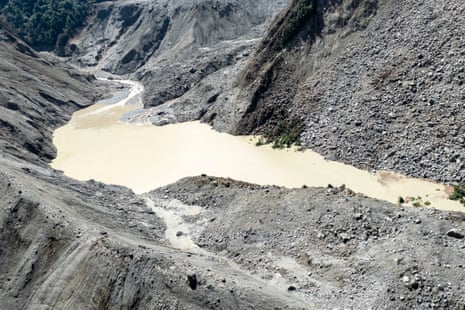
Experts and authorities have warned of the extremely high risk of secondary disasters in the valley, especially from the lake that was formed by glacier debris, potentially endangering rescue operations downstream.
State-owned engineering and rescue enterprise China Anneng, which has been monitoring the lake since Thursday, dispatched a 15-member team on Friday with reconnaissance drones, portable satellite stations and mobile surveillance cameras to gather more data about the lake.
An overflow from the lake on Friday temporarily halted rescue work before further assessment deemed the risks manageable.
Opening summary
Thank you for joining us for our continuing coverage of the aftermath of Wednesday’s catastrophic flash floods in the Himalayan mountains near the Nepal-Tibet border.
Poor weather has hampered aerial rescue operations in Nepal as the search for thousands of people missing enters its fourth day.
Nepal’s finance minister says his country will need up to $5bn to rebuild after the floods, believed to have been caused by a melting glacier high up in the mountains that set off a deadly cascade of water into the valleys below.
Finance minister Swarnim Wagle told Reuters today those figures are “just an estimate” and that “loss and damage is being assessed”.
Here’s a summary of what we know so far:
-
Nearly 3,000 people are missing. Nepal’s disaster agency on Saturday said 2,426 people were missing on its side of the border, while China’s Xinhua news agency reports the total number of missing in Tibet is now 554.
-
The death toll in Nepal has now risen to 626, while China’s Xinhua news agency earlier today reported seven people confirmed dead in Tibet.
-
More than 3,700 people have been rescued in Nepal so far but at least 93,000 people are estimated to have been affected by the disaster, according to the Red Cross.
-
At least 777 foreigners are missing, with Nepal’s disaster agency on Friday reporting 517 foreigners unaccounted for – which could include tourists and foreign workers – and Chinese officials putting the number of foreigners missing at 260.
Explore more on these topics