.png) 3 months ago
90
3 months ago
90
The world’s biggest multiclub network shrank from 13 to 12 in the last week of 2025 but few blame the City Football Group for walking away from Mumbai City and India after six years. The reason for divesting their shares which gave them 65% ownership was addressed, not that anyone needed enlightening in a statement. “CFG has made this decision after a comprehensive commercial review and in light of the ongoing uncertainty surrounding the future of the Indian Super League (ISL).”
Uncertainty is an underestimation. The 2025-26 ISL season was supposed to kick off in September. However, with a 15-year Masters Right Agreement between the All India Football Federation (AIFF) and its commercial partner ending in December and no new agreement or partner in place, it never started. Most assumed that it would be a short-lived delay but here we are, in 2026, and there is still no football. A meeting took place in Delhi on Tuesday and produced a start date of 14 February, just six weeks short of a year since Mumbai’s last ISL game. How it works, if it works, remains to be seen.
Regardless, much damage has been done. Referees had written to the AIFF warning they needed to start earning, imports headed home and then in the new year players publicly begged for a resolution. “Shame on us … this is what we have come to,” the Bollywood actor and Northeast United owner, John Abraham, said as he shared a video with his 3.2 million followers in which the players’ desperation was clear as was their call for Fifa to act.
Ravi Puskur is the owner of the ISL club FC Goa and he, too, is despairing to the extent that the club suspended first-team operations on Monday. “The exit of City Football Group from Indian football is a serious indictment of the failures of the current administration overseeing the game,” Puskur told the Guardian, adding that the dominance of cricket makes it difficult to attract credible, long-term investment even when all is going well.
“To lose an organisation of CFG’s expertise, institutional knowledge and global best practice is not just unfortunate,” Puskur said. “It is a damning reflection of systemic shortcomings. This is a blot on the copybook of Indian football governance and one that should prompt deep introspection rather than quiet acceptance.”
With no games, Mumbai fans cannot even vent their frustrations at stadiums. “There are bigger problems as everyone knows but it is disappointing,” said Suresh Khatri, a Mumbai supporter. “Nobody blames them though, what is the point of investing in a team and league with no games?”
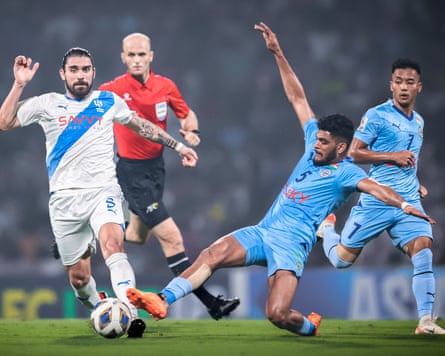
The journey was quite a ride that included two ISL shields (handed out to the table-toppers) and two ISL Cups (lifted by those who won the ensuing playoff series). But there was more. “There are players and coaches we would never have seen I think had there not been the connection with Manchester City,” said Khatri. “I am sure that there were a lot of other aspects of this behind the scenes too.”
The current Mumbai coach, Petr Kratky, came in from stablemate Melbourne City, following the same path as Des Buckingham in 2021. He replaced Sergio Lobera, who left Mumbai for CFG’s Chinese member, Sichuan Jiuniu.
Those connections – in Asia there is also Yokohama F Marinos of Japan – have now gone. “Mumbai may find new owners but brand wise they lose a lot,” said Shaji Prabhakaran, the former general secretary of the AIFF. “You are losing global capacity, not just the money, that is not a big loss, but it is a brand loss, it is part of a network. Getting coaches, support staff and foreign players through CFG is much better. There was a connection with Man City and that has gone.”
There was also the dream – shared by all sides – that an Indian player could move to one of the clubs in the group. “Nobody was expecting any player to go and play for Man City,” Khatri said. “But Japan or Australia would have been a huge thing for all fans in India, not just Mumbai.”
CFG did not want to comment on the split when contacted by the Guardian but is now without representation in the world’s most populous country and one, even with the current chaos, that has huge potential. “Mumbai City Football Club is a good name to have for any brand,” Prabhakaran said. “It is a huge city and the financial and commercial capital of the country. They also did well on the pitch and were building a community. It is a setback for Indian football. It’s a global embarrassment as well, it gets highlighted beyond the borders because of this.”
It is not just international investors that may now think twice. If there is no solution found soon then the danger is that other owners who have, until now, kept their clubs going, may start to think that there is little point throwing good money after bad.
“Their withdrawing sends a message to others who are thinking about investing in Indian football and sends a notice that this is not the time. If CFG could not continue, this means there is something seriously wrong in Indian football,” Prabhakara said. “Something was working, going fine and everything stalled. I don’t know what to say, I just feel really sad.”