.png) 8 hours ago
8
8 hours ago
8
After the comedian Jimmy Cricket chose the catchphrase, “And there’s more!” he may have reflected that the words would one day have a poignant irony. As has now happened after his death, aged 80.
The stage name was adopted by James Joseph Mulgrew, from Cookstown in Northern Ireland, when he worked as an entertainer at the Butlin’s and Pontins holiday camps from the 1960s at a time when these summer resort venues were an academy for UK entertainers.
Both Jimmy and Jiminy Cricket were rooted in polite euphemisms for the expletive “Jesus Christ!”, but Mulgrew, a committed churchgoer and carefully clean comic, is unlikely to have been motivated by the oath. Whether deliberately or by luck, his chosen pseudonym was likely to pique the interest of fans of Disney’s Pinocchio (in which Jiminy Cricket is a key character), those interested in orthopteran insects in general and lovers of the greatest summer game. The Irish climate and distraction of more historically Irish sports might have restricted the resonance of that reference back home but it proved useful to schedulers in Britain. Jimmy’s Cricket Team was the title of his successful BBC Radio 2 series from 1990, making the return to wireless writing of Morecambe & Wise’s greatest writer, Eddie Braben.
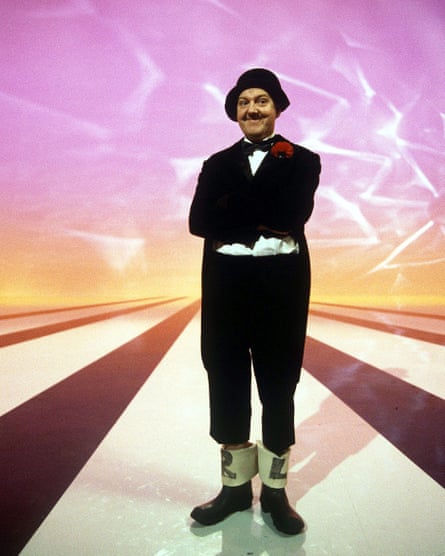
At that time, BBC Radio was tapping into the peak of Mulgrew’s public popularity, encouraged by his biggest television visibility, from 1985-88, on an ITV show titled after his catchphrase, And There’s More. The words perfectly suited a show featuring short sketches, songs and standup. Fronted by Mulgrew as Cricket, the 24 episodes included regular appearances by comedy actors Nicholas Smith (Are You Being Served?) and Joan Sims (Carry On) and guest slots for Hazel O’Connor, singing, and Rory Bremner, impersonating.
As Cricket, he wore a stage costume of too-short formal trousers (possibly a homage to the similarly attired Max Wall), funny hats and Wellingtons on the wrong foot. That – alongside the somewhat silly professional moniker – led some wrongly to assume that he was a children’s entertainer.
It was not, though, entirely misleading. He aimed at adults the sort of material that classified him as what used to be called a “family entertainer” – no smut, no swearing and little songs in which his retained native accent allowed him to rhyme “faffing” with “laughing”.
The purity and implied puritanism of his comedy was perhaps rooted in a Roman Catholic upbringing in Northern Ireland in the 1950s, a creed and era noted for their censoriousness. The lasting impact of his upbringing was also evident in many references in his routines to letters from his “Mammy”. Though uncontroversial at the time, one aspect of the act – many gags relating to “Irish logic” – might now be regarded as offensive, although, in common with Jewish comedians, Mulgrew would have claimed a birthright to explore stereotypes within his own tribe.
Though the hold of the faith diminished for many of his Ulster generation, Mulgrew remained practising, receiving in 2015 a papal knighthood, Catholicism’s highest honour, from Pope Francis. The citation mentioned the recipient’s charitable work; although the Argentinian pontiff was something of a joker himself, the honour is unlikely to have been for comedy. (Mulvey’s Northern Irish peer, Frank Carson, though rather less scrupulously clean mouthed, had received the same honour from Pope John Paul II, creating an intriguing trend among Northern Irish jokers of that generation.)
The highest profile period of Mulgrew/Cricket’s career overlapped with the so-called Troubles in Northern Ireland, its associated atrocities often featuring in the headlines of news bulletins abutting his TV and radio appearances. The performer, though, was wary of sectarianism – holiday camp performers largely targeted those unlikely to be paying customers – and, in turn, didn’t suffer much bigotry, although, as with Carson, few impressionists could resist a go at the Ulster brogue.
“Always let your conscience be your guide,” sings Jiminy Cricket in Pinocchio and that was the credo of his near namesake during a career in which he aimed to provide unthreatening fun – and succeeded.