.png) 1 hour ago
6
1 hour ago
6
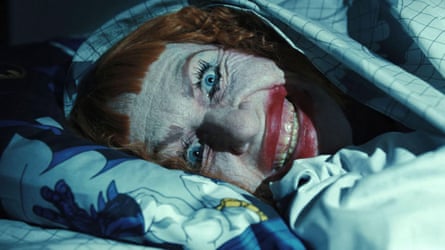
When Barbarian, Zach Cregger’s debut film as a solo writer-director, came out in 2022, it was a big success, creating a buzz among horror connoisseurs, garnering good reviews, and grossing $46m. Then his second film, Weapons, came out in 2025 and did even better. Mounting industry buzz around the project crystallised into a fierce bidding war; Jordan Peele was reportedly desperate to produce and, incensed by his failure to secure the rights, allegedly fired his managers. The rumours went viral, resulting in a wave of incredible PR that saw the film wildly outperform box office expectations and win an Academy Award (for Amy Madigan’s blunt-fringed, bonsai-pruning best supporting actress turn as instantly classic villain Aunt Gladys).
Even if Cregger had not had a box-office smash that crossed over into awards contention, there would still be an atmosphere of hushed expectation around his next move. Both Barbarian and Weapons addressed hot-button issues – sexual assault and school shootings, respectively – while resisting easy interpretation. Both, too, started out seemingly heading in one narrative direction, before thrillingly careening off elsewhere. Thus, with just two features, Cregger had established a reputation for totally terrifying, utterly unpredictable and – most importantly – genuinely original movies.
Yet the real shocker from this nascent horror auteur is still to come. For his third film, Cregger has taken inspiration from existing intellectual property – or IP, those two little letters bound to strike fear into the heart of even the most stoic cineaste. Zach Cregger has made a Resident Evil movie.
“Look, I could make a different movie now if I wanted to,” he says, when I put to him the obvious question: why? He is talking to me via video call, from a warmly furnished but ominously low-lit room, wearing a crumpled navy T-shirt, and sounding much less defensive than his words might suggest. “I understand how people could be like: ‘Why IP?’ But to me, that’s just such a secondary concern because the IP is not the point. The point is the story. The point is, it’s an original movie, even though it is Resident Evil.” He sighs. “And now I can’t wait for everyone on the internet to be like, ‘He admitted it!’”
Cregger is referring to the stick he’s been getting online from more obsessive gamers ever since the first teaser trailer launched in April. “I feel like there’s been so many people taking what I say about this exact thing out of context and saying: ‘He just wanted to make the movie that he wanted to make, and then slap Resident Evil on it, so he could get a bigger budget.’ Which is not the case. It was conceived to be a Resident Evil story. And when you watch the movie, you’ll know that’s the case, because it’s undeniable.”
But what is “a Resident Evil story”? For those who are unfamiliar, the franchise began as a Japanese survival horror game released for PlayStation in 1996. It was then adapted into a live-action film series – Cregger’s film will be the eighth instalment – beginning in 2002, with the Paul WS Anderson-directed Resident Evil, starring model turned actor Milla Jovovich as a woman battling a zombie contagion let loose on Raccoon City by the shadowy Umbrella Corporation. The film series, like the game, has been hugely profitable – that’s why they keep making ’em – and could at one point boast (at nearly $1.2bn and counting) of being the all-time highest-grossing horror film series, until being overtaken by the Conjuring Universe and the Alien series.
Yet from the perspective of those aforementioned cineastes – and also more casual movie lovers – Resident Evil’s reputation is distinctly mid. On reviews aggregate site Rotten Tomatoes, the highest-rated film from the franchise is 2016’s Resident Evil: The Final Chapter, which scores an ignominious 39% “splat”. So while Cregger was – and is – a big fan of the games, the films? Not so much. When I ask what the relationship is of his film to the rest of the series – a sequel? Prequel? Universe-expanding retro-reboot? – he shrugs and says, somewhat proudly: “I couldn’t really say. I’ve never seen one.”
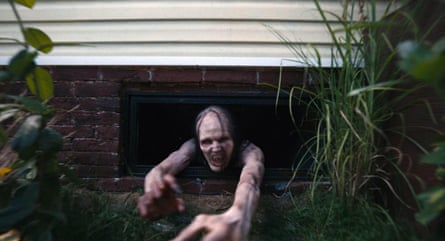
Still, as Cregger appreciates, video game adaptations are tricky for a reason: they are expected to serve the play-experienced aficionados and the clueless noobs. Cregger’s big idea for bridging this gap is to create a moviegoing experience that feels like a 90-minute session on the PlayStation, even for those audience members who may never have previously heard of Resident Evil. Narratively, this means following a single character, medical courier Bryan (Austin Abrams), as he attempts to deliver a cooler containing a transplant organ from hospital A in the flatlands to hospital B in the remote mountains near Raccoon City, Colorado, where – unbeknown to Bryan – a zombie outbreak is now under way. As in the game, Bryan regularly switches environment, progressing from snowy road to deserted farmhouse to sewage tunnel. In each new place, he must find the resources to survive. Shooting the film in a rural part of Czechia was, therefore, an appropriately gruelling experience for Cregger. “It was dark. It was cold. It was unrelenting,” he says. “I had pneumonia for the first half of the movie, and a horrible bacterial infection for the back half … It sucked.”
It may have sucked, but it worked. Judging by the 30-minute preview made available to press, Cregger’s film is exhilarating and immersive. He utilised the over-the-shoulder camera angles now synonymous with third-person shooters to mimic gameplay, and Bryan’s dialogue is mostly a soliloquy of disjointed profanities. “That’s how I talk to myself when I’m sitting on the couch playing Resident Evil,” says Cregger. “I mean, I basically only say ‘fuck’ and run away from things.”
Is Bryan based on Cregger himself, then? “One hundred per cent,” he says. “Everything about him is me, my anxieties and my personality.” This helps explain why Bryan has a verisimilitude that isn’t always present among the plot-serving panickers and simplistic scream queens of horror. “It’s fun to have a character who is a real character and convincing in the scenario, but also behaving the way that I think most people who play Resident Evil would behave,” says Cregger. “He’s more suited to be on the couch playing Resident Evil than surviving Resident Evil, and that’s why he’s the perfect person to put into this scenario.”
Cregger grew up, as video game-playing everymen tend to do, in “a typical, middle-class, suburban neighbourhood”. He was one of four boys raised by a stay-at-home mother, and a father who worked “in mortgages and foreclosures” – a job description that instantly conjures the boarded-up houses of Barbarian’s Brightmoor, Detroit setting. Cregger’s mother was always “very, very involved in the church”, and when his parents divorced, she got a job there too, meaning the brothers attended services four or five times a week. The young Cregger still found time to ride around on his bike, watch movies and play video games, of course. It was “kind of like that classic 80s American upbringing”. Which is to say, for the most part Spielbergian, but with the potential for abject Lynchian horror.
As a teenager, Cregger began playing in punk bands, which gave him his first experience of “catching the big fish”, a transcendental meditation technique pioneered by David Lynch, which has become foundational to his creative process. “I remember I would write these songs and I’d be like: ‘There’s no way this is mine. This just feels like this is from somewhere else, and I’ve just been lucky enough to hook it.’”
after newsletter promotion

Then, in college, Cregger formed his comedy troupe, The Whitest Kids U’Know (“I’ve always hated the name,” he says), which achieved success on the cable TV channels Fuse and IFC, before essentially disbanding in 2022 after the accidental death of founder member, and Cregger’s close friend, Trevor Moore. (Their final project, the film Mars, was eventually released in 2024.) It was in the midst of this bereavement that Cregger wrote the screenplays for Weapons, Resident Evil and his planned next project, a sci-fi film called The Flood, in quick succession. Of The Flood, he says: “It may be the script I’m the most proud of, because it has its own strange anatomy that just fits. I’m very excited to start.”
A background in comedy – Cregger also starred in the TV shows Guys With Kids and Wrecked – is common to many of horror cinema’s most exciting new talents. To Cregger, the connection is clear: “That muscle group that you work out in comedy, where your brain is constantly trying to think, ‘What’s the surprise? How can I inject an interruption into what we’re expecting?’ That’s the same muscle group you need for a scare. So all of my time spent in comedy was going to the gym for horror as well.”
And just as every good standup learns to distinguish different shades of audience laughter, so a horror film-maker hopes to elicit a whole spectrum of scares, from slight startles to full-on existential dread. “My favourite kind is anything that gets me with stillness or a bizarre image,” Cregger says, citing as an example a scene from Curry Barker’s Obsession. “Her, running around, holding the flowers in front of her face? I was like, this is fucked!” And, to clarify: “That’s a good feeling!”
Cregger is often grouped with online-adjacent horror auteurs such as Barker, Kane Parsons (the maker of Backrooms) and Jane Schoenbrun (the writer and director of Teenage Sex and Death at Camp Miasma). But at 45, his inspirations bypass online “creepypasta” in favour of more enigmatic, classically rooted and traditionally cinematic influences. Barbarian, for one, was directly inspired by a self-help book, Gavin de Becker’s The Gift of Fear, published in 1997.
“I have a lot of hippy ideas about creativity,” he says. “I just love the idea of being a conduit for the art, and that these objects of art exist with or without you [as an individual artist]. I understand how somebody could be like: ‘Dude, what are you talking about?’ Fine. I don’t care. I like choosing to exist in that reality where I have the ability to go into my subconscious, cast a wide net and see what I can snag. And if the universe or whatever is smiling on me, I’ll get something that will really make me happy, and that I’ll get to spend a year and a half of my life bringing it to the surface.”
Back here on dry land, however, Hollywood’s current horror boom is mostly attributed to some more straightforward, bang-for-buck economics. The genre can reliably serve up sensation for a sensation-seeking generation, without relying on big budgets, big-name talent or even – sometimes – pre-existing IP. But what horror films do rely on – franchise fare or otherwise – is a film-maker skilled at accessing the audience’s most primal, subconscious terrors. Yes, Cregger has made a Resident Evil movie, and, more’s the surprise, it might actually be really good.
Resident Evil is in cinemas now.