.png) 3 months ago
37
3 months ago
37
Not many people saw the exact moment Ronald Araújo lifted the Super Cup to the sky and a weight from his mind but the men that matter most did: they were right there, standing by him. They had welcomed him back, 47 days later and in a final, lifted him up towards the light, and handed him the captain’s armband. Now, after they had beaten Real Madrid 3-2 together, they handed him the captain’s responsibility and a captain’s honour, inviting him to raise the trophy for all of them. Which was when someone walked in front of the camera, went whoops and walked back again.
By the time the shadow left the screen, Araújo was holding with the cup over his head, teammates roaring around him, and the Real Madrid players who stayed to watch had turned down the tunnel. They had been close to trading places. In a final of sudden storms – three clear chances and a goal in 2min 54sec after half an hour, three goals in 3min 33sec of first half added time, three golden opportunities saved in 10 second-half minutes – theirs had been the last. Some 134 seconds passed between Marcus Rashford smashing wide and two glimpses of salvation appearing before Madrid but they couldn’t grasp either, on 95.04 and 96.42. So Barcelona had first trophy of the season.
The first and, Xabi Alonso noted, the least important. Madrid’s manager wasn’t wrong, only against them nothing is ever small. A final still less so, and for the man wearing the Uruguay flag round his waist and the Catalan flag round his arm especially. “More than champions,” Sport said, which was as true as it was unimaginative; for Araújo, this wasn’t just the title. He was only on the pitch for four minutes and 24 seconds but that was a win already and beyond the football, the play, was something else, always there if not always seen: a person. Now he cradled the cup: no simple solution, no cure, not everything, yet something. A show of strength, support perhaps. “A sign of our love,” Raphinha called it.
“In this situation, to be on the pitch and win this title meant a lot to him,” Hansi Flick said. “I am happy that he is back and it seems he is OK. We will support him, always. It’s important: he’s a fantastic guy, a good player and our captain. I’m really happy for him.”
Araújo had not played since Stamford Bridge at the end of November, when he had been sent off before half-time, leaving his team exposed and defeated and himself even more so. It had happened before, PSG particularly on people’s minds, and that night he was repeatedly told, like he didn’t already know, didn’t already feel, that his mistakes had cost Barcelona defeat. He shouldn’t be there and couldn’t be trusted, all his fault. It had been building for a while and no one is entirely impermeable to the pressure.
There had long been a sense of Araújo being the least Barça of their defenders, an easy scapegoat sometimes. That night against PSG, Luis Enrique had identified him as the one they could let have the ball, while Flick’s defensive line demanded precision over pace, the pressure high. There had been injuries and, just as importantly, interest: he was one of the club’s few sellable assets and nothing feels like rejection as much as being up for sale, left wondering if departure is for the best. Even when he renewed his contract, it came with a buyout clause that was less a deterrent, more an invitation. Plenty would have welcomed it, he knew, left with an inevitable a sense of something lost. At Stamford Bridge, it came to a head.
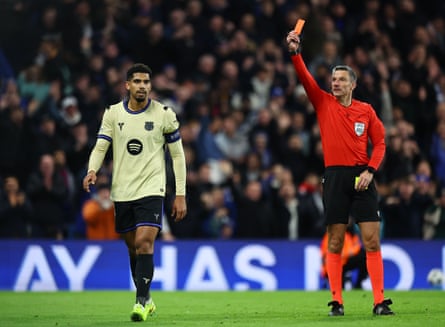
“I want to defend and encourage Araújo,” said the Barcelona president Joan Laporta. “He has been criticised a lot and I don’t think it’s fair. He gives everything on the pitch, he’s our captain and he has to overcome this moment. He’s had a bad time of it and I want to tell him that we’re with him, that we win together and lose together. There isn’t one, single person responsible for victory or defeat. He’s a very emotional person and he has feelings.”
A few days later, Flick admitted that the Uruguayan wasn’t ready to play. “It’s a private situation and I won’t say more: I ask you to respect his privacy,” the coach said. Barcelona revealed he had requested time to “recover emotionally”. Araújo was absent, a few days becoming a few weeks. The player would decide, Flick insisted; his mental health was the priority. He went to Jerusalem and didn’t return to training for over a month, finally coming back after Christmas. On Sunday night, for the first time in six weeks, he was included in the squad. Before the game, officially the club’s second captain after Marc-André ter Stegen, he gave the final talk before they went out – “his speech reached us,” Pedri said later – but he didn’t start and few expected to see him.
But then, with the clock showing 92.35, Araújo stood on the touchline, where he prayed, covered his face with his hands and ran on in place of Lamine Yamal. The significance of his reintroduction was shown by a video that soon circulated on social media, Raphinha’s family back in Brazil cheering and applauding, as he went on. This was about the man before the player, but he did have to play, and not everyone’s reaction was as nice. The board had shown 5, less than three minutes left, but this wasn’t some reward, part of the rehabilitation process, a few throwaway minutes at the end of a final to feel like a footballer again; this was real, this was responsibility. So much the better, so much more meaningful, if it went well, but … if it didn’t?
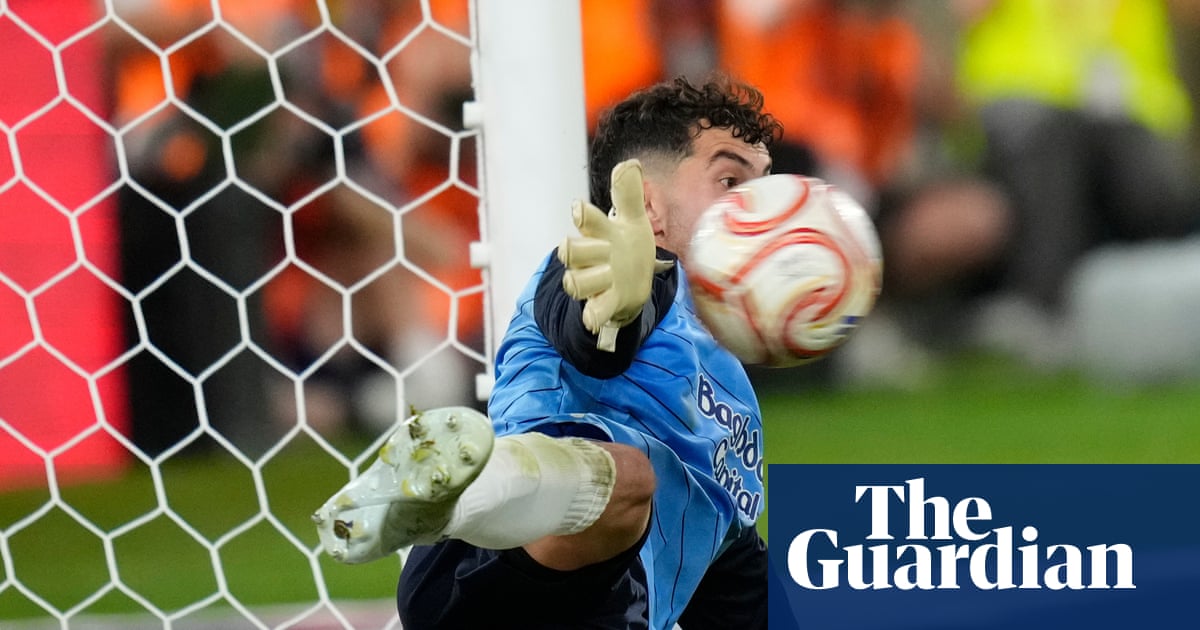
Frenkie de Jong had been sent off, Barcelona were down to 10 and led by a single goal. The extra-defender-and-hold-on routine has a chequered record, sometimes an invitation to suffering. If anyone can come back, it’s Madrid. And, some couldn’t help fearing, if anyone could allow them to it was Araújo. If only because football, fate, can be cruel. And if he came back for a few minutes six weeks on, recovery incomplete, and that happened, then what? There was time for a terrible twist, for sure, and so it was: having done nothing since Rodrygo was denied by Joan García on 62 minutes, Madrid had two clear chances to take it to penalties where the plot could become even more twisted. Álvaro Carreras and Raúl Asencio, though, went straight at García.
Barcelona had got through the storm and so had Araújo, another one. “Ronald’s situation is complicated,” Laporta said afterwards. “He felt emotional. Hansi and his staff putting him on was extraordinary, a gesture that Ronald appreciated a lot. It was some moment to come on, one where they have just sent off Frenkie and you wonder if it can go wrong, and he felt useful. I liked this final’s script.”
La Liga results
Show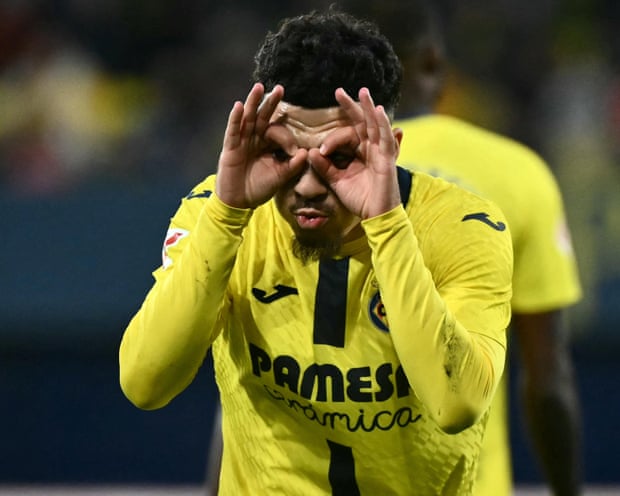
Levante 1-1 Espanyol, Rayo Vallecano 2-1 Mallorca, Valencia 1-1 Elche, Girona 1-0 Osasuna, Villarreal 3-1 Alavés, Real Oviedo 1-1 Real Betis, Getafe 1-2 Real Sociedad.
Photograph: José Jordan/AFP
The whistle went and Arda Guler tried to boot away a water bottle but instead slipped on his backside. Not far from there, Raphinha fell to his knees while other Barcelona subs streamed on to the pitch. They went for Araújo, hugging him. All together, they lifted him up to give him the bumps, throwing him into the sky. You get the trophy, they told him; this for you. While they waited, Vinícius Júnior came to embrace him. Dani Carvajal came too, asking how he was; as they talked, Araujo put a hand on his heart. Barcelona gave Madrid a guard of honour to get their medals, which wasn’t given back, and then it was their turn, Araujo’s turn. Kylian Mbappé called for his teammates to get out of there, not willing to hang about but most stood and watched as a man walked across the camera in the exact moment, his moment, that the Uruguayan lifted the cup. As he departed the stadium smiling, he was still carrying it.
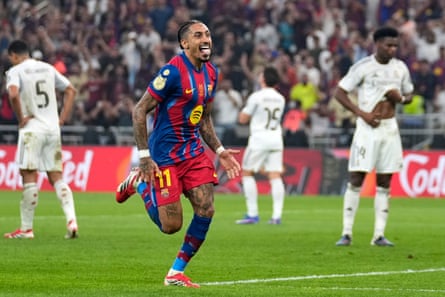
“He’s had a bad time personally and that’s normal because of the demands we have, the shirt we wear, who we are,” Raphinha insisted, wearing in the lucky sunglasses that superstition said he had to pack for Saudi Arabia. “It could happen to others too: I myself have had bad times in the first few seasons. For him to lift this cup was a demonstration of our love for him, that we’re counting on him for everything. It was a way of showing how we feel about him, our affection. He’s been through a bad time but if he’s OK, so are we.”
-
In the UK, the charity Mind is available on 0300 123 3393 and Childline on 0800 1111. In the US, call or text Mental Health America at 988 or chat 988lifeline.org. In Australia, support is available at Beyond Blue on 1300 22 4636, Lifeline on 13 11 14, and at MensLine on 1300 789 978