.png) 2 months ago
63
2 months ago
63
Proposals to deploy reflective mirrors and up to 1m more satellites in low Earth orbit could have far-reaching consequences for human health and ecosystems, leading sleep and circadian rhythm researchers have said.
Presidents of four international scientific societies representing about 2,500 researchers from more than 30 countries are among those who have raised concerns in letters to the US Federal Communications Commission (FCC).
The regulator is considering plans by the start-up Reflect Orbital to illuminate parts of the Earth at night using reflective satellites, as well as applications from SpaceX that could dramatically expand satellite numbers in low Earth orbit.
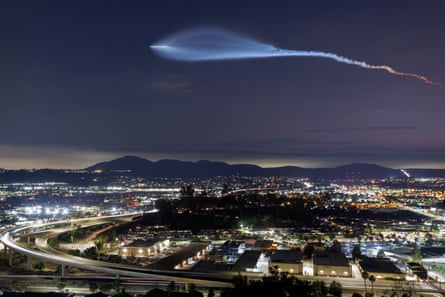
“The proposed scale of orbital deployment would represent a significant alteration of the natural night-time light environment at a planetary scale,” said the presidents of the European Biological Rhythms Society (EBRS), the Society for Research on Biological Rhythms, the Japanese Society for Chronobiology and the Canadian Society for Chronobiology.
They said altering the light-dark cycle could disrupt biological clocks that regulate sleep and hormone secretion in humans and animals, migration in nocturnal species, seasonal cycles in plants and the rhythms of marine phytoplankton that underpin ocean food webs.
They urged regulators to conduct a full environmental review and set limits on satellite reflectivity and cumulative night sky brightness. Prof Charalambos Kyriacou, a geneticist at the University of Leicester and president of the EBRS, said: “We’re saying, please think before you go through with this, because this could have global implications for things like food security. Plants need the night. You can’t just get rid of it.”
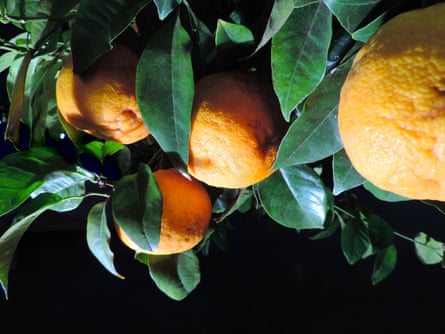
Reflect Orbital hopes to use satellites equipped with large reflective mirrors to redirect sunlight on to areas roughly 5km to 6km wide “on demand”, with brightness adjustable “from full moon to full noon”. The company says the system could extend solar energy production into the evening and provide lighting for construction projects, disaster response and agriculture, with illumination delivered only to locations approved by local authorities.
Meanwhile, SpaceX has proposed launching up to 1m satellites to create a giant solar-powered computing network in orbit designed to run artificial-intelligence workloads. The company says the system could reduce the energy and cooling demands of terrestrial datacentres.
Ruskin Hartley, the chief executive and executive director of DarkSky International, a non-profit focused on protecting natural night skies, which has also written to the FCC, said: “While ideas like mirrors on satellites beaming ‘sunlight on demand’ to Earth or mega-constellations of up to 1m satellites for AI datacentres may sound like science fiction, these proposals are very real.”
He added: “Scientific studies have already shown that the existing number of satellites in orbit has increased diffuse night sky brightness, or sky glow, by roughly 10%.”
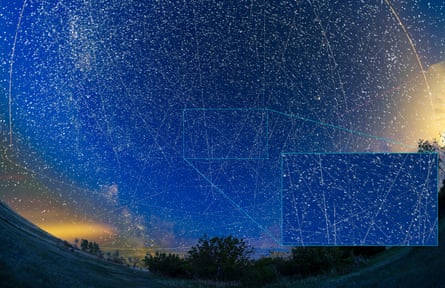
Satellites affected the night sky in two main ways, Dr Miroslav Kocifaj, of the Slovak Academy of Sciences, in Bratislava, said. Individual satellites could leave streaks in telescope images, while sunlight reflected by satellites and debris brightened the sky.
His modelling suggests these objects already add between 3 and 8 microcandela per square metre to night sky brightness. By 2035, he predicts this could rise to between 5 and 19 microcandela, approaching the threshold astronomers have set for preserving naturally dark skies.
While this additional brightness remains far below that of moonlight, “what I can say with confidence is that the phenomenon is real, that it is global and cannot be escaped by moving to a more remote location, and that it will increase substantially over the coming decade if current trends in satellite launches and debris generation continue”, Kocifaj said.
Prof Tami Martino, of the University of Guelph, who is president of the Canadian Society of Chronobiology, said when it came to impacts on life on Earth, “the real question is not brightness compared to moonlight, but whether biological systems can detect the change”.
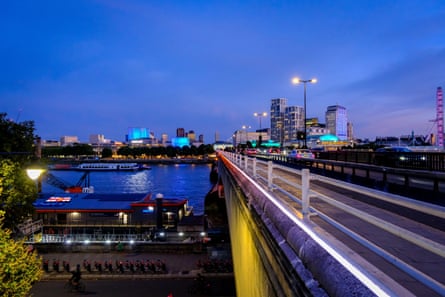
“Circadian systems are sensitive to light levels far below what humans typically perceive as bright,” Martino said. “If the night sky becomes permanently brighter, the consequences could ripple through ecosystems in ways we do not yet fully understand.”
A separate letter from the presidents of the World Sleep Society, European Sleep Research Society, Sleep Health Foundation, Australian Sleep Association and Australasian Chronobiology Society said “circadian disruption is not mere inconvenience; it is a physiological mechanism driving major adverse health consequences”.
“We do not argue against space innovation,” the letter added, saying that altering the night sky should be treated with the same seriousness as other planetary-scale environmental changes, such as climate change and ocean acidification. “The alternation of light and dark is not a trivial background condition. It is one of the oldest organising principles of life on Earth.”
Hartley said that as satellite numbers grew, fast-moving artificial objects could become a dominant feature of the night sky. “There could be times and places where satellites outnumber the visible stars,” he said. Many birds and some insects navigated using the stars, and the human experience of the night sky could also be profoundly altered.
Reflect Orbital’s plans would also introduce a new form of light pollution with largely unstudied consequences, including potential public-safety risks, Hartley said. “As these beams move across the landscape, there is the possibility of intense glare or blinding flashes, particularly if systems malfunction or drift off target. These are exactly the kinds of risks that need to be carefully studied, which is why DarkSky is calling for a full environmental review before proposals like this move forward.”
Reflect Orbital declined to comment, while SpaceX did not respond to a request for comment.