.png) 2 months ago
57
2 months ago
57
Exhibition of the week
To Improvise a Mountain
Painter Lynette Yiadom-Boakye portrays fictional people in made-up settings. Where does she get her haunting ideas? Here she reveals her inspirations from Walter Sickert to Bas Jan Ader.
MK Gallery, Milton Keynes, until 25 January
Also showing
The Sleepers
Helen Cammock, Tracey Emin and others explore what it is to sleep, and not to be able to sleep.
Murray Edwards College, Cambridge, until 22 February
Harold Gosney
A close look at how this Yorkshire sculptor works with bronze and other materials to evoke nature.
York Art Gallery until 28 June
Irma Hünerfauth
This 20th-century German artist created sci-fi sculptures that oppose militarism and the cold war.
Arcadia Missa, London, until 16 December
Ahmet Doğu İpek
Ancient standing stones and Cornish landscapes as seen by this Istanbul artist on a residency in St Ives.
Tate St Ives until 8 March
Image of the week
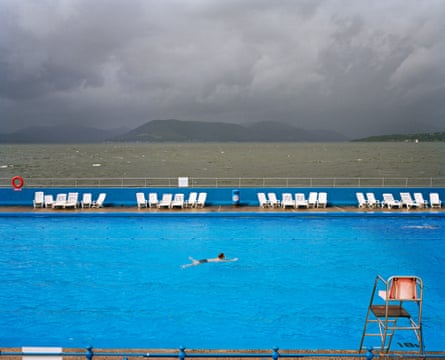
“I make serious photographs disguised as entertainment,” said Martin Parr, the photographer acclaimed for his observations of British life, who died last week aged 73. In August, Parr looked back at his life through his photographs – from the super-saturated snapshots of church fetes and Conservative clubs, to his wry portraits of British leisure – and talked us through them.
What we learned
Japanese artisans using ancient techniques create a dazzling array of exquisite everyday artefacts
Polish artist Zofia Kulik manipulates images of male nudes to comment on masculine power-plays
The London underground is home to an overlooked collection of distinctive designs on its seats
Nnena Kalu became the first artist with a learning disability to win the Turner prize
Frank Gehry, who died last week, changed architecture for ever
Former puppet maker Ron Mueck’s new sculptures are wowing Sydney gallery goers
The Ghanaian capital Accra is showing off its spectacular art scene
Masterpiece of the week
An Astrologer by Cornelis Bega, 1663

Science takes a cool view of magic in this icily observed 17th-century painting. Cornelis Bega’s almost clinical style could easily be mistaken for a much later artist’s photorealist work. In fact, it reflects the optical discoveries – telescopes, microscopes, experiments with projection and the camera obscura – that were at the heart of the scientific revolution then taking hold in Europe. Galileo had led the way and the likes of Boyle, Hooke and Newton were transforming knowledge. Where did this leave occult practices such as astrology that had for so long delivered illusory knowledge? This astrologer looks lost, sitting melancholically among his nonsensical books. He fears the coming of the age of reason.
National Gallery, London
Sign up to the Art Weekly newsletter
If you don’t already receive our regular roundup of art and design news via email, please sign up here.
Get in touch
If you have any questions or comments about any of our newsletters please email [email protected]