.png) 6 hours ago
5
6 hours ago
5
Solar energy supplied more power to Great Britain’s grid in July than in any previous month as households turned to rooftop panels to cut their energy bills.
Solar farms and rooftop panels provided 14.4% of the country’s electricity after some parts of the UK recorded almost twice the average sunshine hours for the time of year.
The long spells of cloudless weather helped solar to smash the previous monthly record of 12.4%, set in May. The July reading is 50% higher than a year ago, when only 9.6% of generation was from solar, according to data from the National Energy System Operator (Neso).
The surge comes after official figures for Great Britain recorded more new solar power installations in the first half of this year than in any six-month period since 2011. The data, which includes large, ground-mounted solar farms and rooftop panels, tracked 142,536 solar installations, putting 2026 on track to top last year’s record solar additions.
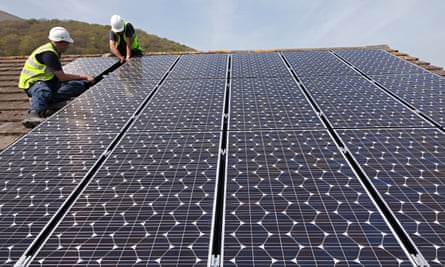
However, the lion’s share of the new solar installations recorded are on household rooftops, with these smaller solar systems making up slightly less than a third of the country’s total solar power capacity.
More households have fitted solar panels to their rooftops in recent years, hoping to cut their energy bills by generating their own low-cost electricity as fossil fuels have caused bills to rocket, according to energy companies.
Chris Hewett, the chief executive of Solar Energy UK – a trade association – said: “Fifteen years ago, solar energy was a footnote in the electricity mix. Now it is a major player, delivering homegrown, cheap, clean and reliable energy.”
The extra solar power helped to meet higher-than-usual demand for electricity to run air-conditioning units and fans, providing a rare positive effect of the heatwaves that have led to drought, wildfires and record heat-related deaths across Europe.
A typical UK home with rooftop solar powered the equivalent of over five hours of air-conditioning each day during the June heatwave, when record temperatures reached a peak for the summer so far, according to Ember, a clean power thinktank.
“The UK is firmly in its second solar boom, joining the trend we’re seeing worldwide, as households and governments look to it as a low-cost and local alternative to oil and gas,” said Frankie Mayo, a senior analyst at Ember.
Great Britain’s new solar additions include the largest operating project in the UK at Cleve Hill in Kent last summer.
The 373 megawatt (MW) Cleve Hill project dwarfs the UK’s first solar farm, the 1.4MW Wheal Jane solar farm in Cornwall, but will soon be overtaken by the largest planned solar farm in development: the 800MW Springwell solar farm in Lincolnshire, which is expected to begin generating in 2029.
Michael Shanks, the energy minister, said: “The lesson is clear: the more power we generate here in Britain, the less exposed families and businesses are to global energy price shocks. That’s how we deliver energy security, get bills down for good and deliver skilled jobs in every part of the country.
“Alongside expanding clean, homegrown power, we’re cutting VAT on energy bills, giving families more breathing space this winter.”