.png) 2 months ago
59
2 months ago
59
Every woman loves a bad boy, or so the cliche goes. Here it is tested when Christy Mahon walks into a pub to confess he has killed his father with a farming tool. It’s not quite the truth but he is, to his own surprise, turned into a local celebrity. Women flock to see him and men hail him a hero.
John Millington Synge’s unromanticised comic portrayal of a farming community in the west of Ireland caused moral outrage at its 1907 premiere at Dublin’s Abbey theatre. This revival by the Abbey’s current artistic director, Caitríona McLaughlin, makes clear that it is something of a woman’s play, ahead of its time, with two female leads abjuring conservative Catholic morality to hope for something bigger than a small, scratching country existence.
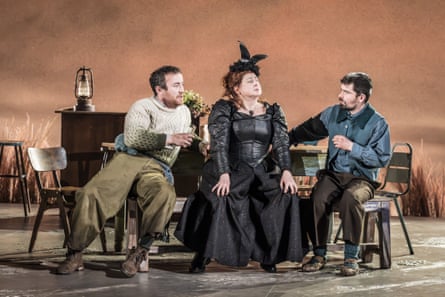
Nicola Coughlan plays spirited barmaid Pegeen, who is dazzled enough by Christy to abandon her suitor, Shawn (Marty Rea). Siobhán McSweeney, as Widow Quin, is more strategic and openly lascivious. Both tread a fine line between comic desire and serious inner yearnings. “It’s true all girls are fond of courage,” says Widow Quin, and Éanna Hardwicke, as Christy, manages the transformation from geek to hero to geek again in a way that shows how little he changes, but how much those around him are willing to believe.
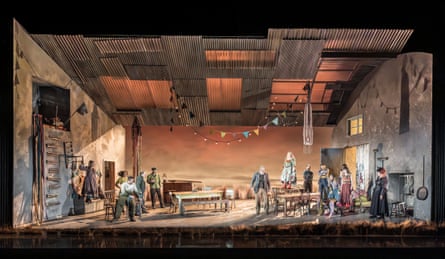
The tragedy of the two central women lies just beneath the surface, sometimes rearing up, from the widow’s anguish that she is not Christy’s chosen woman, to Pegeen’s final howling words of regret after Christy has been exposed and ejected from the pub. Masked musicians in straw headdresses and skirts march ritualistically across the back of a drinking tavern open to the skies and with an inebriated tilt, designed by Katie Davenport.
But there are bumpy transitions between the drama of the first half, with a subtly twisting tension and notes of anxiety, to the physical comedy and outright farce of the second. The stately pace speeds to a gallop as the plot rises into melodrama. Staged in its original, melodic Hiberno-English dialect, it is authentic but hard to follow at times, at least for this critic. Some may not catch the nuance of the dialogue although the beauty of the language is abundant enough to enjoy. A character’s “whole skin needs washing like a Wicklow sheep”, another hears the cows “breathing and sighing in the dark” before coming into the light of the pub.
The play’s influence is evident: Christy might be a blueprint for Jez Butterworth’s silver-tongued self-mythologising Rooster in Jerusalem. The tall tales told in the pub of Conor McPherson’s The Weir may contain the imprint of Michael James Flaherty’s public house here, in which the action takes place over two days. Synge could even have been the Tarantino of his time, glamorising Christy’s violence. But it seems old-fashioned in this faithfully period production.
The central critique – of the hollow elevation of a pretender by a (desperate?) community in dire need of a hero – still holds, but it might have had greater resonance in our populist times.
-
At the Lyttelton theatre, National Theatre, London, until 28 February