.png) 1 month ago
47
1 month ago
47
Matt Shea’s documentary is bookended by two stark facts. One is that the wealth of the world’s 12 richest people is equal to that of the poorest 50% of humanity (you can argue about whether 12 is exactly right, but it’s certainly a horrifyingly small number). The other is that in recent US election cycles, the fossil fuel industry has been replaced as the biggest political donor by a new force: cryptocurrency.
In an hour that manages to be more entertaining than terrifying despite sailing into very murky waters, Shea explores how a fresh breed of tech billionaires are looking to make a bold new move. He shows that in a traditional western democracy, the principle that citizens all have an equal vote and are all equally beholden to the law is heavily compromised by a tiny minority of rich citizens. These people influence what the electorate votes for, by bankrolling politicians and owning media companies, as well as using their wealth to ensure rules do not properly apply to them. But plutocrats still find this system frustrating, thanks to those pesky elections and that annoying rule of law. What’s next?
Shea meets people who have made silly amounts of wonga from cryptocurrency – a sector that claims to be dedicated to freedom and transparency, but is notoriously resistant to proper accountability. First, he observes as Justin Sun, a Chinese tech entrepreneur with personal wealth of around $8.5bn, gets his crypto trading network Tron listed on Nasdaq without going through the standard process of listing the company, via a “reverse merger” with a failing company. That is to say, he buys the business – which is already listed – and changes its name to Tron Inc.
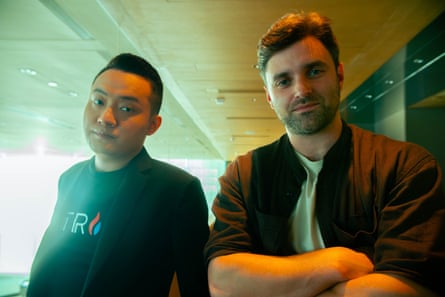
That’s all perfectly legal and not too remarkable, but soon we’re off to a muddy peninsula in the Danube between Croatia and Serbia. This has been claimed by crypto bros as Liberland, a “micronation” that will supposedly become a hi-tech utopia where no tax is paid and regulatory red tape is eliminated. At the moment, though, it’s a few tents that are regularly raided by Croatian police, who disagree about the land having no pre-existing owner.
Shea meets the president, a man named Vit Jedlicka who tries and fails to control what his acolytes talk to the film-maker about. One of them escapes for a one-on-one with Shea, where he stumbles as he attempts to counter the argument that Liberland’s electoral system, under which the purchase of more crypto “merits” gives you more voting power, means its version of liberty is available to relatively few people. The elected prime minister of Liberland? Justin Sun.
At this point Shea is jousting for fun with weirdos, as he is when he talks to the writer Curtis Yarvin, who believes democratic governments are inferior to rule via corporate boards headed up by CEO “monarchs”. The programme gets wackier still when Shea arrives in Singapore for Token 2049, a conference for people who believe crypto is the future and governments can’t be trusted. A man with bitcoin logos all over his suit babbles something about a “new world order” imminently implementing a satanic global dominion.
There’s more fun and games as Shea tours the crypto-themed stands, but one of the main sponsors of the event is Tron, and the keynote speaker is Donald Trump Jr. He’s there on behalf of World Liberty Financial, the crypto company co-founded by the Trump family, who are estimated to have made more than $2bn from their various cryptocurrency ventures. Several investors in World Liberty – among them Justin Sun, before he spectacularly fell out with the Trumps – have subsequently benefited from favourable legal or regulatory decisions by the US government. Trump has denied any link between investments in his family companies and government decisions affecting the investors. His representative calls it: “the same, tired narrative that Democrats have pushed … for a decade. … There are no conflicts of interest.” When Shea raises the issue with Sun, a PR adviser heckles from behind the camera and shuts the question down.
Here is where Shea’s thesis falters slightly. Replacing governments with digital hegemonies might make sense to crypto billionaires, who don’t have to worry about things a functional society offers such as reliable physical infrastructure or a healthy workforce, because they just want machines to turn their money into more money. But taking over countries, or setting up new ones, is unnecessary for now thanks to the Trump regime. There’s no need to form your own government if the current US administration already offers frictionless routes to even greater wealth.
Either way, though, none of this is good and all of it is to be monitored, albeit probably from a position of helpless impotence. The rich keep getting richer and the powerful keep finding ways to help them do it.
-
Tech Billionaire Takeover aired on BBC Two and is on iPlayer