.png) 3 hours ago
3
3 hours ago
3
Linda Noskova has spent almost her entire life working towards mastering her sport. She began travelling around Czechia, Europe and then the world for tournaments before she was a teenager. Her life decisions have revolved around tennis for as long as she can remember.
Those early years prepared Noskova for the challenge of winning her first grand slam title, but the biggest lesson from her triumph at Wimbledon last month has been her lack of preparedness for everything that followed. The world did not come to a halt upon the completion of her ultimate goal. Life continues at the same pace, and now she must find her place in the sport once more.
“Once you feel like you have kind of achieved the dream that you have always been thinking about and dreaming about, it’s very tough to switch and to act like it never happened basically and go for the same thing all over again,” she says.
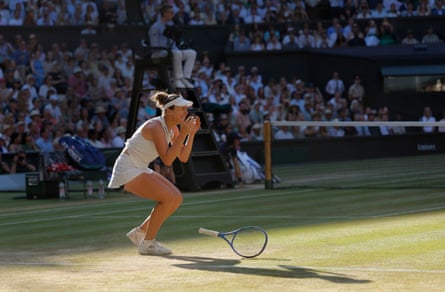
It has now been six weeks since Noskova won Wimbledon at 21 years old under remarkable circumstances against her elder compatriot Karolina Muchova. She had appeared to be blazing through to an easy victory in the final before she squandered five match points and found herself fighting for her life in a third set.
Noskova’s recovery to win the title was one of the most impressive mental performances in years. After her initial celebrations and the champions’ dinner, she returned to Czechia for her homecoming. “You never know what really is waiting for you once you win a grand slam [title], your first one, so everything was new to me,” she says. “I was not prepared for any of those things. So whatever came, that was a big surprise.”
Noskova says the week at home was “crazy and chaos”. Having spent her early years flying under the radar of fans and the media, her return generated intense attention as she tried to capitalise on her success. “It was a lot of [different] experiences. All the new people or all the new opportunities that I had and all the new tasks that I had to do so it was a busy week.”
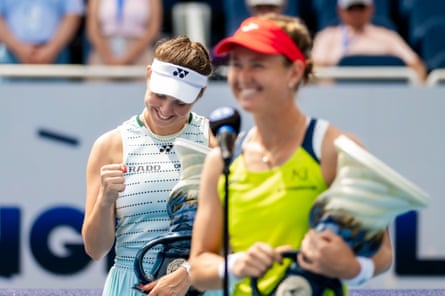
After “managing to steal a few days abroad” in Italy, it was already time to return to practice and look ahead. The tennis circuit moves at such a relentless pace and for every other player on tour Wimbledon had long been old news. Noskova returned to competition with a straight-sets defeat against the then world No 70 Caty McNally, in Toronto, but she fared better in Cincinnati winning two rounds before defeat by the world No 10, Amanda Anisimova, in the last 16. Her excellent performances in doubles, where the pressure is off and expectations are nonexistent, provided her with a reminder that she is still striking the ball sweetly. She won the women’s doubles title in Cincinnati alongside her countrywoman Marie Bouzkova.
Many grand slam title winners say their first major triumph increased their desperation to win big championships rather than satisfying it. Noskova is still waiting with great anticipation for such feelings to surface. “I’m still kind of fighting through that. The motivation is not 100% as it was right before the tournament [Wimbledon]. But I know that it’s hard. I know a lot of players that have dealt with the same issue. But it’s tennis after all. You wake up from what happened and you start all over, so I’m just waiting for that.”
Until then, she has plenty to ponder on a career that has taken her from Bystricka, a Czech village of 1,000 people, to the most prominent stages of women’s sport. “Once I started to take tennis a bit more seriously, I wanted to have better players to play with, better coaches. I had to switch teams, so I did the same thing with school, so we moved to a different city [Prerov]. I could have been around 13, 14. So I guess that might have been the first moment when I was like: ‘OK, I have to move because of tennis.’”
There were indications of Noskova’s potential throughout her young career. Aged 14, her short hair draped over a Yonex visor, Noskova finished as a finalist at the prestigious Les Petites As under-14s event, losing against Alexandra Eala. Aged 16 she won the 2021 French Open girls’ title, a significant achievement that allowed her to believe that she might one day win a real grand slam title. Noskova is a few months younger than the two-time grand slam title winner Coco Gauff, meaning she was far from the most prodigious youngster of her age group. Noskova has kept ahead of the rest of their contemporaries.
after newsletter promotion
Beyond her on-court success, Noskova cuts a distinctive figure for the outside interests she enjoys in a sport where many have no interest in anything other than their careers. She spent some of her off‑season last December volunteering at a school in Zanzibar, Tanzania. On her secondary Instagram page, Noskova describes herself as a “big, big environmentalist” with her interests ranging from LGBTQ and human rights to war and gender equality. She sees herself volunteering in other sectors, particularly to aid environmental causes, during and after her career. “I feel I have always been passionate about these kinds of things, of course,” she says.
“So that’s why I would like to use tennis as a platform to get me into these places. But that still has a lot of time. I obviously want to focus on my career first and then since this kind of comes natural to me it’s not going to be as hard to [pursue].
“I would definitely love to do something with the environment, either with animals or nature after I finish my career. That would be my main goal once I’m done with all of this, but for my career it’s going to be another 10 years so I feel like I will definitely do some of those things during the career.”
For now, though, the focus is on navigating the unknown and understanding how to handle her new reality as a grand slam title winner. There are worse positions to be in at 21 years old and, now that she has an understanding of what she is capable of on a tennis court, her next great performance could well be around the corner.