.png) 4 hours ago
5
4 hours ago
5
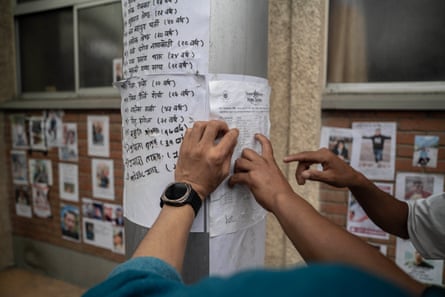
Posters of missing people line the wall of the hospital, the glue still fresh beneath. A schoolgirl smiling in her uniform; a beaming, chubby-cheeked baby; a couple smiling on their wedding day; a young man, hands on hips, atop a mountain peak; a young girl with flowing hair, peaking out from behind a door.
These faces are just a fraction of the thousands who have not been seen since deadly flash floods coursed through the Himalayas and wiped away entire villages. By Saturday morning, the toll of the missing had risen to almost 3,000, in both Nepal and Tibet.
So far, Nepal has recovered 669 bodies, but many remote areas have only been accessed by army helicopters on the hunt for survivors. Rescuers said it was too difficult to assess how many more people might be buried beneath the mud.
The task of identifying the dead is also gargantuan.
In the Nepalese city of Chitwan, the morgues have been overrun by the sheer number of bodies and a makeshift building has been set up to house the dead.
Some of the bodies were carried so far down the river by the force of the floods, they were recovered in neighbouring India.
At Tribhuvan University teaching hospital in Nepal’s capital, Kathmandu, desperate relatives gathered in the hope of news. Four days on since the disaster struck, people continued to crowd round the police desk to register the names of missing family members. Hundreds of the injured are recovering in the hospital’s wards and people were frantically checking lists of patients, desperate to find a sign that their loved ones were still alive.
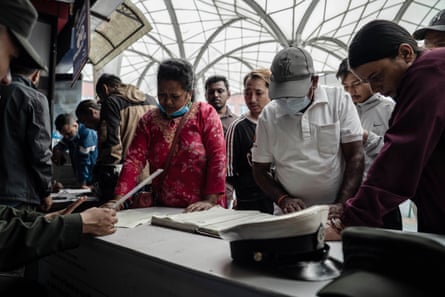
In the absence of information and with affected areas almost completely cut off, many families have resorted to making posters to appeal for information. Yavraj Lama said his sister, her husband and their two children were missing after their village of Jaydada, in Rusawa district, had been entirely washed away.
His eyes filled with tears as he glued a photo of one-year-old Sijan Tawang, a baby in the arms of his mother, to the hospital wall. A picture of 12-year-old Sahil, his brother, hung next to it.
“We are numb, we don’t have words to say how sad and distraught we are,” said Lama. “Our main focus is trying to find baby Sijan. He was so sweet and innocent; it’s impossible for us to think he is not with us any more.
“But their whole village has disappeared,” he added, “so we have no hope left that any of them survived.”
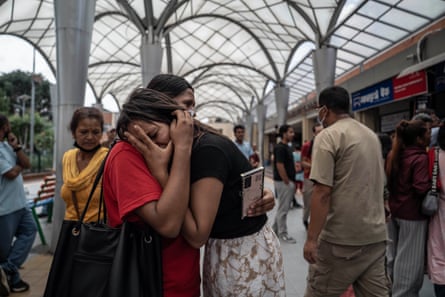
Monita Nepali, 22, howled in grief as a poster of her missing husband Vishal Nepali, 30, was pinned to the hospital wall. They had married six months ago and his work as a driver regularly took him to the border between Nepal and Tibet. She had spoken to her husband an hour before the floods hit when he was out for a morning walk in Rusawa. He had promised to call her that evening, but his phone has been ever off since.
“I don’t want to live on the face of this earth without him,” she said. Four days may have passed, Nepali said, but she had not stopped believing in her husband’s return. “I feel it in my heart he will come back.”
For some families, the scale of the loss was too hard to comprehend. Tulmaya Tamang, 36, came to the hospital bearing posters of some of her 12 family members, including her five-month-old niece, who lived in a village in Rusawa and have not been seen since the floods.
“Our family is under tremendous stress,” she said. “So many are gone, and those of us who are left behind are struggling.”
As hopes for their survival faded, Tamang said they were now just hoping the bodies could be retrieved. “If we had the bodies, then at least we could have peace,” she said. “Otherwise, the family will never stop wondering and this pain will go on for a very long time.”
At least 900 of those still missing were working on the vast hydropower projects along the Trishuli River corridor, high up in the Himalayas, which were decimated by the floods and mudslides. Many of the workers were low-paid labourers, including at least 63 from India.
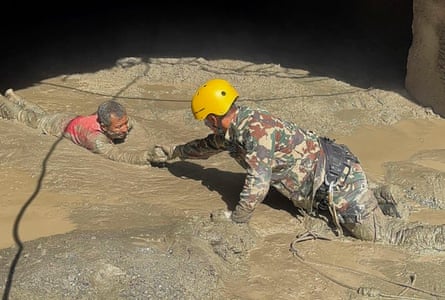
On Friday, dramatic footage showed Nepali soldiers pulling several survivors out through a thick wall of mud from a tunnel in the Trishuli-1 hydropower project. The Nepali army said they believed at least another 100 people were still trapped inside the tunnels, as well as dozens more trapped underground in the Trishuli-3 hydropower plant.
Among those missing was 24-year-old Sujan Nepali, who had just finished his night shift at the hydropower project and was asleep in bed when the wall of water came gushing down the valley. At the hospital trauma centre in Nepal, his sister, Sushisha Maluwar, had returned anxiously every day to check if his name was listed.
“We haven’t lost hope,” she said. “We are writing down his name at the hospitals and putting up his photographs everywhere, hoping that we might find him somewhere. Maybe he has already been rescued. Maybe he had managed to escape and survive.”