.png) 2 months ago
63
2 months ago
63
More than 50 years ago, the Apollo astronauts’ photographs of Earth seen from the moon had a jolting effect on a society distracted by division and conflict. Then, as now, they came in “an hour of change and challenge, in a decade of hope and fear, in an age of both knowledge and ignorance”, as President John F Kennedy had put it. But what he hadn’t predicted was that on the way to the moon, we would discover the Earth.
Here was our home planet, suddenly seen as a finite ball of rock, shrouded in an apple peel-thin layer of life-sustaining air. This view jarred with people’s everyday experience of living on the surface of an apparently infinite world of limitless resources. The creation of a special Earth Day soon followed, along with the founding of the campaigning environmental charity Friends of the Earth and the passing of a slew of environmental protection laws.
And for a brief moment, as the first moonwalkers toured the world, everyone who greeted them referred to their accomplishment as something that “we” did – “we the human race”, instead of an American achievement.
In the decades since then, no human has travelled far enough away to see Earth from such a humbling perspective. Human spaceflight focused instead on observations of Earth from a series of space stations around 250 miles high; only a thousandth of the distance that Apollo’s astronauts had seen it from. This is not far enough away to see the whole Earth, or to feel a sense of the finite precarious nature of our planet’s habitability.
The images that first united and inspired a generation in the 1960s and 70s raise little emotion in us these days. Instead of marvelling at the miracle of Google Earth, with its exquisitely indexed layers of global data and up-to-date imagery, we have become complacent. At the recent sold-out Secret Maps exhibition at the British Library, one such globe, projected beside the exit, felt almost invisible to visitors. “Oh, that’s just Google Earth,” I overheard a man declare to his friend, as he strolled dismissively past it.
The borderless, unifying sense of our world as a single global community that entranced us after Apollo, and might have marshalled us all to act together for a greater environmental good, could have been amplified by social media. Instead, these platforms’ profit-driven, algorithmically tuned echo chambers have driven many of us in the opposite direction. Instead of fighting for the habitability of our home, we are fighting each other; our minds occupied by divisive, polarising politics and broken international relations.
Now four of us have ventured far away from our divided planet again. This international crew of calm, curious, kind, thoughtful people represents the best of us. They symbolise something important. They will ride a spaceship built by communities from 11 nations who have harnessed their inherent diversity of thought and their broader problem-solving abilities to accomplish a new moonshot. Instead of individual nations racing there, the Artemis missions represent a group of united nations going to the moon together, first to fly around the moon this week with Artemis II, then to land there in 2028. Sixty-one countries have signed the Artemis accords, a set of global agreements committing to working peacefully together in space and on the moon.
“I think it’s wonderful,” Artemis II astronaut Christina Koch, set to be the first woman to fly around the moon, told us when we were shooting with the crew for our immersive film The Moonwalkers. “Any country that’s interested in exploring, come, come along, be a part of this.” The mission’s commander, Reid Wiseman, agreed. “We are going as humanity,” he says. Artemis II astronaut Victor Glover, set to be the first African American to fly to the moon, said that “one of the things going to space teaches you is that we’re all brothers and sisters, and when we work together to do really hard things, it just brings you together in a way nothing else will.”
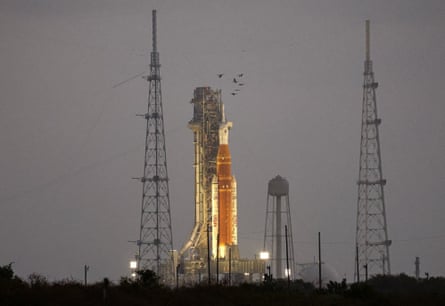
The first Artemis astronauts will travel more than 4,000 miles beyond the moon before its gravity tugs them back. As they pass the moon again, the Earth will emerge from behind it. Unlike the first Apollo astronauts, who were not expecting this view, scrambling to suddenly document and marvel at it, the crew of Artemis II are planning to photograph it. They might even attempt to stream the sight back to us live.
As the first humans for over half a century prepare to set eyes on the whole Earth in this way, they are about to experience something almost sacred. Sharing this experience will change them more than they can imagine. But perhaps the knowledge that there are other people up there again looking back from so far away will also change us. It will be a reminder to see ourselves as poet Archibald MacLeish did after seeing the first photos from Apollo 8, “as riders on the Earth together, on that bright loveliness in the eternal cold”.
Lying on the lunar surface, a few thousand miles below them, as the Artemis astronauts pass over the moon, will be a tiny silicon disc of goodwill messages from world leaders, placed there by the crew of Apollo 11 in July 1969. One message is from a man called Eric Williams, then prime minister of Trinidad and Tobago. It reads: “It is our earnest hope of mankind that while we gain the moon, we shall not lose the world.”
-
Dr Christopher Riley is the author of the book Where Once We Stood, and co-writer of The Moonwalkers with Tom Hanks, featuring the crew of Artemis II, now playing at Lightroom London