.png) 2 hours ago
6
2 hours ago
6
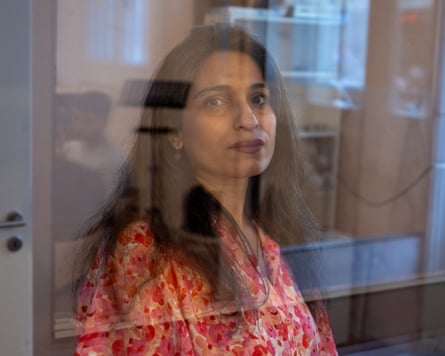
As the Bible study session wrapped up, leaving worshippers to mingle over cake and coffee, Fatemeh, 44, fought back tears as the conversation turned to Sunday’s state election in Saxony-Anhalt.
“I worry about it every day,” she said. “I can’t stop thinking about my son and what might happen to us.”
Three years ago she fled Iran with her son after he was stopped by police during a protest over the death in police custody of Mahsa Amini. They ended up in Saxony-Anhalt, where, as they await a final decision on their asylum claim, she has watched him blossom into a gifted athlete and develop a knack for repairing vehicles.
-
Fatemeh worries about what might happen after the elections. Photograph: Christian Jungeblodt/The Guardian
Looming over their lives, however, are the politics of Saxony-Anhalt. Polls have suggested that the election on Sunday could yield Germany’s first-ever state government led by the far-right Alternative für Deutschland (AfD), shattering a postwar taboo and leaving Fatemeh and her son’s fate in the hands of a party that has promised to launch deportations “from day one”.
That possibility has left her racked with worry. “They might send us back to Iran,” she said. “As a converted Christian, that could mean the death penalty for me.”
It was a glimpse of the stakes at play in the election. Polls suggest the state’s AfD, whose antisemitic, anti-Islam and anti-migrant discourse has contributed to authorities classifying the party as “firmly rightwing extremist”, is poised to win the most votes.
-
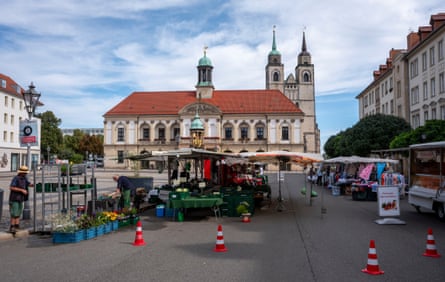
The square in the centre of Magdeburg where the Christmas market attack took place on 20 December 2024. Photograph: Christian Jungeblodt/The Guardian
A strong showing in the election could allow it to govern Saxony-Anhalt, turning the eastern state into Germany’s first testing ground for the AfD’s long-running hostility towards migrants, including refugees, Muslims and the LGBTQ+ community.
“We’ve never seen emotions run so high over an election,” said Undra Dreßler of Lamsa, an umbrella group for migrant organisations in the state. Calls were coming in daily, she said, as people wrestled with whether the time had come to pack up their lives and start over again somewhere else.
“People are really worried and scared,” said Dreßler. “For those with migrant backgrounds, it feels like this vote is about their right to exist and their security.”
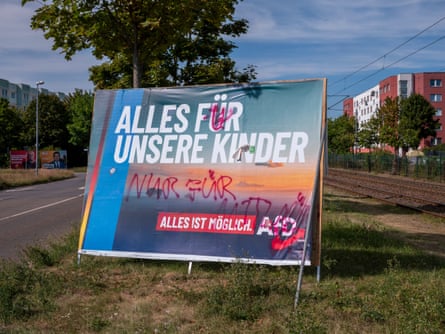
The pages-long manifesto for the AfD in Saxony-Anhalt promises a “complete, 180-degree” overhaul of the approach to migration, from educating refugee children separately to redirecting funds earmarked for integration to a unit focused on remigration, and calling on federal officials to stop recognising Ukrainians as war refugees.
In June, Dreßler’s organisation appealed to Germany’s 15 other states, calling on them to prepare to take in refugees from Saxony-Anhalt after the election. “It’s a precautionary measure,” she said. “The social climate here is already extremely heated. We don’t know what will happen after the elections.”
-
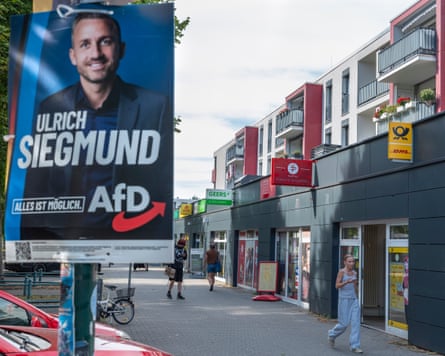
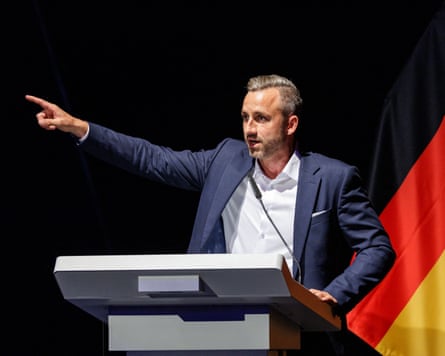
Left: A billboard in Magdeburg shows the AfD candidate Ulrich Siegmund and the slogan ‘everything is possible’. Photograph: Christian Jungeblodt/The Guardian. Right: Siegmund addresses delegates at the federal congress of Generation Germany, the party’s youth organisation. Photograph: Jens Schluter/AFP/Getty
Tensions have run high in Saxony-Anhalt since late 2024 when a Saudi man drove his car into a crowded Christmas market in Magdeburg, killing six people and injuring hundreds more.
Authorities described the attacker as an anti-Islam activist who was sympathetic to the far right. Even so, rightwing voices seized on the moment to scapegoat migrants and minorities for the ills of a state long ravaged by deindustrialisation and depopulation. In the aftermath of the attack, reports of racist attacks soared as migrants and people of colour told of being spat on, threatened and, in some cases, physically attacked.
“By mid-2025, we had received as many reports of racist insults and attacks as we did in all of 2024,” said Dreßler. “As forces on the right become stronger, everyday racism and discrimination have become part of everyday life.”
On the streets of Magdeburg, many shared their own brushes with overt racism. “When you’re on the street, some people harass you verbally,” said Kirti, 27, a student from India. “They show you the middle finger.”
-
An AfD billboard reads ‘All for our children’. The party has promised to educate refugee children in the state separately. Photograph: Christian Jungeblodt/The Guardian
Kirti moved to Magdeburg just over a year ago to study for a master’s degree, becoming part of a cohort of foreign students for whom reports of racism were all too familiar. “I heard of one incident where a student was travelling on a train and people were throwing stones at the door, but the door was closed,” he said. “So people are more concerned about going out. They go out with fear, rather than feeling safe.”
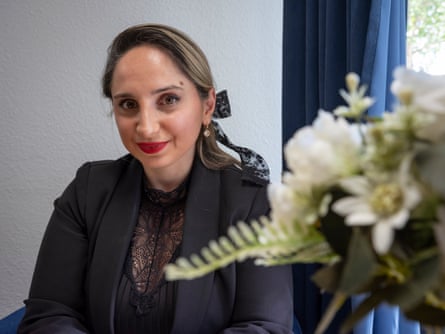
A recent survey suggested that as many as 80% of people with a migration background in Saxony-Anhalt are considering leaving, said Ketevan Asatiani-Hermann, who leads the board of the Advisory Council for Integration and Migration in Magdeburg.
As questions swirl over what the AfD could realistically do if the party garners enough votes to govern alone, a chorus of voices has begun to warn of the fallout. Saxony-Anhalt is a rapidly depopulating state where the average age of 48.2 ranks as the highest in Germany. “So the fear is that we lose people because of what happens on 6 September,” said Asatiani-Hermann. “And Saxony-Anhalt is dependent on migrants, so it’s absolutely necessary that they stay here.”
-
Ketevan Asatiani-Hermann says Saxony-Anhalt is dependent on migrants and it is ‘absolutely necessary’ they stay. Photograph: Christian Jungeblodt/The Guardian
Foreign nationals account for about 9% of the state’s population – compared with approximately 15% nationwide – with many playing a critical role in sectors such as hospitality and care for elderly people.
In May, the state medical association said that more than one in four doctors working in Saxony-Anhalt’s hospitals, or 27.1%, do not hold a German passport. “In many regions of the state – especially in rural areas – comprehensive healthcare coverage would no longer be possible without foreign colleagues,” it said, citing the possibility of longer waiting times or facility closures if some of these doctors were to leave.
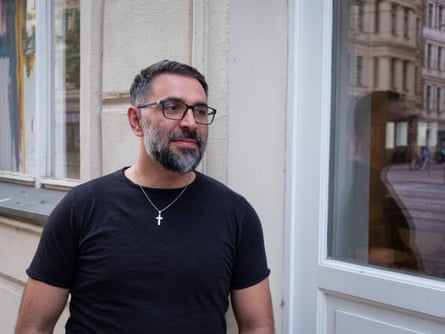
“Migrants make up a huge part of healthcare. If you were to take them out, the whole system would collapse,” said Hamid, 41, a paramedic originally from Iran. “So it’s like if you have a bus and you take off all the tyres. You cannot move.”
-
Hamid, a paramedic originally from Iran, says without migrants in Magdeburg, the ‘whole system would collapse’. Photograph: Christian Jungeblodt/The Guardian
At Magdeburg’s synagogue – whose light-filled foyer includes a mural showing one of the few remaining photographs of the original synagogue that was destroyed in a 1938 pogrom – people listed their concerns about an AfD majority, from whether it would affect the funding they receive, to what the party’s plans for a “remigration offensive” would mean for the Ukrainian refugees who had joined their congregation after Russia’s full-scale invasion.
The far-right party has also promised to make changes to the school curriculum, in what one party member described as “more Bismarck, less Hitler”. The underlying assumption was that the focus on the rise of National Socialism and the Holocaust – as opposed to the unification of Germany by Otto von Bismarck – had shifted the guilt over what had happened to the current generation, said Igor Mendel Itkin, the synagogue’s rabbi.
“They think: ‘If we get rid of this, we will feel free.’ But I think it will be the other way around,” he said. “You cannot get rid of this ghost; you can pacify it, but you cannot get rid of it. If people don’t learn about it, then something like this could happen again, maybe not with the Jewish people, but maybe with the Muslims.”
He pointed to Saxony-Anhalt’s AfD manifesto, which makes no mention of the Jewish community but includes promises to “exhaust all legal means to restrict the influence” of Islam, even as it notes that Muslims account for just 2-3% of the 2 million people in the state.
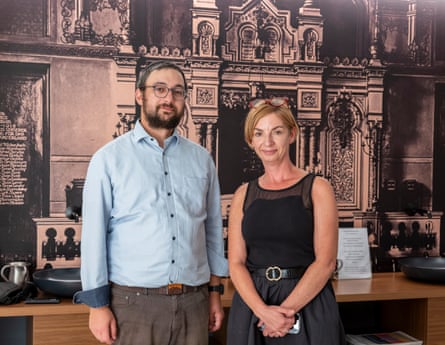
-
Rabbi Igor Mendel Itkin with Maria Schubert at the Magdeburg synagogue say an AfD win is ‘unimaginable’. Photograph: Christian Jungeblodt/The Guardian
An AfD win would put Jewish people in a complicated position, said Maria Schubert from the Synagogue Community of Magdeburg. “If they win, we don’t know how we will act with them. For me, it’s unimaginable,” she said.
She worried that it could also be a dilemma faced by others if Sunday’s election turned out to be a bellwether of shifting political forces rather than an outlier. “I see it as a threat, in that this could just be the beginning. In other German states, many are looking at Saxony-Anhalt to kick things off,” she said. “I mean, at the beginning, nobody took Hitler seriously.”
The AfD was approached for comment.
With contribution from Niclas Boenki