.png) 3 months ago
83
3 months ago
83
The Aintree morning was still young, and the temperatures frigid enough for a thick coat, when Hayley Bentley arrived at Ladies’ Day wearing only a bridal dress and veil. “I love racing and got my future husband into it,” she explained. “So what better excuse is there to get dressed up for Ladies’ Day and spend your hen party with 23 of your favourite people?”
Everywhere you looked that sentiment was being echoed and magnified by 55,000 other racegoers, most dressed in their finest suits and silks, who were basking in the first Ladies’ Day sellout since 2012.
Forget the limping economy and the violent headwinds from the war in the Middle East. Liverpool was determined to look its best and party like it was the roaring 20s. Indeed, such was the demand for hairdressers on Friday that ITV’s racing presenter Ed Chamberlin revealed that one of his friend’s girlfriends could only get an appointment at 4am.
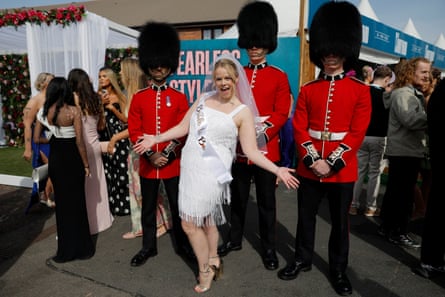
This was also a much younger and less fusty crowd too – dressed more in Burberry than Barbour – with the majority appearing to be in their teens and 20s. This, it turned out, was not an accident, but rather a determined campaign by the Jockey Club, racing’s 276-year-old organisation, to use TikTok and Instagram to stress the social side of the sport to younger audiences.
“The Jockey Club now has 162,000 followers on TikTok, and in January we also started an account for Aintree, which is more focused on those very much interested in the day-out experience,” said Joe Hughes, the social media manager at the Jockey Club.
“We’ve got our team and cameras out there and they’re asking people about their race day routine, how long it takes to get ready and how they are enjoying the day. We’ll post a lot of that today, and reuse it in the build up to next year.
“The TikTok effect is definitely helping, along with better marketing. But Ladies’ Day has become even more of an event too. There’s a big demand to be here.”
One racegoer, Tracy Ramsey, said that her outfit from Abundance and hat from Lynne Young had cost £1,000 – although her shoes were only £3 off Vinted. “Today was a Christmas present from our children,” she said. “I love horses. And what people often don’t realise is how well they’re looked after.”
Meanwhile her husband, David Beck, was revelling in the atmosphere after making the trip from Middlesbrough. “Where could you go this time of the year in the UK and get dressed up like this, as if you’re in San Tropez?”
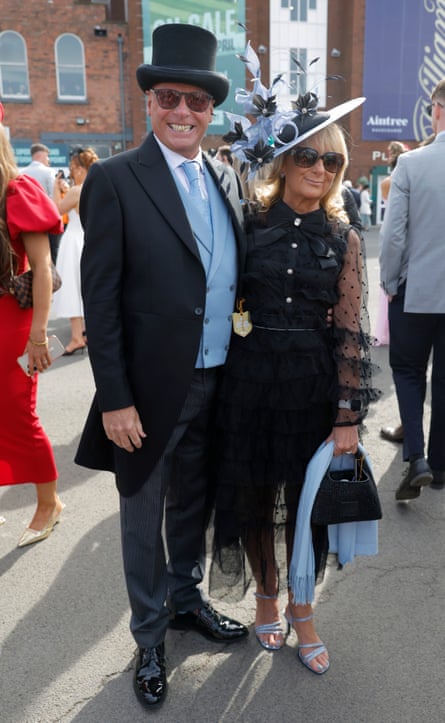
Photograph: Tom Jenkins/The Guardian
Dickon White, whose role at the Jockey Club includes overseeing Ladies’ Day, said that about half of Friday’s crowd were women, who had largely come to be seen and to escape the unrelenting grind of the news cycle.
“Ladies’ Day is targeted at a younger demographic,” he said. “We don’t hide from that. It has a fantastic atmosphere. People come here to forget about some of the challenges outside of life. Because we are in tough times.”
Some of those casual fans might think Red Rum is a type of alcohol. But, crucially for the sport, they are happy to pay upwards of £50 for the day – and enjoy not just the racing, but the accompanying musicians, jugglers and fanfare, including competitions that award prizes such as trips to Ibiza for best-dressed and best-suited fans.
“It’s not cheap to come racing, but it’s all about value for money,” said White. “We’re giving people the opportunity to come and enjoy some absolute top class sporting action, but we also want them to have entertainment, excitement and to enjoy the colour.”
There will be another sellout crowd for Saturday’s Grand National, which is expected to attract more than five million viewers on TV. But the dangers inherent in jumps racing were again illustrated on Ladies’ Day when screens were placed around the winner of the 2.20pm, Gold Dancer, 100 metres after he had crossed the line. Later it was confirmed he had died, having suffering a broken back after jumping the final fence.
Townend escapes sanction after Gold Dancer death
Show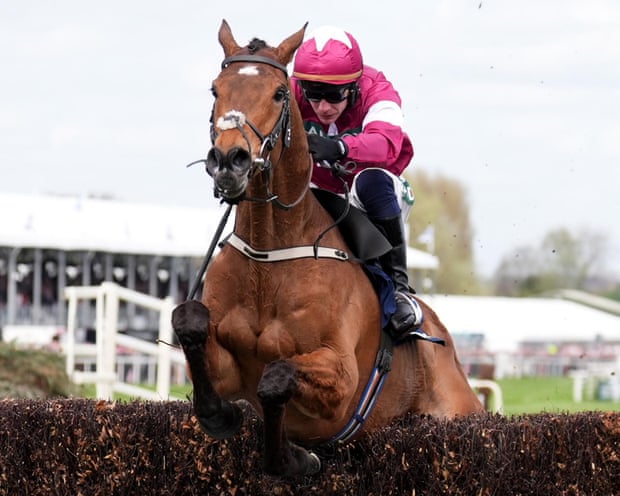
The second day of Aintree’s Grand National meeting yesterday was marred by a fatal injury to Gold Dancer which was sustained as Willie Mullins’ gelding jumped the final fence on the way to victory in the Grade One Mildmay Novice Chase, but did not become apparent until after the line.
Paul Townend, Gold Dancer’s jockey, told a subsequent stewards’ inquiry that his mount “had made a mistake at the last fence after which it had taken a stride or two to gather himself before, in his opinion, running on in a straight line to the winning line”.
Townend added that it was “only rounding the bend towards the pull up area that the gelding’s action changed … after which he immediately dismounted from the gelding”. His explanation was noted by the officials.
James Given, the British Horseracing Authority’s director of equine, safety and welfare, also gave evidence to the track stewards, saying that in his view, Gold Dancer’s action had been “typical of a three-mile chaser in the final stages of a race and supported the evidence of Townend”. Greg Wood
Photograph: Mike Egerton/PA
Everyone in racing understands that the Grand National is the sport’s shop window. It reaches the parts the sport would otherwise not reach. About a third of British adults will have a bet on the race, and stake £150m on the outcome. The action is spectacular, the bravery of horse and jockey unmatched. But when a horse pays the ultimate price, what was a joyous afternoon feels less like a party and more like a wake.
The Jockey Club says it has made the race safer in recent years by making the fences less perilous, and reducing the field from 40 to 34 horses, and White acknowledges that more might need to be done.
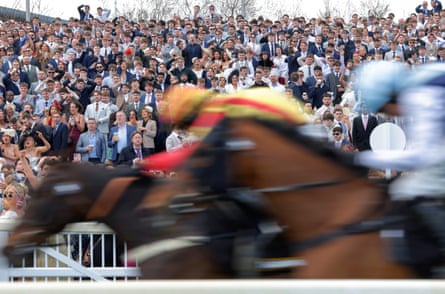
“The welfare of horse and rider has always been our No 1 priority,” says White. “In recent years we have made changes, and we won’t be afraid to make future changes if we need to. The Grand National jump racing is enjoyed by millions of people around the world and we have to just make sure that we don’t stand still.”
Coincidentally, one of the favourites for the National is called Panic Attack, which is aiming to become the first mare to win since Nickel Coin in 1951. But racing will be praying for no alarms or palpitations when the world’s greatest steeplechase gets under way at 4pm.