.png) 3 months ago
62
3 months ago
62
Children are potentially being exposed to the controversial weedkiller glyphosate at playgrounds across the UK, campaigners have said after testing playgrounds in London and the home counties.
The World Health Organization has listed glyphosate as a probable human carcinogen since 2015. However, campaigners say local authorities in the UK are still using thousands of litres of glyphosate-based herbicides in public green spaces.
Campaigners from the Pesticides Action Network (Pan) UK took swabs and soil samples at 13 playgrounds in Kent, Cambridgeshire, Buckinghamshire, Tower Hamlets and Hackney. They found traces of glyphosate or its breakdown product aminomethylphosphonic acid (AMPA) at eight of them.
The only area where no trace of the herbicide was found was in Hackney, which went glyphosate-free in public green spaces in 2021.
“It is deeply concerning to find a highly hazardous pesticide like glyphosate present in the very places where our children play,” said Pan UK’s Nick Mole. “We all know that young children tend to put their fingers and other items in their mouths, so finding glyphosate residues in playgrounds, including on play equipment such as swings and slides, is particularly worrying.”
Controversy has grown around the use of glyphosate in recent years. But the chemical remains authorised for use in UK public spaces and is routinely applied by councils on parks, playing fields, cemeteries and pavements.
Cancer is not the only illness linked to glyphosate. Prof Michael Antoniou, a specialist in molecular genetics and toxicology at King’s College London, said: “Our studies have shown that exposure to glyphosate herbicides is a significant risk factor for the development of a range of serious health conditions including fatty liver and kidney disease and, most worryingly, a wide range of cancers including leukaemias.
“The assertion by government regulators that glyphosate is safe does not stand up to latest scientific scrutiny, which shows that a safe dose of glyphosate is, at present, unknown. Thus, all efforts should be made to reduce glyphosate herbicide use in both agricultural and urban settings, and to eliminate unnecessary routes of exposure, especially for children.”
The Health and Safety Executive, the government agency responsible for pesticides, is due to re-examine authorisation for the use of glyphosate this year and campaigners have said they expect a public consultation on the renewal to begin soon.
Pressure is mounting for its use to be heavily restricted. Siân Berry, the Green MP for Brighton Pavilion, has tabled a private member’s bill calling for councils to ban the use of glyphosate in public areas.
“Many councils in cities, towns and villages across the UK have taken a different approach to controlling plant growth, and they manage streets and playgrounds in ways that work to keep children and nature safe,” Berry told the Guardian. “Councils have many other options than covering our children’s local environment in hazards.”
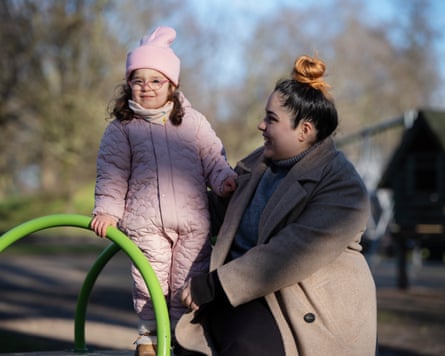
At Victoria Park, the biggest park in Tower Hamlets, on Wednesday afternoon, Dafina Bozha said she was shocked to learn there could be traces of carcinogenic chemicals in the playground. “This should be their safest place,” she said, looking over towards where her young daughter was climbing on to a roundabout. “If it’s something that gets to my child’s health, it’s something that’s very important to me.”
Another mother, who asked to be named as Naz B, said she felt the use of glyphosate ran counter to what playgrounds ought to be about. “I don’t think it’s acceptable,” she said. “The playground is supposed to be about nature and survival.”
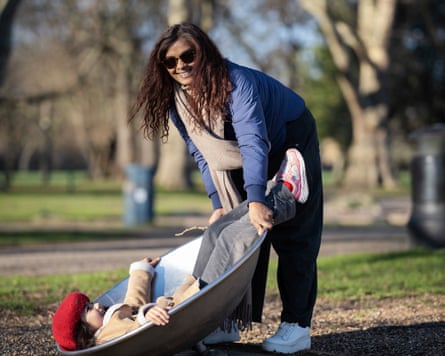
As her daughter scratched around in the soil with a stick finding a lost fragment of jewellery, Naz went on: “Kids are around the park to touch the grass and the mud … no one wants unnatural visitors.
“We have so many products, natural products, we have organic products. We have people that come to the park that are vegan, vegetarian, so I’m sure there’s products out there that you can use without using the old-fashioned chemicals.”