.png) 2 hours ago
5
2 hours ago
5
Would Hollywood have brought Practical Magic back from the dead if the intervening 28 years looked more visible on Sandra Bullock and Nicole Kidman? An awkward question, as it risks subjecting their faces to the invasive scrutiny older female actors already endure. Their return as leads in their late 50s and early 60s should count as progress. Yet it reveals a condition of female stardom: age can increase a female actor’s nostalgic value, provided it does not show too clearly on her face.
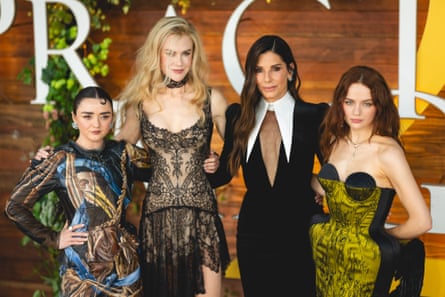
In Practical Magic 2, Bullock, 62, and Kidman, 59, return as sisters Sally and Gillian Owens. Dianne Wiest, 78, and Stockard Channing, 82, are back too. Joey King and Maisie Williams play Sally’s adult daughters, but Sally and Gillian remain central.
As producers, Bullock and Kidman helped choose director Susanne Bier and protect the original’s tone. That creative influence is quite a reversal from 1998, when the film’s female cast and subject matter drew condescension. Bullock remembers being asked: “How many women do you need in a film?” Yet it became a cult favourite. The female world once dismissed as excessive became the source of its value.
Legacy sequels can change age’s commercial value. Hollywood usually treats age as a reason for a female actor’s career to contract, but for Practical Magic 2, the years create the history being sold and give returning stars leverage. But that leverage comes with conditions.
Tom Cruise returned to Top Gun at 59, 36 years after the original, looking astonishingly like his 1986 self and remaining both hero and romantic lead. Men also face pressure to look young, but ageing is far less likely to cost them the starring role.
Kelly McGillis, who played Maverick’s instructor and love interest in the original, was not asked back. In 2019, she was refreshingly unsentimental. “I’m old and I’m fat and I look age-appropriate for what my age is,” she said. “And that is not what that whole scene is about.”
Instead, Cruise was paired with Jennifer Connelly, who is 13 years younger than McGillis. Kosinski said he wanted new characters rather than revisiting every old storyline. Fair enough. But Cruise was essential to the nostalgia. McGillis was not.
Practical Magic is harder to separate from its women. The original seemed genuinely fond of them, mess and all. They fell in love, screwed up, raised children, cast spells, survived male violence, rescued one another and drank tequila in a conga line. Its emotional centre was sisterhood.
Top Gun discarded Maverick’s original love interest and became a huge commercial success. Practical Magic without Sally and Gillian would barely be Practical Magic at all.
Bullock and Kidman fit Hollywood’s narrow ideal for an older leading woman. Perhaps that is the bargain: older women can remain central provided ageing has altered them with sufficient discretion. Hollywood has long found room for eccentric aunts and grandmothers; it is less comfortable when older women’s desires and emotional lives drive the story.
Whatever either actor may have done cosmetically is her own business. Hollywood’s beauty game gives women no winning move. Look older and she has “let herself go”; look unusually youthful and everyone and their granny feels entitled to inspect her forehead for Botox. Visible work is treated as undignified too.

But some demystification can help: Hollywood beauty requires money and expertise; looking unusually youthful at 60 takes a lot more than drinking water and slapping on olive oil. Trouble begins when that level of physical maintenance is sold back to ordinary women as what ageing should look like.
Walking away offers no escape. Bridget Fonda left acting over 20 years ago, yet photographers pursue her and newspapers declare her “unrecognisable” or “worlds away” from the glamorous woman audiences remember. Well, yes. Decades have passed. Faces tend to show it. There is no clean exit once the public has decided it owns your face.
Legacy sequels complicate all of this because nostalgia demands authenticity. This sequel depends on Bullock as Sally and Kidman as Gillian. Recasting them with younger women would defeat the point and lose the audience.
The women who watched Practical Magic in 1998 have accumulated 28 years too. Their lives continued while Sally’s and Gillian’s were suspended. Seeing Bullock and Kidman again connects viewers with the younger selves who watched two sisters leap from a rooftop and dance around the kitchen to Coconut.
There is irony in an industry that spent decades treating women’s ageing as a commercial liability, and has now found a format in which age can be an asset. Audiences want to know what happened to the characters and the women who played them. That shared history is part of what they are paying for. And then comes the catch: nostalgia needs the decades to have passed, while beauty culture would rather they did not show. Come back as the woman audiences remember, 28 years later, but please do not look too much as though those 28 years happened.
That is the contradiction at the heart of Practical Magic 2. Hollywood may finally have found a commercial reason to value women’s accumulated years. The real test is whether it can also tolerate the evidence of those years on their faces.