.png) 3 months ago
90
3 months ago
90
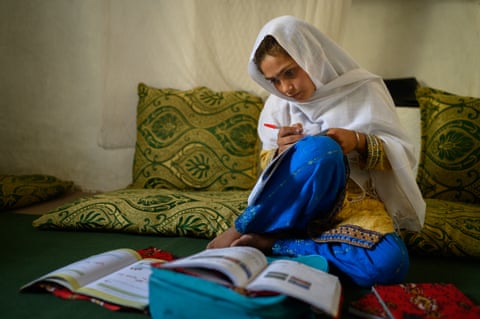
First prize was won by Elise Blanchard, who documented the lives of girls and young women in Afghanistan. Second prize was won by Natalya Saprunova, who captured the how children in Mongolia are affected by air pollution. Third prize was awarded to Sourav Das, who documented childhood in Jharia, home to one of India’s largest coal mines. Honourable mentions went to seven other photo series from Afghanistan, Gaza, South Africa, Ukraine and the UK
An exhibition of the work will run until the end of January 2026 at the Haus der Bundespressekonferenz in Berlin, and then at the Willy Brandt Haus, also in Berlin, from 30 January to 26 April 2026
Fri 19 Dec 2025 16.34 CET

Girlhood in Afghanistan | At the madrasa
Since their takeover in August 2021, the Taliban has again turned women in Afghanistan into second-class citizens. Although hunger and malnutrition run rampant, and clinics and doctors are scarce in this already destitute country, it is especially girls who feel that fundamental human rights simply no longer apply to them. They are only allowed to attend school until 7th grade, after which they are denied any further education.Photograph: Elise Blanchard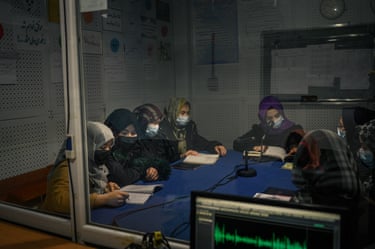
Girlhood in Afghanistan | Radio Begum
Elise Blanchard visited radio stations, sewing workshops, gemstone polishing factories and hidden schools in Kabul and remote mountain villagesPhotograph: Elise Blanchard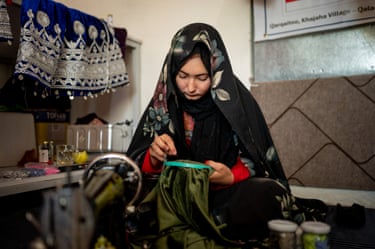
Girlhood in Afghanistan | Nazia
Blanchard visited regions where drought and the resulting poor harvests led to such poverty that families had to marry off girls as young as seven to older men. Photograph: Elise Blanchard
Girlhood in Afghanistan | Malalai, Gulalai, Farzana and Jalil
Blanchard could feel the hopelessness of a 13-year-old who combats her depression by helping younger girls from her neighbourhood become familiar with the world of letters. Photograph: Elise Blanchard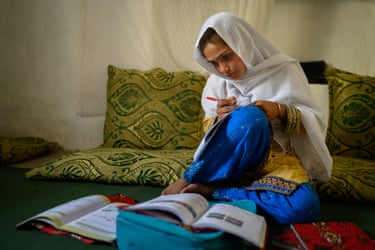
First prize – Girlhood in Afghanistan | Hajira
Hajira has little time left at elementary school, tirelessly studies textbooks at home, and joyfully writes numbers on the walls of her house. She lives with her siblings in an extremely poor family in a remote village in Nangarhar province, east of Kabul. Blanchard met her at a health centre, where she was nursed back to health after several months of illness.Photograph: Elise Blanchard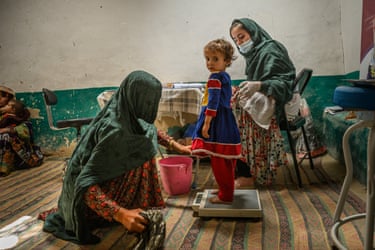
Girlhood in Afghanistan | Shukuria
Photograph: Elise Blanchard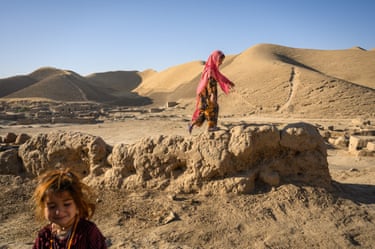
Girlhood in Afghanistan | Gulalai
Photograph: Elise Blanchard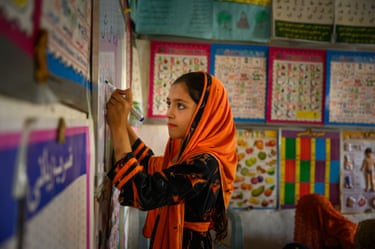
Girlhood in Afghanistan | Khudba
Photograph: Elise Blanchard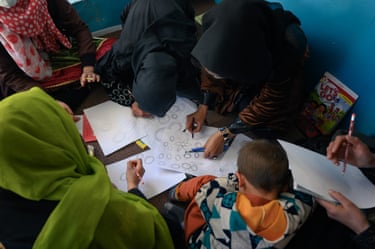
Girlhood in Afghanistan | Secret art classes
Photograph: Elise Blanchard
Second prize – Mongolia’s children at risk | The devastating impact of air pollution
Natalya Saprunova’s image shows a kindergarten in the capital, where air purifiers have been installed to reduce pollution levels. Four-year-old girls are admitted to hospital with respiratory illnesses, young children undergo lung X-rays, and dozens die from carbon monoxide poisoning, while brown clouds rise from hundreds of thousands of chimneys into the icy winter air that can drop to -30C. Photograph: Natalya Saprunova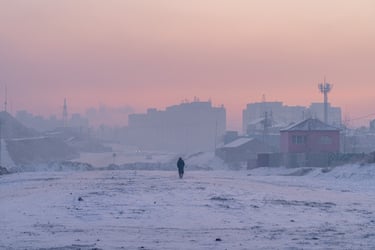
Mongolia’s children at risk | The devastating impact of air pollution
Mongolia ranks among the world’s 20 largest countries, but it is also the most sparsely populated, with an average of two inhabitants per square kilometre, compared with about 240 in GermanyPhotograph: Natalya Saprunova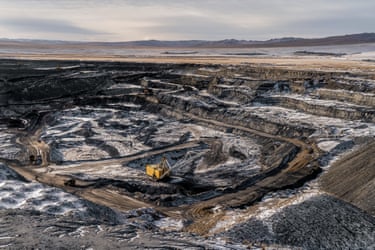
Mongolia’s children at risk | The devastating impact of air pollution
Particulate pollution from burning coal, which accounts for about 70% of the country’s energy generation, has catastrophic consequences.Photograph: Natalya Saprunova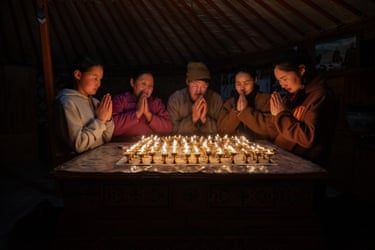
Mongolia’s children at risk | The devastating impact of air pollution
Once famous for its ‘eternal blue sky’, Mongolia has a severe air pollution. People living in the capital, Ulaanbaatar, are the most affected. Photograph: Natalya Saprunova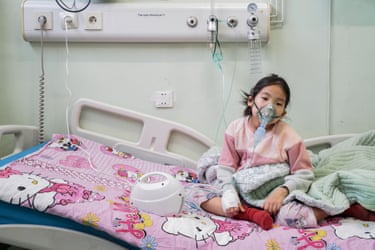
Mongolia’s children at risk | The devastating impact of air pollution
Ulaanbaatar is home to almost half of the country’s 3.5 million people. Particulate pollution from burning coal causes exceptionally high rates of lung and heart disease. It is estimated to contribute to about 10% of all deaths. Photograph: Natalya Saprunova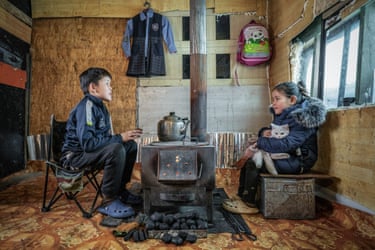
Mongolia’s children at risk | The devastating impact of air pollution
Four-year-old girls are admitted to hospital with respiratory illnesses, young children undergo lung X-rays, and dozens die from carbon monoxide poisoning, while brown clouds rise from hundreds of thousands of chimneys into the icy winter air that can drop to -30C.Photograph: Natalya Saprunova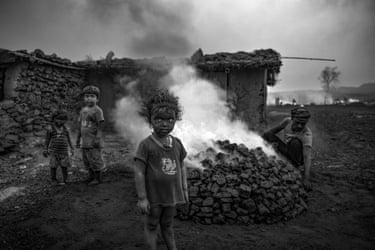
Third prize – India: Children in Jharia’s coal mines | Childhoods lost to smoke, fire and an endless struggle for survival
They breathe hot air from smouldering underground fires. They carry sacks instead of books, drink filthy water, and wade barefoot through black mud. And instead of the bell that signals the start of school, they hear the sound of pickaxes. This is what childhood looks like in Jharia, the infamous ‘burning city’, home to one of India’s largest coalfields for about a hundred years. Photograph: Sourav Das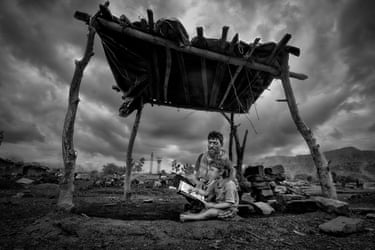
Children in Jharia’s coal mines | Childhoods lost to smoke, fire and an endless struggle for survival
Sourav Das has documented the fate of children whose lives are little more than a struggle for survival in the harshest of conditions. No healthcare, playgrounds or classrooms. Photograph: Sourav Das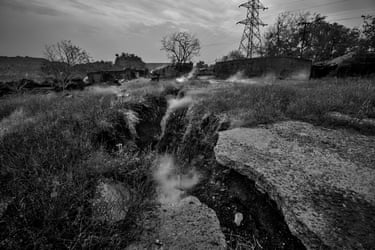
Children in Jharia’s coal mines | Childhoods lost to smoke, fire and an endless struggle for survival
When houses and shacks collapse into cracks that open up in the hollowed-out ground beneath them, they have to live in ruins. Some crawl out of the coal mine entrances or scurry across smoking rubbish heaps like pitch-black shadows, dressed in rags, faces covered in black dust. Indian law prohibits child labour under the age of 14, but violations are rarely punished.Photograph: Sourav Das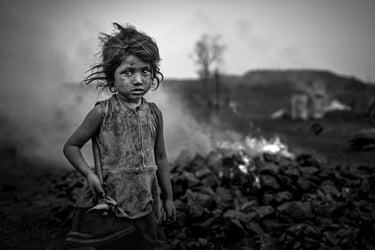
Children in Jharia’s coal mines | Childhoods lost to smoke, fire and an endless struggle for survival
Hope in shadowsPhotograph: Sourav Das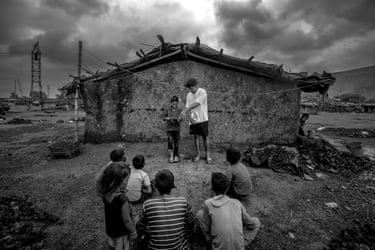
Children in Jharia’s coal mines | Childhoods lost to smoke, fire and an endless struggle for survival
Lessons in the dustPhotograph: Sourav Das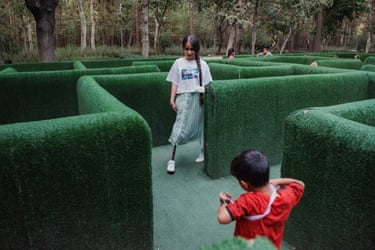
Honourable mention – Iran: Walking back to life
Yeganeh Farjam, 12, walks through a maze at Laleh Park in Tehran.Photograph: Hossein Beris/Middle East Images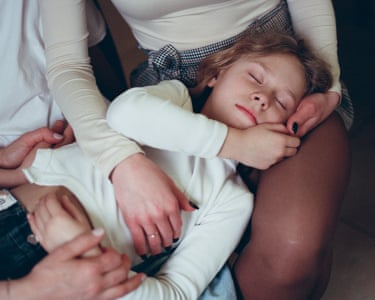
Honourable mention – Ukraine: I hope your family is safe
Since the Ukrainian photographer Anya Tsaruk left her country – first to go to Poland and then Germany – she has repeatedly been asked if her family is safe. More often than not, she doesn’t know what to answer. What does safety mean since the Russian invasion? What is it like to live with the constant threat of drone and missile attacks? The danger is everywhere. In tender images, she deliberately captures everyday scenes such as young Varvara in the arms of her mother and auntPhotograph: Anya Tsaruk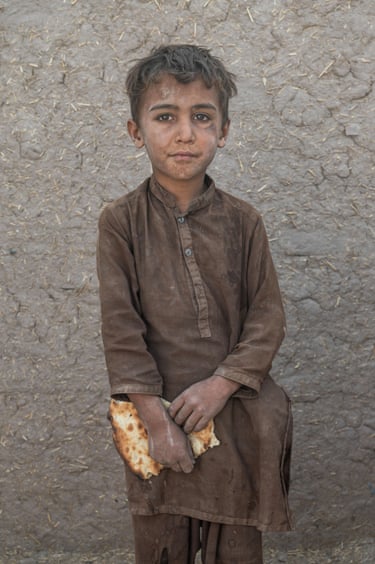
Honourable mention – Afghanistan: What children’s faces reveal
They came with their parents from villages far away in Afghanistan or Pakistan. Now they carry sand, earth, stones and water in a brick factory in Sultanpur. The Iranian photographer Arez Ghaderi captured tired, weathered faces, each revealing a stolen childhood and eyes reflecting a life of hardship.Photograph: Arez Ghaderi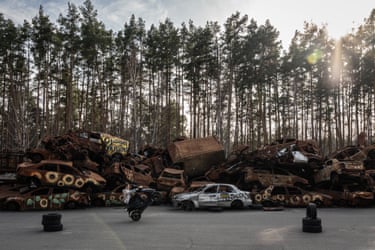
Honourable mention – Ukraine: Raised by war
A teenager doing a wheelie on a scooter at a site where cars destroyed during the siege of Irpin are piled up. In nearly 1,400 days of war, more than 3,100 children have been killed or injured in Ukraine. Countless girls and boys have lost fathers or brothers at the front. They are repeatedly forced to seek refuge in bunkers, metro stations or bombed-out schools, enduring constant air-raid alerts, power cuts, and blaring sirens.Photograph: Sandro Maddalena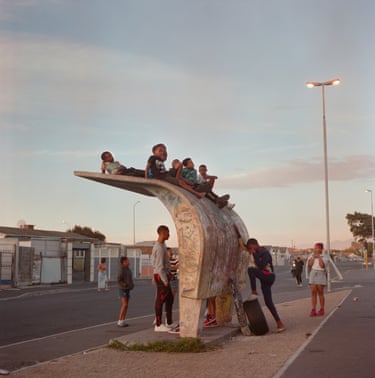
Honourable mention – South Africa: The journey home
Going to school in Cape Town can be risky, because some areas of the city are controlled by armed gangs. This is especially true in the Cape Flats, a plain where notorious townships were established during the apartheid era. High youth unemployment contributes to gang-related violence. The British photographer Laura Pannack accompanied teenagers on their way home from school.Photograph: Laura Pannack/UNICEF Photos 2025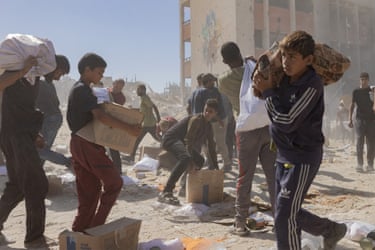
Honourable mention – Gaza: Displacement, hunger and suffering
Young Palestinians collecting aid. Since Hamas’s assault on Israel triggered the army’s military response in the Gaza Strip, life – above all for children – has turned into a living hell. The Palestinian photographer Saher Alghorra vividly depicts their plight.Photograph: Saher Alghorra for the New York Times
Honourable mention – UK: Miss Vogue
The Danish photographer Emilie Toldam accompanied nine-year-old Vogue from Cumbria (holding a lollipop), witnessing small triumphs and defeats. Vogue entered her first contest at the age of seven. Child beauty pageants are often viewed critically, but they are booming in many parts of the world. About 10,000 children take part in such events in the UK each year, according to the BBC.Photograph: Emilie Toldam for Jyllands-PostenExplore more on these topics