.png) 2 months ago
58
2 months ago
58
In 1971, Manolo Blahnik created shoes for the designer Ossie Clark’s catwalk show in London. Relatively new to shoemaking, the Spanish designer forgot to put steel pins in the heels of the shoes, which meant that models wobbled, unbalanced, down the catwalk. Blahnik thought it was the end of his career. But the press thought it was a deliberate style; the photographer Sir Cecil Beaton even christened it “a new way of walking”.
The sandal in question, a green suede heel with ivy leaf embellishments, is just one treasure currently on display at the V&A Dundee’s new exhibition, Catwalk: The Art of the Fashion Show, which helps bring to life more than 100 years of history, charting its journey from the discreet salons of 19th-century London and Paris all the way up to the extravaganza it is today.
According to the museum’s director Leonie Bell: “The fashion show influences every single thing that we choose to wear and what we’re able to buy, so we’re trying to show that.”
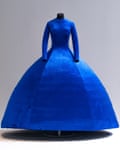
A collaboration with the Vitra Design Museum in Germany, where it was hosted until February of this year, Dundee is a pertinent new home for the exhibition. According to Bell: “Scotland is not only a stage for the catwalk, but is a key part of its history.” In 1938 there was a fashion show as part of the Empire Exhibition at Bellahouston Park in Glasgow; in 1955 Dior held two fashion shows in Scotland – one at the Grand Central hotel in Glasgow and another at the Gleneagles hotel, then in 2024 it returned to stage another at Drummond Castle in Perthshire.
The exhibition showcases the work of great Scottish designers, including an orange and white dress from the much-loved Glaswegian designer Christopher Kane’s debut London fashion week collection in 2007. It’s apt timing: Kane was recently named creative director of Mulberry. There’s also an elaborately layered “queen of hearts”-style dress from Glaswegian Charles Jeffrey Loverboy, and a tartan kilt and Fair Isle jumper from Nicholas Daley, of Jamaican-Scottish origin.
Catwalk starts with the arrival in the 1850s of mannequins vivants (or living mannequins, an early term for models), which were used by fashion houses such as Worth, Lucille and Paquin to present their designs to society women.
Over the next century, the model and the catwalk as the definitive vehicle for showcasing designs became gospel. According to the co-curator of the exhibition, Svetlana Panova, in the 20th century shows moved out of the salons and to “where people gather” – gardens, ocean liners and horse races – revolutionising them as a marketing tool.
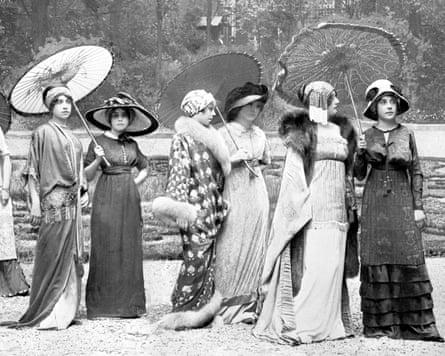
The rise of ready-to-wear in the 1950s and 60s pushed the dynamics of the catwalk further still: out with the stilted, elite movement of haute couture and in with models stomping and dancing down the catwalk to funky music in Spanish-born French designer Paco Rabanne’s “unwearable” metal mirror dress, or British 60s designer Mary Quant’s burgundy vinyl raincoat with matching sou’wester hat, both of which are on display.
The exhibition covers the modern fashion show via looping screens of key moments, capturing what shows have become: an immersive spectacle where theatrical staging, A-list front-row guests and stunts converge to create a global cultural event; one that is instantly broadcast, through livestreams and guests’ Instagram stories.
This shift began in the late 1980s, with the rise of luxury conglomerates. “Fashion houses become part of this big portfolio of assets, it’s not just about the clothes, they start producing many different product categories,” says Panova. As such, “fashion shows become even more of a marketing tool for creating the fantasy around the brand. With that comes great ambition and great resource.”
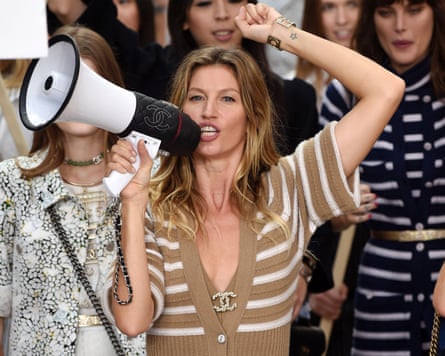
What better way for Catwalk to showcase that than through displaying footage of Karl Lagerfeld’s autumn/winter 2018 show for Chanel, in which a purpose-built Chanel-branded rocket blasted off in the Grand Palais in Paris. As part of the exhibition, it is projected on to a screen and there’s also a scale model of the show’s set, which sits alongside other props used in some of Lagerfeld’s other famously theatrical shows. There is, for instance, the Chanel-branded megaphone, with a quilted handle reminiscent of the classic bag, used in his spring/summer 2015 show, which was transformed into a banner-waving feminist protest led by models Cara Delevingne and Gisele Bündchen.
Every detail of a fashion show is now part of the stunt mechanics, including invitations. On display is Lacoste’s autumn/winter 2024 invitation made with slices of tennis net, Jonathan Anderson’s recent collarette for Dior and a beaten-up wallet stuffed with ID, receipts and coins that was an invitation to a Balenciaga show at the time Georgian fashion designer Demna Gvasalia was its rebellious creative director.
There is also a VR set from his December 2020 pandemic show – with it came a vintage-looking stained envelope, also on display. “The paper envelope is scented,” says Panova. “It’s made to smell like dust and archives, but it smells like mould … [it] makes you think of money, power and blood – so it wasn’t a pleasant aroma, but something unsettling which becomes part of the show.”
All of this might seem very elitist; after all, the majority of people will never attend a fashion show. Yet Catwalk constructs a view of fashion that is more democratic. That is particularly emphasised in the central room of the exhibition, which explores the chaos backstage via the kits used by makeup-artist Val Garland and hair stylist Sam McKnight. The eclectic wigs McKnight created for Vivienne Westwood’s shows sit on mannequin heads. “Nobody is working in isolation,” says Bell of the household-name designers. “They’re working with makeup artists, photographers, hairdressers, people pinning this and that.”
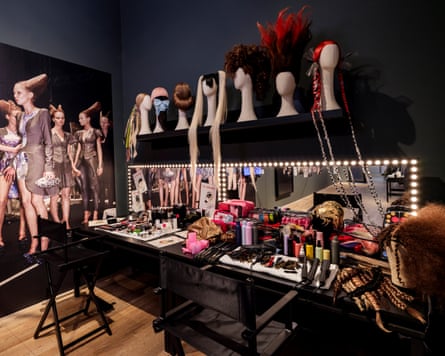
In tracing the evolution of fashion, Catwalk also speaks to how this happened in tandem with the social and cultural changes that were sweeping Britain and the world, particularly since the 1960s – whether that was through Quant popularising miniskirts or digitalisation in the pandemic era, with fashion houses experimenting with virtual realms.
What Catwalk demonstrates is that whether you’ve attended a show or not, what takes place on the runway is not an isolated moment but one that both responds to and shapes culture. In that way at least, everyone is on the guest list.