.png) 3 months ago
77
3 months ago
77
Morning opening: JD Vance 'sad that Orbán lost,' but will work with new Magyar government

Jakub Krupa
Hungarian election winner Péter Magyar has been invited to meet with the Hungarian president, Tamás Sulyok, on Wednesday to discuss the government-formation process following the stunning win over Viktor Orbán in Sunday’s election.
The meeting could be a bit awkward, given Magyar’s repeated calls for Sulyok, an Orbán loyalist, to resign from the office.
“He was appointed to sign everything; every document that he is presented with – whether it’s the menu or the constitution or the laws – so we don’t need people like that. To me, he is not the president,” he said yesterday.
Erm, nice weather, Mr President, huh?
Speaking of presidents, we finally heard from the US vice-president JD Vance overnight as he defended his decision to travel to Budapest last week to interfere with the Hungarian election support Orbán in the final days of the campaign.
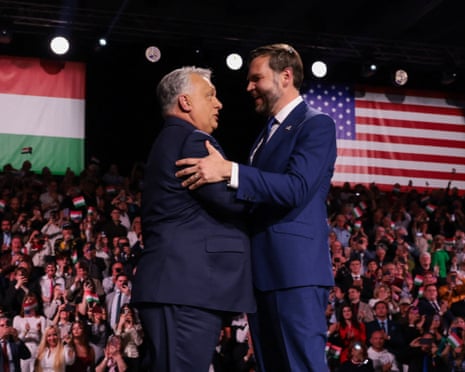
Appearing on Fox News, he said he was “said that [Orbán] lost,” but insisted the intervention “was not about Russia, and fundamentally, it was not about Europe,” merely a sign of thanks from the US administration for defending its interests against the EU bureaucracy.
“He’s one of the few European leaders we’ve seen who’s been willing to stand up to the bureaucracy in Brussels that has been very, very bad for the United States. So for example, when you see a European bureaucrat go after an American company, sometimes the only vote ‘no,’ the only vote to protect that American interest, has been Viktor Orbán.”
Vance added that the White House “certainly knew there was a very good chance that Viktor would lose that election,” but he wanted to “stand behind a person who had stood by us for a very long time.”
He also insisted that Orbán “is a great guy who’s done a very good job,” before adding:
“I think that his legacy in Hungary is transformational, 16 years, fundamentally changing that country.”
Well, hard to disagree with that.
But in a sign that will be reassuring to the incoming Magyar administration, however, he declared that “we will work very well, I am sure, with the new prime minister of Hungary.”
I will bring you more reactions and news from across Europe during the day.
It’s Tuesday, 14 April 2026, it’s Jakub Krupa here, and this is Europe Live.
Good morning.
Key events Show key events only Please turn on JavaScript to use this feature
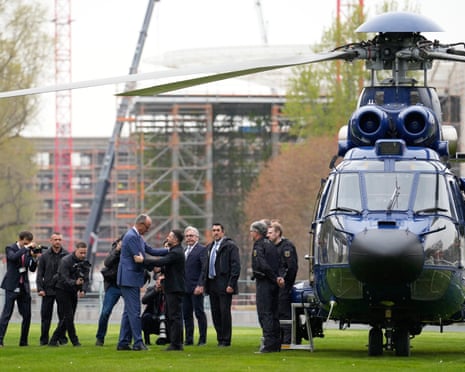
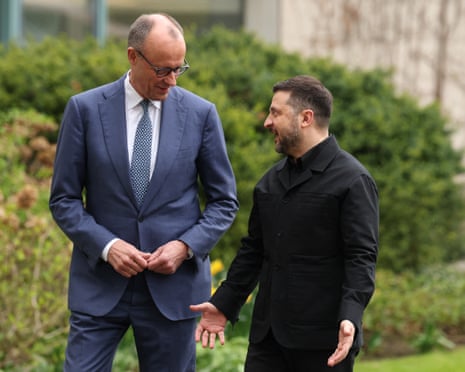
Zelenskyy arrives in Berlin for talks with Merz
As mentioned earlier, Zelenskyy is in Berlin today for talks with Merz (and between their two governments).
He has just landed in central Berlin in the last half hour, and we should hear from both of them later today.
New Hungarian government can 'do a lot' to restore rule of law, leading MEP says

Jennifer Rankin
in Brussels
The European parliament’s lead MEP on Hungary has expressed hope that Péter Magyar’s incoming government can “do a lot” to restore the rule of law thanks to its sweeping parliamentary majority.
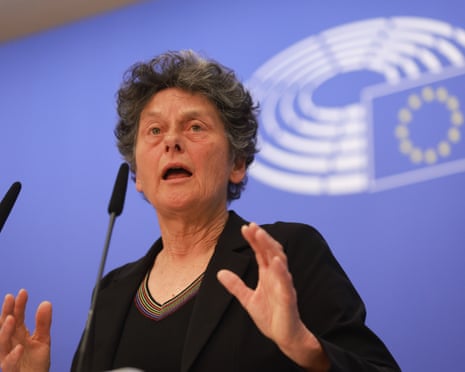
Tineke Strik, a Dutch Green MEP, who is the European parliament’s lead coordinator on Hungary and the rule of law, said “that even a deeply cemented electoral autocracy as [Viktor] Orbán has created can be overturned so overwhelmingly” was “bad news for autocrats” in general.
The incoming Hungarian government, she said, had to deal with EU institutions over two sets of rule-of-law issues:
-
unlocking €17bn EU funds frozen over concerns about corruption and breaches of EU law;
-
the ongoing rule-of-law sanctions procedure (article 7) launched by the European Parliament in 2018.
The Dutch MEP is responsible for overseeing the article 7 process, long becalmed because EU member states could not find a majority to sanction Hungary.
Speaking to journalists, on her return from Budapest, she said:
“Magyar has promised to restore the rule of law, to respect the primacy of EU law and to combat corruption. And these are vital promises. And the big mandate that the voters have given to him also enable him to fulfil his promises. But it’s a complex operation which requires time and close cooperation with the EU.
In the light of the two-thirds majority we are hopeful that they are able to do a lot on the restoration [of the rule of law].”
Unlike Poland where a nationalist president stymied a new reformist government’s attempts to reform the courts, Hungary should face fewer obstacles, she said.
She also suggested EU authorities needed to show flexibility on deadlines – Hungary risks losing €10.4bn in long-frozen Covid recovery funds, unless there is an agreement by the end of August 2026.
On 16 June, the Hungarian government is due to face a long-scheduled hearing under the long-running article 7 procedure, to discuss what steps it is taking to address concerns about captured courts and systemic corruption. Previous governments have used these occasions to mount aggressive denials.
In contrast, Strik said the 16 June hearing would be the “perfect occasion for a discussion in the [EU] Council where Magyar can present complete proposals with complete timelines”.
Magyar would be represented by his EU affairs minister at the 16 June hearing, which falls a few days before what is likely to be his first EU summit on 18-19 June.
‘Now I’m hopeful’: Hungarians welcome change after 16 years of Orbán rule
Ashifa Kassam and Flora Garamvolgyi
in Budapest
In a small plaza facing Budapest’s Nyugati train station, Gabor, 40, confessed that he was very, very hungover after the election night.
“I partied all night,” he said, laughing. “It was crazy, I thought Fidesz was going to win. Now I’m really hopeful.”
It was a hint of the mix of excitement, disbelief and hope that has gripped much of Hungary. After 16 years of Viktor Orbán’s efforts to transform the country into a “petri dish for illiberalism”, Hungarians overwhelmingly cast their ballots to oust Orbán and his Fidesz party from power in Sunday’s election.
Instead, the record turnout translated into a landslide victory for the opposition Tisza party in a result that sent thousands of jubilant supporters pouring into the streets of Budapest on Sunday night.
Led by Péter Magyar, the centre-right party won 138 of the parliament’s 199 seats, giving it the power to amend the constitution and potentially dismantle many of the key pillars that had sustained Orbán’s “illiberal democracy”.
“I’m so happy. I can’t quite believe that it happened,” said Eva, 37. “This morning I was bracing for something to happen – like they would say they found some massive number of ballots that would change the results. Now I’m starting to believe that it could be real.”

The election result was due, in part, to the mobilisation of young people who voted against Orbán’s government. Many of them had come of age as the country plunged in press freedom rankings, faced accusations of no longer being a full democracy and became the most corrupt country in the EU.
As the results rolled in on Sunday, an impromptu party sprang up on the banks of the Danube, spilling across the city as strangers hugged and high-fived each other in metro stations and people chanted “We did it!” and “It’s over” against a backdrop of honking vehicles.
Zelenskyy to meet Merz in Berlin for talks on German-Ukrainian cooperation
Elsewhere, Ukrainian president Volodymyr Zelenskyy will meet with German chancellor Friedrich Merz in Berlin today, as part of intergovernmental consultations between the two countries.
AFP noted that Germany has become Ukraine’s biggest backer in its four-year war against Russia’s invasion as the United States under President Donald Trump has cut back on support, and Kyiv is keen to keep Berlin on side.
The two administrations are also expected to discuss joint defence ventures, including their work on drones.
Several ministers are expected to part in the meeting, including foreign minister Andrii Sybiha, energy minister Denys Shmyhal, and economy minister Oleksii Soboley.
Morning opening: JD Vance 'sad that Orbán lost,' but will work with new Magyar government
Jakub Krupa
Hungarian election winner Péter Magyar has been invited to meet with the Hungarian president, Tamás Sulyok, on Wednesday to discuss the government-formation process following the stunning win over Viktor Orbán in Sunday’s election.
The meeting could be a bit awkward, given Magyar’s repeated calls for Sulyok, an Orbán loyalist, to resign from the office.
“He was appointed to sign everything; every document that he is presented with – whether it’s the menu or the constitution or the laws – so we don’t need people like that. To me, he is not the president,” he said yesterday.
Erm, nice weather, Mr President, huh?
Speaking of presidents, we finally heard from the US vice-president JD Vance overnight as he defended his decision to travel to Budapest last week to interfere with the Hungarian election support Orbán in the final days of the campaign.
Appearing on Fox News, he said he was “said that [Orbán] lost,” but insisted the intervention “was not about Russia, and fundamentally, it was not about Europe,” merely a sign of thanks from the US administration for defending its interests against the EU bureaucracy.
“He’s one of the few European leaders we’ve seen who’s been willing to stand up to the bureaucracy in Brussels that has been very, very bad for the United States. So for example, when you see a European bureaucrat go after an American company, sometimes the only vote ‘no,’ the only vote to protect that American interest, has been Viktor Orbán.”
Vance added that the White House “certainly knew there was a very good chance that Viktor would lose that election,” but he wanted to “stand behind a person who had stood by us for a very long time.”
He also insisted that Orbán “is a great guy who’s done a very good job,” before adding:
“I think that his legacy in Hungary is transformational, 16 years, fundamentally changing that country.”
Well, hard to disagree with that.
But in a sign that will be reassuring to the incoming Magyar administration, however, he declared that “we will work very well, I am sure, with the new prime minister of Hungary.”
I will bring you more reactions and news from across Europe during the day.
It’s Tuesday, 14 April 2026, it’s Jakub Krupa here, and this is Europe Live.
Good morning.