.png) 2 hours ago
5
2 hours ago
5
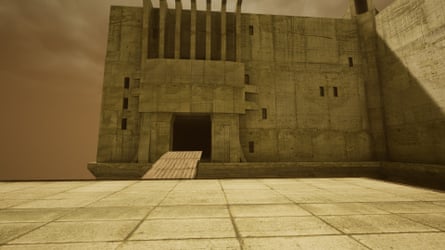
At first, Vholume seems like a quick rush through some smartly selected references. Has this breathless yet austere parkour game been designed or ingeniously curated? The urban gymnast moveset comes from Mirror’s Edge. Level names use terms like conapt, first coined by Philip K Dick. And the environments themselves are dystopian and surreal, Half-Life 2’s City 17 colliding with the blasted avenues and mute archways of de Chirico. Many games have influences. Vholume has actual taste.
All the surface stuff fades away when the game is in motion, however. Vholume’s an on-foot racing game in which you hoof it through spectacularly odd environments, moving from one beam of concrete to the next. You’re clipping your wall-runs and power-slides together to bridge seemingly impossible gaps between buildings, forever in search of the next stretch of track, the next turn, the next jump that gets you to the level’s exit and the worldwide leaderboards. And once that’s done, you have a choice: onwards to another gauntlet, or back to the start of this one again to slice a few microseconds off your score? Or maybe you’d rather head over to multiplayer to race against the ghosts of others?
This quickly becomes utterly compelling, and at the heart of it all is the realisation that Vholume is surprisingly accommodating to players of all abilities. Powered mainly by trigger squeezes that allow you to hop or duck, the game truly wants your wall-kicks and mantling to connect neatly and leave you feeling lithe and speedy. It’s also happy to let you find height-gaining exploits and kludge a save from falls that really should have killed you. This is ultimately confidence rather than indulgence. It’s the confidence of a game that knows it can let weaker players muddle through because, up in the thin, high-altitude air at the very top of the leaderboard, real beauty is unfolding.
As you progress further into the game, simple full-ahead courses are interleaved with more complex levels that feel like puzzles, but in truth every level is a range of different potential routes depending on how quickly you’re travelling, how eager your reflexes are, and how far your fingers on the pad can get ahead of your own interrupting thoughts. If you’ve ever done the Couch to 5K, you’ll understand Vholume’s slightly cosmic suggestion that time is equivalent to distance when you’re wearing running shoes; the game’s endlessly eager to open up the number of paths forward at any moment depending on how fast you’re going. Welcome to the garden of forking PBs.
As is often the case, I’m not sure Vholume always gets better as it gets busier, however. Jump pads, maze-like special levels and parts of the environment that move by themselves all start to play a role in the game as you progress. But while the intricate later levels are fascinating, the balance between the fun the designer is having and the fun the player is having is more even in its early stages, which are a twitchy headlong thrill.
That’s what’s so perverse about this game. One of Vholume’s creators made their name with Babbdi and Straftat, two games that look like a product of the demoscene but actually zero in on deeply satisfying mechanics delivered with care. Vholume’s world is horrible, then, but your path through it is paved with joy and exhilaration. It understands that the only thing better than a game that wants to make you think is a game that wants to make sure you never think, even for a millisecond – because if the thinking brain gets itself involved, the whole beautiful thing will fall apart.