.png) 2 hours ago
4
2 hours ago
4
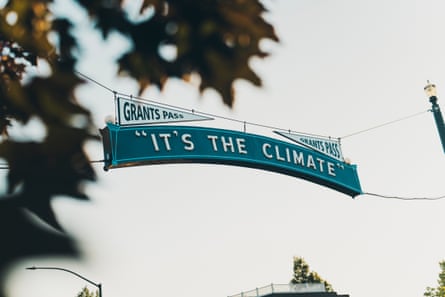
Driving into the county, you can’t miss the sign.
“IT’S THE CLIMATE”.
The letters are so big they form an arch over 6th Street in Grants Pass.
Locals tell me it’s a flex – or was before the irony set in. This evergreen corner of Oregon, near the California border, is a beautiful tangle of mountains and forest carved out by the Rogue and Illinois rivers. Once upon a time, the climate was the draw. Cool and wet in the winters, sunny but not too hot in the summers. The forests protected you from unbearable heat beyond the ridge.
Now, you don’t hear the term summer much.
Just “smoke season”.
May-ish to October-ish.
Across the US and Europe this summer, people have choked beneath red skies and endured extraordinarily unhealthy air – scenes that would be grimly familiar to anyone in the American west.
Josephine county is the deadliest place for wildfire smoke in the US, according to a 2025 study published in Nature magazine. It ties with Trinity county, California, as having the highest rate of wildfire smoke deaths linked to climate breakdown between 2006 and 2020, the years the researchers analyzed, with an estimated 17 premature deaths per 100,000 people.
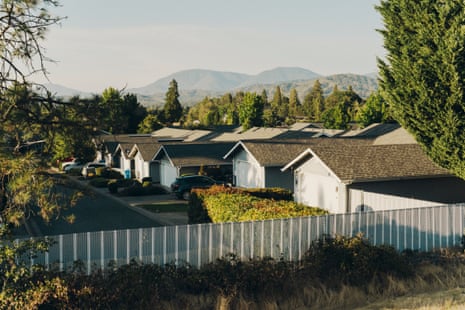
Everyone here has a story about how bad it can get.
They describe ash falling from the sky and coating their cars like snow. “You can taste it!” says Cynthia Hewitt, a retiree and restaurant owner. When the smoke is particularly thick, she wets towels and wedges them around her doorframes to try to prevent the haze from coming into her living room. “It gets on the furniture and everything,” she says.
Everything includes wine. If you taste certain bottles from bad smoke years, I’m told, that campfire tang clings to the grapes.
Randi Maldonado, a beautician I met in a hair salon with two workers and three air purifiers, tries to calm her toddler’s lungs by sitting in the bathroom with the door closed and hot water roaring from the bathtub faucet. “Like a humidifier,” she says. It helps her child breathe.
Her mother, Kim Williams, the other salon worker, tells me that her client’s husband died not long after leaving the windows open overnight during a wildfire smoke inundation.
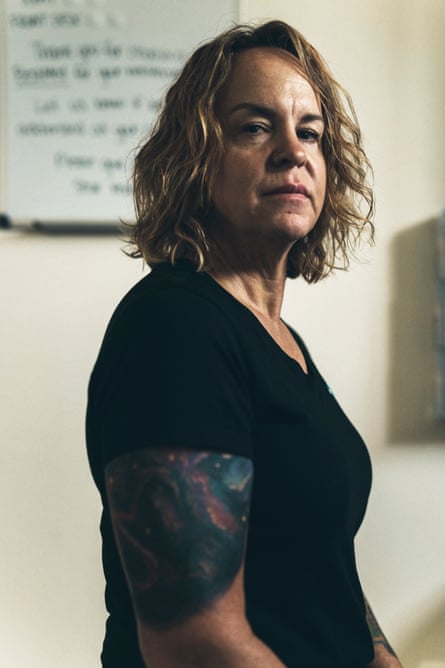
A local nurse, Joann Reed, says the smoke has gotten so bad in recent years that even hospitals can’t keep it out. She recalls a summer, a few years ago now, when a hospital where she was working tasked employees with standing near exits, in part to shut doors as fast as possible. “You could see a smoke cloud, just a haze, as you walked up and down the hallways,” she tells me. “There’s no filtration system strong enough to get rid of that much constant smoke.”
Some wear masks. Others wish they were brave enough to wear masks but they get tired of the stares from people who still see masks as code for “woke America”. (Josephine county is far more conservative than Oregon’s familiar “Portlandia” tropes. More than one person suggests to me that the way to solve the wildfire problem is to log or even clearcut the forest so there’s less of it to burn.)
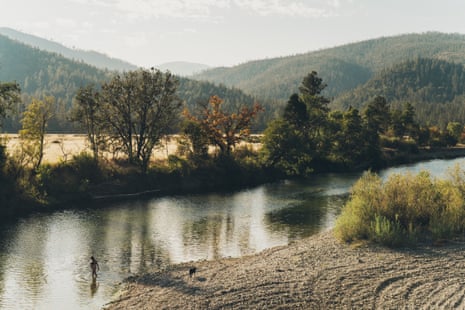
It is true that the area’s forests are thick, and its valleys are deep, trapping smoke in place for weeks or sometimes months at a time. “Socked in” is a phrase you hear a lot – as in, we’re just socked in with smoke.
“We stay kind of like a convection oven,” says Susan Albright, a family nurse practitioner who works at an urgent care in Grants Pass. “Everything just kind of stews.”
Throw in an aging population and high rates of poverty and you have a county that’s being ravaged not by one particularly bad fire but by years of insidious haze.
I tell Joy Shinerock, who owns a woodworking art gallery along Redwood Highway, about the statistics – the high death rate, the worst in the nation.
“Jeez,” she says.
She pauses, and I imagine she’s thinking about her late husband, Harvey.
“I can see why.”
Here’s the thing: Despite the hazy red skies and smoky, 1970s-casino tinge of the air, Josephine county is an extremely lovable place – and it is loved fiercely by people like Joy.
It’s kind of like the wood in Joy’s art gallery, which is called It’s a Burl. A burl – and I didn’t know this – is the knotty growth on the trunk or branch of a tree, sometimes caused by stress or disease. It’s a tumorous blob that can grow to the size of a car. Joy had just given birth to their youngest child, Sara (“It’s a girl!”), when her late husband named the place. Sara is a mother to two now, and the gallery’s manager.
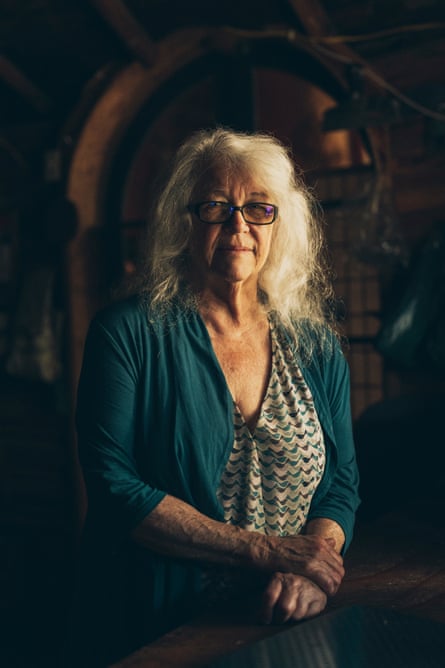
I find Joy this afternoon in the back corner of her art gallery, an air purifier buzzes at her feet. She is wearing purple headphones and watching Korean soap operas while doing Sudoku and talking to me. She’s more gen Z-coded than most 78-year-olds.
Behind her is a watercolor portrait of Harvey, her late husband. In it, he’s wearing overalls, his signature look, and peering over glasses. Harvey was a woodworker and started the gallery with Joy. He died during the summer of 2013 after the smoke rolled into the valley and his illness worsened.
Their love is still palpable.
“I couldn’t believe him. I just couldn’t believe him,” Joy says, still awestruck. “He was so easy. It seemed like I’d always sort of just struggled in relationships with people who were not really there.
“He was just so grounded.”
They fell in love over art and moved to Oregon from California in 1987. Wildfires had been flaring up more often in California, she says, and she wanted to get away from those. Oregon felt cooler and wetter – and therefore safer.
There were cruel twists of fate on the way, though. In 1995, the gallery burned down in a chimney fire. The family was safe, but nearly all of their art was lost. With the help of neighbors, they rebuilt another gallery, home and woodshop. But the shop burned down a decade later – another accident – and then, while the family was trying to clean up brush to prevent another fire, the replacement shop didn’t burn down so much as melted in a third fire, Joy says.
The experience had a way of bringing them closer to the community. The rebuilt gallery has stood for decades now, with countless burls carved into wizard faces watching visitors from the walls.
When she’s at the gallery, Joy feels like Harvey is still here with her, too. “It’s his soul,” she says. His soul lives here among all this knotted wood.
“People always tell me it’s magical,” she says.

It’s not the flames that kill. It’s the smoke.
The Camp Fire in Paradise, California, killed 85 people. The Maui fire killed 102.
With far less attention, wildfire smoke contributed to an estimated 164,000 premature deaths in the US between 2006 and 2020, according to the same 2025 study in Nature.
That’s an average of nearly 11,000 deaths per year.
By 2050, if industry keeps warming the planet with such reckless abandon, that number is estimated to jump to 70,000 Americans killed by wildfire smoke per year.
Lately, more attention is being paid to the ways smoke sickens wildland firefighters. The Trump administration last year reversed a longstanding ban on members of the US Forest Service wearing masks on wildfire assignments. Masks are now being passed out to firefighters.
In Josephine county, fires are coming straight to the people. They live inside plumes of smoke much of the time. And it’s getting worse as the climate crisis worsens.
Between 2016 and 2025, Grants Pass saw 94 days with air that was unhealthy for sensitive groups or worse because of wildfire, according to data from the Oregon department of environmental quality. Compare that with only 16 days in the decade before, the data shows.
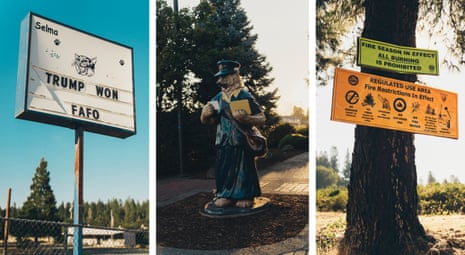
Wildfire smoke burrows deep into the lungs, causing inflammation and in some cases choking off the ability to breathe. That makes people with COPD, asthma, allergies and congestive heart failure especially vulnerable. Local people say it can feel like someone is standing on your chest.
Josephine county’s residents are doing their best. Officials drive through the more remote parts of the area – near Cave Junction, out by Joy – making megaphone announcements about evacuations, says Laura Mancuso, who started a local non-profit, Illinois Valley Wellness Resources, that distributes home air purifiers. Neighbors who don’t have solid mobile phone coverage, she says, have even banded together on a Citizens Band radio network to alert each other to fire danger.
Chris Granville, 73, carries a handwritten note in her purse during wildfire season, warning people about her severe asthma and allergies that can cause her to temporarily stop breathing. “Allergy reaction,” the note says in purple ink. “Lose ability to talk. Have my own meds. Don’t call EMS. Allergic to their med. 20 minutes after I take meds, [I should] get voice back.”
She tells me the note is important because she doesn’t want anyone to worry about her, and she trusts that she can revive herself with medicine without the hassle of an ambulance. The worst part about having to stay inside during smoke season? Chris is unable to volunteer, she says. She drives other seniors to appointments and to get groceries – and she worries about them needing her.
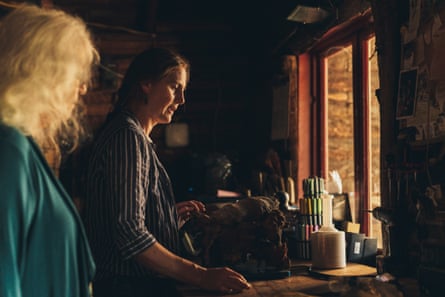
“I just want to show kindness,” she says. “I wish [the smoke] would go over the ocean where nobody is.”
The smoke snuck up on them that summer.
It was 2013, and Joy would look out the odd-shaped windows in their home and see Harvey asleep outside in a hammock while soup-thick smoke clung to the sides of the valley.
Then there was the night-time cough. The cough – and an intense fatigue – had started in the late spring, before the summer fires, she says, but it deepened and started to rattle.
Harvey went in and out of the hospital for tests, frustrated and sometimes leaving before he could get answers. By late summer, he entered the hospital for the final time.
Diagnosis: pneumonia, according to Joy and their daughter, Sara. Both believe the wildfire smoke contributed to and accelerated the illness. They could hear his breathing deteriorate.
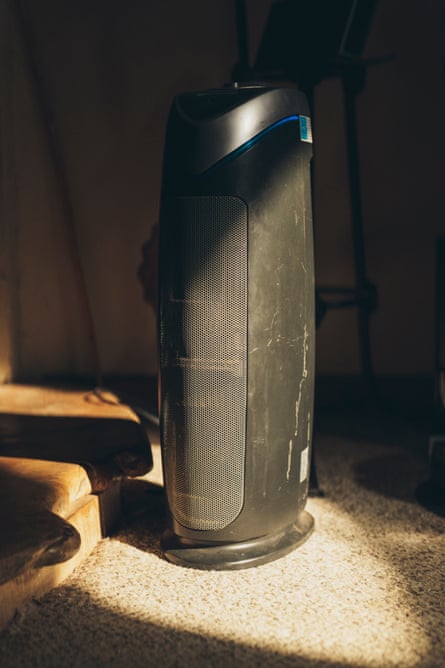
“That fire seemed to go on forever,” Joy says.
“It was apocalyptic,” says Sara.
He died on 7 August.
Doctors listed Harvey’s cause of death as sepsis, according to Sara. That may seem unrelated but wildfire smoke has been shown to weaken the immune system and increase risk of sepsis.
It’s difficult to link any individual death to wildfire smoke exposure. Studies show that long-term exposure to wildfire smoke is unhealthy, and deadly, and is analogous to smoking cigarettes. To die from wildfire smoke, quite often, is to be pushed there by illness combined with smoke.
Sara and Joy both believe Harvey died too soon because of the wildfires.
How do we still love our home when it’s dangerous? When there are cancerous knots in the wood?
Joy doesn’t talk about it much, but she has congenital heart failure and a heart arrhythmia. She knows the smoke is extra-risky for her, just as it was for Harvey.

She checks the weather. There’s still that wildfire one county over – called the East Evans Creek Fire. Her fire-watch app shows a patchwork of red and orange evacuation zones. It’s not visible from the gallery, but a cauliflower cloud of smoke has been blooming on the horizon.
The next afternoon, that smoke is still rising unseen in the distance. The evacuation zone grows. The sky remains blue above the gallery, though, and classic rock is on the radio.
A woman in high-waisted shorts and a crop top walks into the back. She’s on vacation for a friend’s 50th birthday and snuck away for the afternoon to make a trip to the Oregon coast.
“I just stumbled across this, and – I mean – every single inch of this entire space is just filled with creativity and magic and love,” the visitor tells Joy. “I’m just like, ‘Wow, this kind of place exists.’
“It’s a reminder that there is real magic still in the world.”
Joy smiles.
She agrees.
-
John D Sutter is an assistant professor of environmental media at the University of Oregon, as well as an independent climate journalist and film-maker. He lives in Eugene, Oregon