.png) 7 hours ago
6
7 hours ago
6
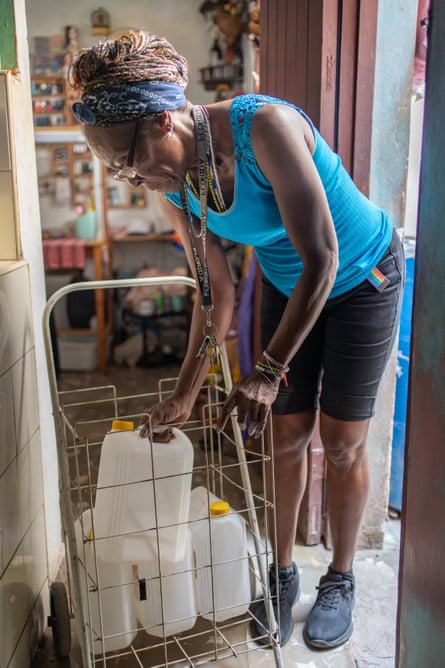
In the cramped kitchen of her flat in Havana’s Chinatown, Mirella Martínez pushes an old metal trolley stacked with empty jerrycans. Wiping the sweat from her forehead, she fans herself gently. “It’s so hot!” she says, as the electric fans remain still due to another power outage that has left her flat sweltering in near darkness for hours.
-
Mirella Martínez’s flat in Havana has been without running water for nearly three years
In a few minutes, the 61-year-old former security guard will walk about half a mile to her daughter’s workplace, one of the few buildings nearby where water still flows regularly. For almost three years, the flat she shares with her three daughters and grandson has had no reliable running water.
In Cuba, power cuts do more than leave people in the dark: they also leave taps dry. As the country’s energy crisis deepens, electricity shortages prevent many pumping stations from operating, while an ageing distribution network and chronic fuel shortages leave millions struggling to access water.
The country’s energy crisis, already severe, worsened further earlier this year after the capture of the Venezuelan president, Nicolás Maduro, by US forces. The suspension of oil exports from Venezuela, Cuba’s main fuel supplier, deepened fuel shortages already exacerbated by the US embargo and economic sanctions.
-
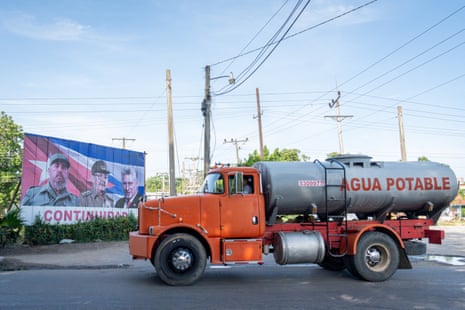
A drinking water truck drives through Cotorro in Havana
According to Cuba’s National Institute of Hydraulic Resources, nearly 3 million Cubans are experiencing difficulties accessing water. The country’s water system is operating with just 37% of the fuel it requires, while up to 70% of Havana’s water is lost through leaks before it can reach households.
Wealthier families can afford private water trucks. Everyone else waits for deliveries, hauls water home themselves or pays informal water carriers to do it.
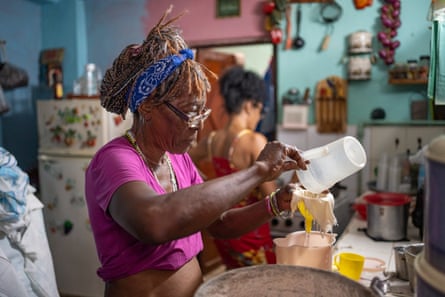
Martínez boils and filters part of the water for drinking. The rest is rationed for cooking, washing and laundry.
-
Martínez filters water for drinking after boiling it. ‘Everything is rationed,’ she says
“This water is used for everything. We count every litre. I make this journey three times a day even though I’m retired. At my age, I shouldn’t be carrying these jerrycans, but I have no choice,” she says. “I often wonder how elderly people who live alone manage.”
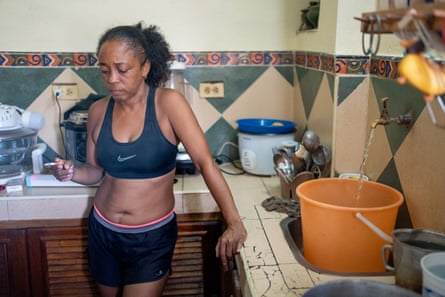
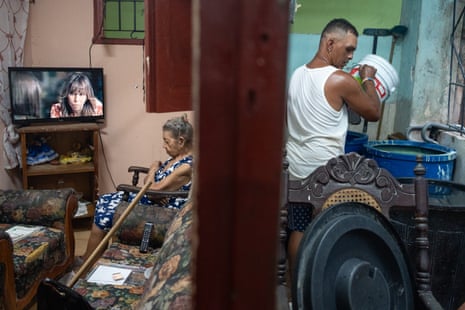
In Centro Habana, Dhayamis Hernández Díaz watches a thin stream of water slowly fill a plastic bucket. Cigarette in hand, she waits until it is full before emptying it into the rooftop tank serving her building. Nobody knows how long the water will keep flowing.
-
Dhayamis Hernández Díaz fills a bucket in her flat in Centro Habana to refill the tank on the roof
“I’m exhausted. As soon as the electricity comes back – sometimes in the middle of the night – we get up to fill the tank, cook and charge our phones. Our whole lives depend on those few hours of electricity. This isn’t living.”
Along with her sister, she earns a modest income operating an electric three-wheeled taxi. Hiring a private water truck is far beyond what they can afford.
“So we fill the tank ourselves, bucket after bucket. At night, I barely sleep because of the heat. We just wait for the electricity to come back.”
In Havana, life is organised around the few hours when electricity returns and water begins to flow. Water no longer arrives with the turn of a tap. It must be fetched, carried home and carefully rationed. As the public water system continues to fail, an informal water economy has emerged across the capital.
-
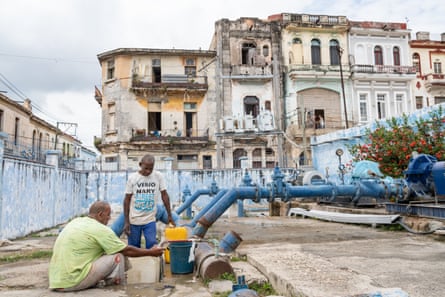
At the Escobar pumping station in Centro Habana, Juan de la Cruz Villalón, 66, and Juan Carlos Reyes, 55, fill containers with water to sell
Early each morning, Juan Miguel Reyes waits outside a state bakery with his ration book. After more than half an hour in the queue, he leaves with a few bread rolls to share with his brother and uncle.
“Last night, the water came back for about two hours. We got up immediately to fill every bucket before going back to sleep. Sometimes, that saves us a trip to the pumping station.”
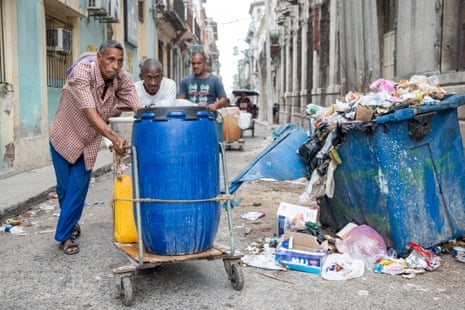
By midday, the three men push a heavy cart through Los Sitios, a working-class neighbourhood of Havana. Its wheels rattle over broken pavements as they weave around piles of uncollected rubbish. After walking over a mile, they reach one of the few pumping stations still operating before hauling water to people whose taps have long run dry.
-
Juan Miguel Reyes, 58, Juan de la Cruz Villalón and Juan Carlos Reyes push their water tank through the rubbish-strewn streets of Havana
For 23 years, Reyes worked as an intensive care physician. “I never imagined I’d end up selling water. Now we spend hours walking under the blazing sun before carrying buckets up staircases,” he says. “It’s exhausting, but at least we always have something to eat.”
Each 200-litre tank sells for 1,500 pesos (about £1.75 at the informal exchange rate). Reyes earns between 3,000 and 4,000 pesos a day.
“Demand keeps growing. Every week we have to fetch water from further away, and we never know whether the pumping station will still be working tomorrow,” he says. “People often thank us because many are too old to collect water themselves. Here, without neighbours, nobody would make it.”
-
Carlos Sánchez tops up the water tank in a flat in Centro Habana
A few miles away, near Havana’s ferry terminal, Carlos Sánchez collects water spilling from a broken pipeline. Bucket by bucket, he fills a 200-litre tank mounted on his bicycle.
“The whole network is falling apart. All this water is being wasted while so many people need it. I collect it and sell it to people who don’t have the strength or the time to come here themselves.”
Once the tank is full, he covers it with a tarpaulin and pushes his bicycle into Havana’s historic centre. Helped by his nephew, he carries buckets up the staircases of a crumbling building.
“My back is starting to give out, but I have no choice. I earn more transporting water than I did working as a funeral technician,” he says. “My children have left the country. I stayed behind.”
-
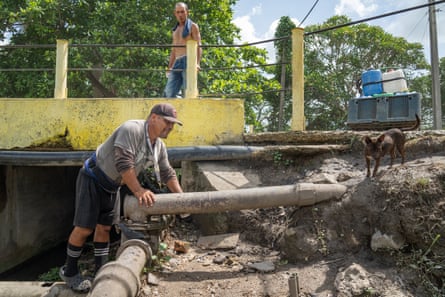
In Cotorro, Havana, a man tries to repair a damaged water pipe to restore the supply
By evening, Martínez is home again. The jerrycans line the walls of her living room. She carefully stores the day’s water, setting aside enough for drinking, cooking and washing over the days ahead. The television remains off. Without electricity, the family’s nightly telenovelas have become a rarity.
“We never know when the power will come back. Water and electricity should be basic rights, but here they’ve become luxuries. I no longer go out after dark, and I don’t let my daughters go out either,” she says. “When the streets go dark, everything becomes more dangerous. I just hope that one day we’ll have a normal life again.”
-
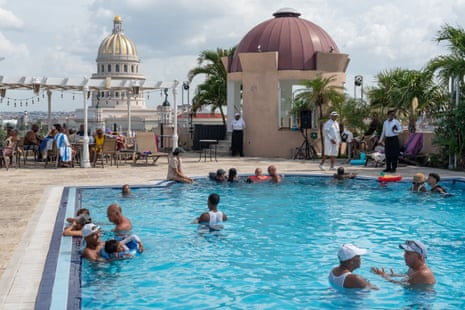
Guests enjoy the pool at a luxury hotel in Havana’s historic centre. Hotels and wealthy households often have water storage tanks, generators or solar panels