.png) 3 hours ago
3
3 hours ago
3
A cellist, a horn player and a soprano saxophonist walk into the Royal Albert Hall … it could be the setup for an exceptionally nerdy joke, but instead it’s a new triple concerto, with three soloists rather than the usual one, to be premiered on the final weekend of the Proms. The concerto – by Gwilym Simcock, the Mercury-shortlisted composer, jazz pianist and horn player who in 2006 was the BBC’s first New Generation jazz artist – reunites the three finalists from the 2016 BBC young musician of the year competition, hence the unusual lineup. “This is a unique combination of instruments,” says the saxophonist Jess Gillam. “I’m fascinated by the colours that we’re going to find. I hope we’ll be able to make a sound where people will think: what instrument is that?”
BBC young musician has launched many careers, but 2016 was exceptional: all three finalists have become major names. “It’s not like you win the competition and all these things fall from the sky, but it does give you a bit of public exposure,” says the horn player Ben Goldscheider, the 2016 brass section winner. “Then it’s up to you and the people around you what you make of that.”
Talking to a friend in the music business a few years later, Goldscheider realised that it wasn’t only the finalists who had found the competition special that year. So he wrote to Gillam and to the cellist Sheku Kanneh-Mason, the overall winner in 2016: “I said we should do something to celebrate, 10 years on, maybe a chamber music tour.” That turned into a full-scale BBC co-commission and a Proms premiere, with performances scheduled in Birmingham, Antwerp and Sofia – and now here they are at the Royal Albert Hall, animatedly comparing notes on what Simcock has written for them.
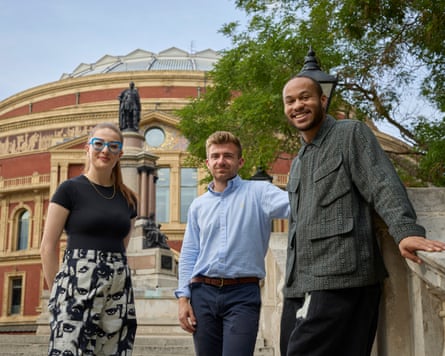
“It’s a very celebratory piece,” says Goldscheider. “It begins with this incredible, uplifting fanfare. There are a lot of jazz harmony influences. The second movement is extremely lyrical” – it is dedicated to Simcock’s father, who died while Simcock was writing the concerto – “and then the third movement is a ‘traditional’ finale, full of fireworks. There’s a nice big cadenza section where the three of us play together for ages.”
Simcock will be at the piano, in among the BBC Symphony Orchestra. He has also included a solo improvisation for himself. Do the soloists have to improvise? No, says Gillam, but “there are these moments of jazz-influenced solos in a kind of trad sense, especially in the saxophone part”. More widely, she says: “We’re going to have to groove! I think, together with the orchestra, we’re going to have so many conversations about where the beat actually is, because I imagine how we feel the beat is going to be very different to if we were playing anything typically classical.”
There aren’t many triple concertos in the repertoire; the only one that springs to mind is Beethoven’s. It isn’t often regarded as one of his greatest works. Is that fair? “I strongly disagree – I love it!” says Kanneh-Mason, who recorded it two years ago with two alumni of the 2004 BBC young musician competition, the violinist Nicola Benedetti and the pianist Benjamin Grosvenor. “It’s usually put together with three characters who come together just for that project, so the complexity comes from three people plus the conductor plus the orchestra agreeing on something. But that doesn’t mean that the music itself doesn’t work.”
Having three soloists who know each other – and have chemistry – is a different proposition, as is the triple-soloist format. “There are so many options for different kinds of conversations,” says Kanneh-Mason, referring to how the soloists can interact with each other or with individual orchestral musicians. Gillam adds: “It’s going to be a really interesting challenge: my articulation versus your articulation, a bow versus a reed. How are we going to find the sound that’s in the middle? I think I’m going to learn a lot about how to play the saxophone better. Not just by being inspired hearing you two, but by thinking about the way that the instruments operate.”
Apart from this concerto, all three soloists are expanding the repertoire in their own directions. In October, Kanneh-Mason will give the UK premiere of the cello concerto written for him by Edmund Finnis. Goldscheider – who has already commissioned more than 70 horn pieces – has a site-specific project at the Hayward Gallery’s Anish Kapoor exhibition, plus four concertos in the pipeline from composers including Anna Clyne and Cheryl Frances-Hoad.
As for Gillam, she will be back at the Albert Hall next year for a headline show, premiering five commissions. “When I was a very little girl, I dreamed of playing here. And still, every time I walk into the building, I think there’s something it does so beautifully: it gives you the sense that everyone can feel at ease, but also a sense of occasion. The Proms is an amazing example of that.”