.png) 5 hours ago
13
5 hours ago
13
There have been 600 books written about Marilyn Monroe since she died in 1962. So we are told by Monroe (Pixie Lott) herself in Sharleen Cooper Cohen’s play. The star’s body was discovered by her housekeeper, and her death at the age of 36 has spawned as many conspiracy theories as Elvis Presley’s. Was it an overdose, or a contract killing by the Kennedy family because she had kompromat on them? Did the mafia have something to do with it? Was an enema administered on the night she died? These are some of the questions that have been asked by Monroe obsessives.
You imagine this drama is setting itself up for something beyond the slew of familiar theories. But there is little to gain from this trot through Monroe’s life, narrated in cliches.
Lott has the signature blond hair, red lipstick and white pedal-pushers (she almost but not quite resembles the Marilyn of The Seven Year Itch scenes in a halter-neck dress). Monroe tells us that her husbands only ever saw the famed icon rather than the woman beneath. Ironically, this is what she remains here, due to a thuddingly on-the-nose script that spells out Monroe’s woes and pathologies. There are brief glimpses into her marriages with baseball player Joe DiMaggio (Henry Proffit) and playwright Arthur Miller (Ben Dilloway), and encounters with JFK (Mars Sams) and Bobby Kennedy (Paul Kane). There is no exploration of her first and potentially more illuminating marriage.
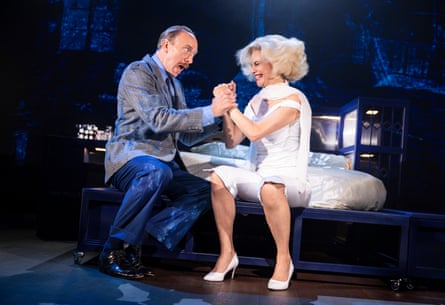
Under the direction of Philip Wm McKinley, Lott struts on to a stage with a bed at its centre – both her place of death and an overused motif for the life of a sex symbol. She keeps strutting on and off, striking Marilyn-esque poses, without giving any true sense of the woman beneath the iconic exterior. The other performances are also underwhelming, with the men in her life played with a wooden uniformity and no uncanny resemblances. A sex scene with JFK ends with his backache and appears like accidental farce. The whiff of drama school end-of-year show persists.
It pays little attention to Norma Jeane – the person she was before she created Marilyn. There are fleeting references to her family history of mental instability, her early life in an orphanage, her experience in a psychiatric unit. These are drive-by glances in a play that prefers to centre Monroe’s sex life, in the most hackneyed of ways.
Her unravelling at the end conveniently takes place with her psychiatrist (Ryan Ellsworth) in situ so she can expound on her pain and her breakthrough when she realises she has been trying to fill a “bottomless pit” within her. It is basic tortured-starlet psychology, which does little to develop the complexities of her inner world.
There is an answer to the titular question at the end but the bigger mystery of who Monroe was remains entirely untouched.
-
At Emerald theatre, London, until 29 October