.png) 3 months ago
99
3 months ago
99
Liam Rosenior looks up at the towering Strasbourg Kop. He shouts and pleads as he points to his players, demanding the fans applaud them. Met with hostility, boos and jeers in the stands, he cuts a lone figure, one at pains to sow unity at a divided club. Strasbourg had just won the game, beating Le Havre 1-0 earlier this season, but the club’s fans were in no mood to celebrate.
Behind an image are a thousand words, or three banners in this case. One called for the club president Marc Keller to leave Strasbourg; another criticised the bizarre Ishé Samuels-Smith back-and-forth transfer; and the one to which Rosenior took particular exception concerned his captain, Emmanuel Emegha. It read: “Emegha, pawn of BlueCo, after changing shirts, hand back your armband.” Emegha had agreed a deal to join Chelsea a few days earlier, once again confirming to Strasbourg fans that they were subservient to “big brother” Chelsea in the multi-club hierarchy.
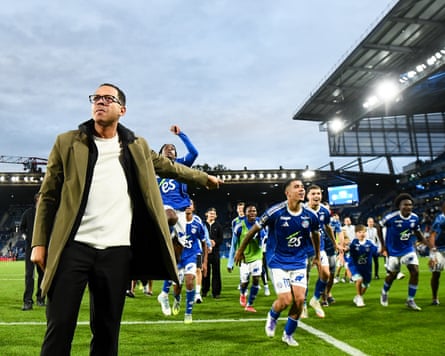
Rarely has Rosenior looked or sounded more emotional. “I’m devastated,” he said. “I’m so disappointed with the reaction – and it’s not all of the fans – who don’t give the respect that my players deserve.” He was not being an apologist for BlueCo, the company that owns Strasbourg and Chelsea. Nor was he demanding fans forsake their misgivings about the ownership’s intentions. He was simply pleading with supporters to back his young and exciting squad.
Rosenior described himself as “an emotional person” earlier this season. While he goes to great lengths to defend his players, his support is not unconditional. Emegha discovered that last month when he was on the receiving end of a one-game ban from his own club, the result of a set of statements in the media, including one where he revealed he initially thought Strasbourg was in Germany.
“Emegha made some clumsy comments that hurt a lot of people and he had to be punished for that. He also needs to realise that every action has consequences,” said Rosenior. The rest of the squad felt Rosenior’s wrath a fortnight later. “If there are players that don’t respect the instructions, no problem, we’ll find other ones that do respect them,” he said after Strasbourg’s draw with Lorient in mid-December.
Those comments came during a significant dip in form. Strasbourg were riding high in the Conference League, beating Crystal Palace and finishing top in the league phase, but just one win in their last seven games in Ligue 1 leaves them cut adrift in the race for European football next season. They have not won a league game since early November.
Balancing the demands of the Conference League and domestic football proved difficult for Enzo Maresca at Chelsea last season, and the same has been the case for Rosenior at Strasbourg this time around. Strasbourg had a settled XI last season as they went from relegation contenders to European qualifiers, and Rosenior spoke of “connections that were created”, but this season, he has had to find new ones – out of necessity – with varying degrees of success.
The Englishman has not been shy to try new things, notably trialling a two-man attack – albeit unsuccessfully – when the case for starting both Emegha and Joaquín Panichelli, Strasbourg’s top scorer, was too strong. But therein lies one of Rosenior’s biggest strengths: his flexibility. He has switched formations and systems, adjusted depending on the opposition and their strengths and weaknesses, played to the strengths of his own players, and not “pigeonholed” them to certain roles or positions in the team.
At a time when clubs are no longer hellbent on regurgitating a Pep Guardiola brand of football, an ability to adapt an out-of-possession approach and to shift between transitional, direct approaches and a more possession-based style is key. That said, Strasbourg were at their most effective when they sprang forward with rapid and vertical transitions, exploiting spaces. Facing more settled defences has been a bigger challenge. “Last season, we were a surprise. Now we are met with low blocks. I have to find the solution,” said Rosenior.
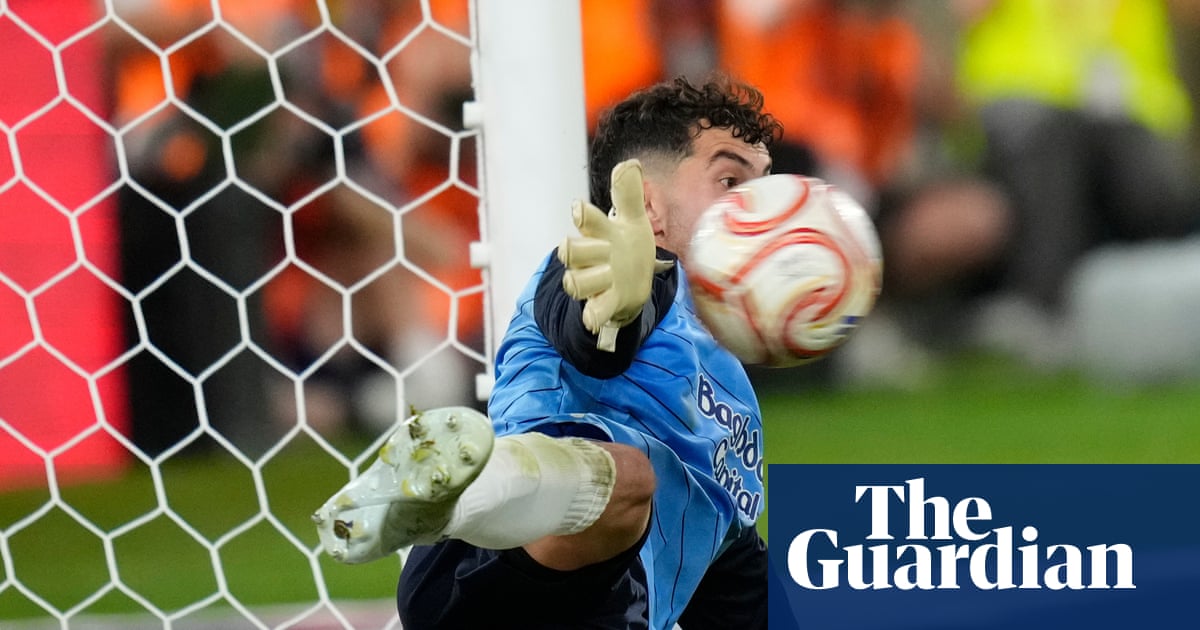
One of those solutions has been to use goalkeeper Mike Penders, on loan from Chelsea, almost as an extra defender in the back four. It was a risky decision but Rosenior has always been brave with his tactical choices, especially against the bigger sides. “I prefer to concede goals by trying something than by playing a low block and hoping not to concede – in England, that is called ‘a slow death’. I don’t believe in slow deaths,” said Rosenior after an entertaining 4-2 defeat against Paris Saint-Germain during the opening months of his debut season.
A defeat can be blamed on ambition but Rosenior will never hide behind the youthfulness of his side. On the opening weekend of this season, he fielded a starting XI of players born after the year 2000, a first in Europe’s top five leagues. The youngest side he has put out this season had an average age of just 20.8 years – the youngest in the history of Ligue 1.
“I’m sick of giving the excuse of youthfulness,” said Rosenior last month. With squads trending younger more generally, not just in France, he sees youth as a means to success rather than a barrier. Watching PSG – the second-youngest team in France – win everything has left its mark. His familiarity with young players also coalesces with the Chelsea strategy; the team they played against Bournemouth last week was the youngest fielded in the Premier League this season (23.4 years). That strategy was in place before Maresca’s arrival and he began to doubt its wisdom, citing a lack of experience after a draw against Newcastle last month.
Chelsea’s player recruitment has been mirrored in their managerial choice. And like a young player, Rosenior is malleable. His major formative experience, his springboard to the elite, has come within the confines of the BlueCo model, and so his philosophy has naturally been moulded by it. He won’t point out its flaws, as Maresca did.
But such criticism would not be befitting of his demeanour in any case. Beyond results on the pitch, he has also been the elder statesman of the club, successfully navigating the political maelstrom. He has not achieved a rapprochement between the fans and the owners, but he has always found the right words. If the supporters’ groups are calling for Keller’s head, it is in spite of Rosenior’s handling of the situation, not because of them.
There is still resistance to the BlueCo regime – which Rosenior in a way embodies – in Strasbourg, but the results he achieved turned many sceptical fans into believers. He must now do the same at Stamford Bridge.
This is an article by Get French Football News