.png) 5 hours ago
12
5 hours ago
12
Five British prime ministers ago – and six French ones – when Emmanuel Macron first confirmed that France would return the Bayeux tapestry to Britain after 1,000 years, he told an audience at Sandhurst and Theresa May – the No 10 seat-warmer of the day – that when it came to France and Britain there were “two things that nothing can change, be it a vote or a political decision: our history and our geography”.
It was January 2018, 18 months after the UK had voted to leave the EU, and relations between the near neighbours were not good. The French political establishment had been shocked and angered by Brexit; personal relations were frazzled, and cross-Channel government contacts measurably dwindling. This was not a rupture that a piece of embroidered medieval linen, however perfectly it represented that tangled history, was going to solve on its own.
It took only eight and a half years and many, many changes in personnel, but this week Macron finally made good on that pledge with the unveiling of the tapestry at the British Museum in London, in scenes of such amitié that one could almost forget the bilateral chill that had gone before.
No one pretends that the Bayeux tapestry alone has been responsible for stitching together two nations whose connections had visibly frayed. (When it comes to the tapestry, as every commentator this week has shown, the needlework metaphors are hard to resist.) But the French president’s single-minded commitment to drive through a loan that he has previously called “seemingly impossible” illustrates that, in diplomatic terms, the London exhibition is not just a decorative sideshow.
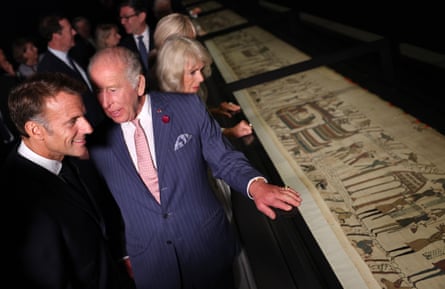
“It is much more than just a linen canvas embroidered with wool,” Macron told an audience at the museum on Wednesday. “It represents a whole chapter of French, British and European history.”
In that context, it was notable that he speculated that people “decades or even centuries from now” would look back not only on the tapestry itself but on “what we did here today” – the very fact of its loan to the British Museum – as being a significant marker in the long span of Franco-British relations. “Two countries which, after centuries of shared history, [chose] to forge a bond as close as the threads of this thousand-year-old embroidery,” he said.
The latest UK prime minister, Andy Burnham, agreed in language tailored to suit his own political project. As a “tremendous demonstration of goodwill”, he said, the loan “says so much about the friendship of our two nations … It shows the power of collaboration to lift people’s lives.”
The Bayeux tapestry, of course, was always a highly political artefact, even before it acquired its status as a foundational text for the English nation (1066, the date of the Battle of Hastings, is “the nation’s pincode”, the British Museum chair, George Osborne, noted drily on Wednesday).
Much remains unknown about the circumstances of its commission and creation, but a vast artwork showing a clash of kings and wholesale invasion of a nation is not a neutral object. “It was definitely designed with a political purpose in mind when it was first made,” says the historian Dr David Musgrove, who has written a book, The Story of the Bayeux Tapestry, with Prof Michael Lewis, the curator of the exhibition.
“That political purpose was essentially to legitimise the invasion of William the Conqueror, to explain why he did it, why he chose to send his fleet across the Channel,” argues Musgrove, who is the content director of HistoryExtra magazine and podcast. The “crux scene”, he argues, is not the famous bit where Harold takes an arrow to the eye, but an earlier portion that shows the then English earl Harold making an oath to support William’s future claim to the English throne.
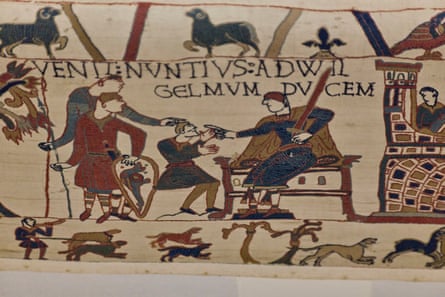
Harold reneges on this later when he has himself crowned king of England. “So he perjures himself and that gives William the reason to invade,” Musgrove says. “My take is that the tapestry is entirely predicated on making that justification. So it’s very modern in that sense; people trying to justify military action today is kind of the same thing. It’s a retrospective justification for what happened.”
Most historians believe it was made in Canterbury, but “just about everything around [the tapestry’s creation] is a little bit uncertain”, according to Leonie Hicks, a professor of medieval studies at Canterbury Christ Church University. She says historians’ “best assumption” – based on the internal evidence of the embroidery itself and other contemporary documents – “is that it was likely commissioned by Bishop Odo, who was William the Conqueror’s half-brother, bishop of Bayeux and also earl of Kent after the conquest. Or somebody very close to Odo.”
Odo and Willliam had fallen out, so an elaborate narrative wall covering at Odo’s Norman cathedral celebrating the new English king could be seen as an attempt to regain favour. But if the tapestry undoubtedly flatters William, it is not a piece of crude propaganda, argues Hicks, and the politics of its depiction are nuanced. “It’s not a straightforward piece of ‘Yay, aren’t the Normans great, they dumped the English and took the throne.’”
Among the most intriguing details, she notes, are the depictions in the margins of the human cost of war – all stitched, most likely, by English women who may have lost husbands and sons in the battle. “We have the scene where a house is being burnt and a woman is holding a child’s hand and leaving the house. [There are] very graphic depictions in the margins of decapitated soldiers, and bodies being looted. It does give that sense that war is horrific and terrible.”
It is context which, we can assume, was lost during the tapestry’s long afterlife. History records nothing about it until it turns up in an inventory of the Bayeux Cathedral treasury in 1476. The tapestry, it noted, was hung around the cathedral for a few days each year. During the French Revolution it was narrowly rescued from being used as a wagon cover.
It would not be long, however, before the tapestry’s political usefulness would again be recognised. Napoleon, planning an English invasion of his own in 1803, displayed it in Paris where “it was quite a sensation”, says Musgrove. “I think Napoleon probably thought it was useful to have an artefact which showed a previous cross-Channel invasion by forces from France into Britain.” When the invasion plans foundered, the tapestry was quietly returned to Bayeux.
The Nazis were “obsessed” with the tapestry – “they basically saw it as part of their worldview of Aryan Teutonic supremacy”, says Musgrove – and in the days before the liberation of Paris planned to whisk it away to Germany. They were, however, frustrated by the French resistance, who had been alerted by codebreakers at Bletchley Park.
Eight quiet decades followed before the renovation of the museum where it is housed in Bayeux prompted its removal from display. But if that immediate circumstance opened the possibility of the artwork being loaned to Britain, there was certainly no inevitability that this would happen.
Britain first made a request almost a century ago, in 1931. A request to borrow the artwork in 1953 to mark Elizabeth II’s coronation was initially agreed by France, before it reversed the decision over conservation concerns. Another attempt in 1966, to commemorate 900 years since the battle, foundered in the face of local and national French opposition. Another bid in the 1980s came to nothing.
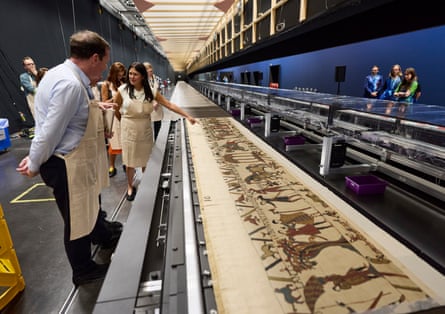
Macron could easily have come to the same judgment, not least because there was plenty of opposition in France to the loan, including from artists and conservation experts. Why, then, such commitment to making happen a loan which, he only half joked last year, had been more complicated to negotiate than the Brexit withdrawal agreements?
To Helen Drake, a professor of French and European studies at Loughborough University London, making the loan happen fits with Macron’s view of himself as a cultured international statesman – but also with the value he attaches to repairing the Franco-British relationship in the face of mutually threatening global forces.
“Macron is a French president who has pulled the maximum levers that the constitution give him to operate on the international stage, and that will probably be his legacy. So from that perspective it would make sense to him to be seen to be behind the transfer of the tapestry.
“But he has also very much made it part of his mandate to be at the forefront of ameliorating France’s relations with the UK.” On Ukraine, defence and security, migration and Trump, British and French shared interests have become ever more pressing, she says. “The external environment, to put it bluntly, has pushed the two together.”
But for all the genuine bonhomie over a dazzling piece of history, Drake says, neither side has any illusions about the dynamic tension that has always characterised their love-hate relationship. “The fact is that France habitually plays hardball with the UK in its negotiations with the EU post-Brexit,” she says. “You can have all the warmth you like in the British Museum, [but] the Quai d’Orsay will still drive a hard bargain. The two co-exist and they’re not even contradictory – they’re just part of how we see the Franco-British relationship.”