.png) 2 months ago
61
2 months ago
61
In August 2021, Mike Dawber, the UK’s leading detective in cargo crime, got a call from officers in Bradford CID. They were planning to search two warehouses that contained, in their words, an awful lot of suspicious goods. This was a job that required Dawber’s expert eye. He drove an hour from his home, in the unmarked police car that doubles as his office, and arrived to discover the description barely did it justice.
As soon as he walked in to the first warehouse, he noticed 17 pallets of golfing equipment. They had, he knew, been stolen three weeks before from a truck at Lymm motorway services, just outside Manchester. He reckoned they were worth about £1m. As Dawber continued his survey, he came across 18 pallets of Asics trainers, stolen three years before, at Warwick services. Then 14 pallets of lawnmowers: five years before, from a truck on the A1 at Colsterworth. He came across IT equipment, sportswear, high-end fashion, electrical goods, toasters, microwaves, beauty products. One pallet was simply labelled “Eyelash technology”. Dawber didn’t know what eyelash technology was, exactly, but he later learned that a pallet of it was worth more than £500,000.
Dawber did not need to consult the records to know much of this; in many ways, he is the records. Ask him, say, about the time someone tried to make off with a truck of Cadbury Creme Eggs, and Dawber will instantly tell you the date (11 February 2023), the location (Telford), the true market value of the eggs (£250,000, far higher than reported), the location where the thief had travelled from (Leeds) and where he was arrested (the M42). When Nottinghamshire police stopped the driver of a Mercedes Sprinter van on false plates a couple of years ago, with an amount of Martel cognac in the back that didn’t suggest stocking up for Christmas (2,300 bottles, worth about £250,000), their first call was to Dawber. He immediately identified that the goods had been stolen several hours earlier in Daventry, 80 miles away. The driver was arrested. The goods were returned. You may have drunk the cognac.
Dawber is 49, sturdy, with a broad Lancashire accent. He is a field intelligence officer for the national vehicle crime intelligence service (Navcis), a kind of FBI for wheel-based theft, based in Coventry. His job is to connect the 43 police forces around England and Wales, sharing intelligence and accompanying detectives on warrants when that intelligence leads somewhere. Within the industry, people speak of Dawber with something approaching awe. “He has so much knowledge in his head,” says Sharon Naughton, his boss at Navcis. If he doesn’t answer when she calls, she starts to fret. “He’s the only person with the answers.”
Dawber is a busy man. These days, organised criminal gangs aren’t after bullion, but baby formula, kitchen fittings, perfume, PS5s. “When I first joined the police 20-odd years ago, people were still holding up jewellery shops, banks or post offices,” says Dawber. “Your switched-on villains don’t do that any more, because if you get caught doing that, you’ll get 15 years. So they’ve moved on to less risky crimes.” Since 2017, when Dawber joined Navcis, the number of cases that reach him have more than tripled, to about 5,000 each year. When I first spoke with him last spring, he was investigating a case of stolen plastic drinking cups worth about £70,000, and laptops worth £250,000. It was a typical day. Two years earlier, he said, an entire truck of sex toys went missing. He was still trying to locate them.
Cargo theft operates according to the law of supply and demand. When a truck carrying 400 50-litre kegs of Guinness – the equivalent of 35,000 pints – was stolen from a logistics hub in Northamptonshire in December 2024, it was widely seen as the cause of a nationwide shortage. This wasn’t quite true – the truck was targeted because there was a shortage in the first place – but it only made the scarcity worse, which in turn only made the stolen Guinness more valuable.
The cost of living crisis has made food and beverages an increasingly attractive target, with thefts rising as much as 79% in 2024 according to one report. In October of that year, 950 wheels of premium cheddar were stolen in London, an incident soon dubbed “the grate cheese heist”. (Jamie Oliver asked the public to keep an eye out for “lorryloads of posh cheese”.) Last week, a truck carrying KitKats went missing after setting off from Italy. A spokesperson for Nestlé said criminals had “made a break” with more than 400,000 bars. In some ways, it’s the perfect crime. If stolen cargo isn’t found within the first few hours, it’s as good as gone. It re-enters the supply chain, and, soon after, the evidence will get eaten. At present, Dawber says, olive oil is a popular target. With the value of Italian extra virgin hovering around £10 a litre, the average truckload is worth about £250,000, making it more valuable than most wine.
When accounting for lost revenues, VAT and insurance costs, cargo crime is estimated to cost the UK economy about £700m a year. For freight companies, often operating on minuscule profit margins, the impact can be crippling. Insurance premiums rise with every claim. Excesses are regularly in the thousands. Many haulage companies have to absorb the costs and pay the customer for the goods lost.
For years, the industry has attempted to sound the alarm. One partial remedy, it argues, is maddeningly simple: make freight theft its own crime. (At present, it is categorised as “theft from motor vehicle”, the same offence as nicking a pair of sunglasses from a glovebox.) In parliament last year, Rachel Taylor MP introduced a bill that would do just this, meaning that sentences for criminals could be longer and accurate statistics on the scale of the crime could be collected. A second reading is due to take place next month.
The goods Dawber found in the Bradford warehouse showed just how easy cargo crime had become: a single gang had amassed a vast emporium of stolen goods. The goods had been “lagged” – stored while the gang waited for the heat to die down. Or, for some items, while waiting for buyers. And because it was all so easy to steal, the thieves had just kept stealing it. Only one arrest was made.
Nearly everything travels by truck. Air and sea play their part, of course, but at some point, goods will inevitably be whisked to their destination on wheels. If you’re reading this newspaper in print, it travelled by truck from printers in Watford, Oldham or Cardonald. If you’re reading this online in Britain, odds are your device hit the road at Felixstowe, where electronics from China come ashore.
When goods are on the ocean, packed away in shipping containers, they are more or less safe from theft. It’s when they are loaded by forklift, one pallet at time, on to a curtain-sided articulated lorry, no more than 16.5 metres in length and 2.5 metres in width, that they become vulnerable.
In its own quiet way, the invention of the curtain-sided lorry, in 1969, was as revolutionary to haulage as the tank was to warfare. Previously, loading goods was a laborious process, either in careful order into the back of a box truck, or individually lashed to the back of a flatbed. Now, with the simple release of tensioned tarpaulin, forklifts could load from both sides, in any order. As the value of the goods has increased, haulage vehicles have effectively become bank vaults on wheels, protected by no more than a PVC-coated polyester sheet.
About a quarter of all the theft Dawber sees comes from curtain-slashing. He has even come to recognise different groups’ signature slashes: the incision in the shape of the number seven of a gang looking for whisky, the letterbox cut of a crew after laptops, who peer through the flap like a nosy neighbour. In other cases, trailers can be stolen wholesale. The criminals are well organised. “They have networks that can get rid of goods and move it on for serious sums,” he says. “It’s mind boggling, the values, the volumes of thefts. It kind of knocked me on my heels when I came into the job.”
By his own telling, Dawber spends much of his life in motorway services. He travels about 30,000 miles a year and brings his own sandwiches. Yet a crime scene with a Starbucks has its benefits: it’s where he holds most of his meetings. When we first met, on a spring morning at Beaconsfield services on the M40, Dawber had already been there for hours, laptop on lap in car, working on a case involving high-end vacuum cleaners, 23 pallets of which had been stolen some hours before. He was due to meet a couple of leading industry figures a little later, and I’d been permitted to tag along.

Dawber is old school. Offenders aren’t criminals, but villains. Standout cases are “Match of the Day jobs” – a career highlight package in waiting. He has several mantras. A truck at rest is a truck at risk. To catch a cargo thief, you have to think like a cargo thief. He even met his wife, Louise, via cargo. Recently divorced, Dawber had lost custody of the cooking equipment. Louise, too, was recently single, but had been left with too much kitchen stuff. Dawber bought a toaster, a microwave and a slow cooker from her. Within three months, Louise had joined them at his house, and they joke she only did so to get them all back. Her own, meticulously planned, cargo heist.
He likes to say his former job, as a rugby referee, informs his current one. When he’s called to a “hostile policing environment” – police code for complete crap hole – Dawber doesn’t fret or frown, but simply thinks of the mob of 100 angry fans that awaited him at Doncaster, making throat-slitting gestures as he left the pitch, and knows it could be worse.
It was in 2012 that Dawber realised that solving vehicle crimes was his true calling. As a Cheshire police officer specialising in vehicle theft, he was tasked with looking into a notorious Manchester gang linked to more than 70 thefts of farm machinery. The cases had all been investigated in isolation, so Dawber did his own cold-case review, poring over the evidence for each, revealing their MO – the areas they most frequently hit, the times they did so. A sting was set up. A police digger with a tracker was planted in a suitably vulnerable spot. Dawber likes to tell the story that, at the sentencing, the ringleader, resigned to his fate, paid his respects to the cops who had caught him. “You’ve done a good job with this one,” he said.
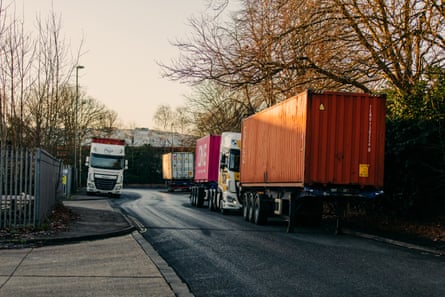
A typical raid goes something like this: in the dead of night, a spotter will enter a truck stop, while drivers are asleep in their cabs. They will go truck-to-truck, slashing open the sides to see what’s worth stealing, crawling under each to avoid the CCTV. Once a suitable target has been identified, accomplices will arrive in a side-loading vehicle – Sprinter-style vans with slide doors are common, though larger removal trucks are sometimes used. They will park alongside, as close as they can, cut a hole in the target truck to match their own side door, and quietly load from one to the other. From the outside, you’d never know a crime was taking place. Their feet won’t touch the ground. Drivers mostly realise in the morning.
A quick, clean score generally requires a truck with a free bay next to it. Cargo thieves can spend a lot of time essentially waiting for a parking spot. No one said it was glamorous.
Dawber often marvels at some of the things taken, the way their destination hints at the scale of the criminal enterprises. A few years ago, pallets of baby formula milk kept going missing – he later discovered formula was selling for about eight times the price in China, and the thieves had their own international supply chain. Yet, with limited police resources, no arrests were ever made.
At Beaconsfield, we decided to go for a walk around the trucks to stretch our legs before the meeting. Many bore patched-up slashes like scars. But freight theft doesn’t always require breaking and entry. Sometimes criminals dressed in company-branded hi-vis simply flag down a truck on its way to a distribution centre, spin a story about the warehouse being full, and tell the driver to unload in a “satellite” yard down the road. Then there’s exchange fraud, in which thieves take advantage of haulage exchanges – stations where drivers can bid for goods to carry on return journeys so they’re not driving empty – by arriving with fake documents for real companies. Entire lorryloads of cigarettes have gone this way, but also bathroom equipment. This happens about once a week in England and Wales.
There are trailer-hook-up thefts, in which entire trailers are stolen outright. Handily enough, these often sit fully loaded, and mostly unattended, in distribution centres over the weekend. During Covid, more than £1m worth of government-funded laptops destined for home schooling were hitched up to a stolen cab and driven away by three members of a Birmingham-based gang. This is also classified as theft from a motor vehicle, despite the theft being most of the vehicle.
High-value goods are often sold online – either individually, via sites such as Gumtree, or, using a recently formed company, en masse via Amazon marketplace. Dawber recalls seven pallets of perfume, worth about £1.5m, that went missing from a lorry in Kent and within 24 hours were listed for sale on eBay on accounts located in Essex, Luton, Watford and east London. It was easy to spot, as the perfume was yet to be released. As is so often the case, no arrests were made.
Other stolen goods reappear via the “grey market” – independent wholesalers either duped by fake documents or who don’t ask too many questions. A couple of years ago, a batch of barbecues meant for Tesco was stolen in Staffordshire, only to end up back on sale at Tesco, which had unwittingly repurchased its own stolen goods.
Attending the meeting at Beaconsfield was Michael Yarwood, managing director for loss prevention at TT Club, a global cargo insurer, and Ross Mendenhall, the group operations director for Extra MSA, a company that operates several key motorway service stations, including the one we were sitting in. In the US, Yarwood said, cargo theft was “off the charts” but the thieves there had different methods. Lately, they had been hacking into the driver software system and getting trucks diverted directly to them. Among the members of Yarword’s company, there were more than 400 losses of this type in 2024, compared with a handful of thefts from truck stops.
Mendenhall, meanwhile, lamented the dire state of the UK’s haulage infrastructure. By most estimates, there are twice as many trucks on UK roads than there are places for them to pull up. We’re about 11,000 parking spaces short, says Ashton Cull of the Road Haulage Association (RHA). With drivers forced to park up in laybys for their statutory rest, freight crime becomes even easier.
What we really need, Mendenhall said, is more service stations, where trucks could park – if not perfectly securely, at least under lights and CCTV. Yet locals didn’t want them, and councils opposed them. “They think they’re horrible, noisy, crime-ridden places,” he said. Planning permission for Beaconsfield alone took nine years. A site in Cobham took 19 years. It went through two judicial reviews.
The meeting ended with Dawber and Yarwood talking of a shared dream: a truck stop with perimeter fencing, full CCTV coverage, 24-hour guards. Yet service stations, Mendenhall pointed out, have little motivation to stump up for such security: by 7pm every night, as drivers park to sleep in their cabs overnight, they’re full.
The national vehicle crime intelligence service is not your typical police department. When I visited its headquarters in Coventry last year, I found a low-slung breeze block hut just about big enough to fit a scout troop. Unusually, it is not funded by the government, but by industry, after the Home Office pulled its funding in 2011.
Each desk focuses on a different kind of vehicle theft – cars, caravans, farm machinery. Dawber’s desk, freight crime, nearly shut down entirely in 2020 when a key backer – a large marine insurer – pulled out. Ever since, about 70 or so companies pay an annual fee (from £700 to £2,500 depending on turnover) for access to the one-man cargo-crime department that is Mike Dawber. Dawber also spends a chunk of his time encouraging others to sign on so that his job still exists. Amazon, he says, recently clicked subscribe.
It’s a precarious setup. “I’ll sing his praises to the rooftops,” says Cull of the RHA. “But we need more Mikes. What if he fell under one of those trucks he’s investigating? All that intelligence would be lost.”
Whenever we spoke, over several months at service stations and over video, Dawber would tell me not just about the cases he was working on, but the events he was speaking at: the Commercial Vehicle Show, the RHA quarterly forum, a driver engagement talk at a truck stop. This was on top of the 1,300 investigations each year he assisted, the 300 or so arrests in which he played a key role, and the 50 or so police operations, from stakeouts to searches, he took part in. He also writes a fortnightly bulletin.
He sometimes frets about the hours, the toll. When he remarried, Dawber already had three children with his first wife and didn’t expect to have more. Louise had gone through the trauma of two stillbirths in her first marriage. With Dawber, she miscarried after 16 weeks during the pandemic. Then, a miracle. They called her Hope. She started school in September. Dawber is religious about booking holidays every three months to spend quality time with his family. When he’s away at a conference, after a long day, he always drives back through the night, to be there for when Hope wakes. “I like my job, but it’s the volume that is the stressful part of it,” he says. He also admits that after a few days away, he’s desperate to get back to it.
Surprisingly little is known about the gangs behind the cargo crime crisis. Arrests are almost exclusively made at road level, catching criminals as they attempt to drive stolen goods away. Until now, no serious investigations have taken place to look at the criminal networks above them. But that is about to change. The National Police Chiefs’ Council recently appointed its first lead for freight crime, Northumbia’s deputy chief constable, Jayne Meir. When we met this year, Meir was fresh out of a meeting with Dawber, along with several leading industry figures. “It’s a very small team, and has not had a great deal of policing support over the years,” she said of Dawber and Navcis. That was her job, along with a new team at Opal, the national unit for organised crime, which began work this month.
The first step to solving the problem, Meir said, was for the industry to admit there was one. Firms were reluctant to report cargo crime to the police, for fear of being seen as unsafe. One supermarket chain fired 75 drivers last year on suspicion of collusion with thieves, yet the firm only reported seven of those to the police. The others could easily have moved on to jobs at other companies. Last year, an expert in cybersecurity, David Benford, gave a talk at the British International Freight Association that alarmed many in the industry, showing how criminals were hacking into mobile phone masts near fulfilment centres. They were reading drivers’ texts and preying on those who inadvertently revealed they were in financial difficulties, offering them cash for cooperation: tipping the gang off about valuable consignments, say, or parking the vehicle in an agreed spot.
Still, drivers are far more likely to be victims than accomplices. It’s rare for drivers to be assaulted, though people within the industry told me stories of drivers being threatened with knives, machetes, baseball bats and, on one occasion, a gun.
In February, I took a trip to Cambridge services, a noted cargo theft hotspot, to talk to drivers as they settled in for the night. Nearly everyone told me they’d had their side-curtains slashed at some point. One driver I spoke to, Rob, who had been driving trucks since 1985, told me the problem is getting worse. He found it harder and harder to sleep at night. “It’s always a worry because you’re very, very vulnerable.” Tony Price, 60, told me that his truck had been slashed on 10 occasions. He pointed in front of him: “The last one was over there, two weeks ago.” Nothing was taken: his cargo had been flat-pack plastic sheets.
What Meir doesn’t know, yet, is who exactly the gangs are. A small number, she thinks, commit the majority of offences. The latest, and most audacious, type of cargo theft is known, somewhat dubiously, as the “Romanian rollover”, in which criminals from eastern Europe target trucks while they’re on the move. The pursuers climb on to their own bonnets and break into the truck ahead while on the motorway; boxes are tossed back at speeds of more than 50mph. Dawber showed me a video of one such operation: I watched as two men climbed out of the sunroof of an SUV that was tailgating a truck, one holding on to the others’ legs as he broke into the truck’s rear door ahead. Such cases are relatively rare – about 20 or so a year according to Dawber – and reserved for high-value goods. Meir told me they had intelligence to suggest the criminals behind the rollovers probably “fly into the country to undertake a series of offences”, and possibly even train others to do so while here.
Det Ch Supt Jim Taylor, the head of Opal, told me he was recently briefed by his French counterparts on rollover offences. He had been amazed at the audacity: the way, in examples he saw, the criminals’ cars would form a box around a truck to slow it, allowing one member to more easily break into the back. “It’s almost like a police interceptor. It’s military precision. I’ve been part of those types of stops with firearms in the past, and it takes weeks of practice. These guys are doing it, and it’s a slick operation.”
The new Opal unit, Taylor said, would look beyond those driving the stolen goods away, who are often people exploited by the gangs. “We’d look up the hierarchy: a 21-year-old with a few stolen pallets is not Mr Big.”
There is a strong case that ground zero for UK cargo crime – the place most headphones are hijacked, the most makeup goes missing – is Leicester. This is where truck parking is most oversubscribed and where regional crime gangs in Leeds, Liverpool and Birmingham overlap. The city also happens to be a short drive from Magna Park, the largest distribution hub in Europe, which hosts the likes of Amazon, Asda and DHL. In the logistics industry, the area is known as the golden logistics triangle, bounded by the M1, M6 and M69 motorways, spanning Leicestershire, Northamptonshire and Warwickshire. Truckers are required by law to stop every four-and-a-half hours: this is what makes the golden triangle golden. Drivers can reach it from the ports at Dover and Felixstowe; drivers departing Leicester with goods can reach 95% of the country in their allotted driving time.
Last May, I joined Sgt Michael Hooper, of Leicester’s road policing unit, on an overnight shift. Hooper, who boasts a square jaw and the clipped efficiency of someone permanently reporting over a radio, deals with every type of road crime. Earlier that evening it was a kidnapping, which became the unit’s problem once the victim was bundled into a boot and driven away. But Hooper reliably gets a couple of cargo crime calls a night. Along with the 42 other police forces across England and Wales, he had read the latest briefing memo from Dawber. For his area: be on the lookout for a spotter car used in a cargo theft a few days before.
Cargo thieves are organised, Hooper told me as we set out, but that doesn’t always mean they’re smart. A few weeks earlier, one took a diversion with a stolen trailer, and promptly crashed into a low bridge. Hooper found a sheepish-looking man trying to explain away a lorryload of mobility scooters. He was charged with handling stolen goods. The sentence would be minimal.

One of the problems for patrol police is the people actually moving the goods are often hired hands, rather than gang members. Hooper told me that the previous night, a van linked to several cargo thefts had been identified travelling south from Leeds. Hooper and four colleagues in unmarked cars followed the van on the M1, and once they hit a stretch of motorway with no exit ramps, they attempted to box it in. Hooper, in a marked police car, trailed behind. As soon as his colleagues formed around the van and flashed their lights, the driver rammed the police car in front to escape. When they formed around him again, he attempted to ram the police car to his right, overdid it, and flipped over the central reservation. The driver, miraculously, was mostly unharmed. His GPS had been set to Watford Gap services, where the gang who had hired him had probably picked a target truck. The man in question had a £1,000-a-week crack habit. (“How was he even alive?” wondered Hooper.) The gang paid cash-in-hand.
The spotters – those who do the slashing and peering – are nearly always part of the gang, but the most they can be arrested for is criminal damage. Of the 5,000 cases that Dawber deals with each year, only 300 or so result in arrests. Of those, only about 10% result in convictions. The night before I went out with Hooper, 12 trucks were slashed at nearby freight firm Pall-Ex. No one was caught.
Our first stop was the services at Leicester Forest East. It was 9pm, already full, and eerily quiet, the drivers alone in their cabs, in the midst of their night-time routines. Sleeping overnight in a truck’s cab is called “tramping” – sleeping in a small bed behind the driver’s seat – and nearly every driver does it. Hooper knocked on one driver’s door to check his tachograph printout, the document that shows the driver’s activities in the truck. He’d only been driving for a little over an hour, and was taking a short break. Hooper gave the all-clear.
At several points during the night, Hooper slowed down to show me how many trucks were parked in laybys. Many had their back doors open to show they were empty. This had the unfortunate effect of telegraphing the ones that were full.
One of the quirks of road freight is how often work is subcontracted. A large international haulier – the kind with its own secure parking – may take on a job, but pass it to another company, which passes it to another. The chains can be five or six deep, the profit margins getting smaller each time. Before long, as one insider put it to me, a journey that looks secure on paper, having first been taken on by a firm with dedicated parking, becomes “Bill and Ben Cargo in a layby”. The disputes over who’s responsible when goods go missing can end in complicated court cases. About 80% of trucks on the road, estimate the RHA, are from firms with six trucks or fewer.
On our way to Rugby services, an armada of DPD trucks thundered past us in the opposite direction. These are the remaining 20%. Until recently they were virtually untouched by cargo theft. Their dedicated parking is too secure. “It was so strict inside,” said Hooper. The only opportunity for thieves was to target the trucks as they were moving. Which is what they did. In 2021, Hooper began receiving reports from DPD that its trucks were being tailed by Transit vans with holes cut in their roofs, all the better to steal boxes too big to fit through a sunroof. Some firms have even taken to hiring private security cars that travel in tandem with them. Hooper will get calls when they suspect a rollover is closing in. “It’s very Fast and Furious,” he said.
On the night I accompanied Hooper, things were a bit quieter. A kid driving without a licence. A man sleeping in his car after being kicked out by his wife. A pursuit of a stolen car that strained my neck muscles as we went through the gears.
Before Hooper’s shift ended, we took a drive through Magna Park, the sprawling mini-town of fulfilment centres built on a former RAF base to the city’s south, now a 220-hectare (550-acre) symbol of our home delivery age. Your sense of perspective becomes warped here: the buildings are so big that they make the trucks look like toys. The site is so enormous that Leicestershire police bill the owners just to patrol it.
A striking thing about the cargo crime crisis is that the firms most affected are doing little to alleviate it. Fulfilment centres rising across the land rarely provide parking for the trucks that deliver the orders. Drivers are often given strict 10-minute slots in which to arrive, and forced to park in laybys as they wait for parking spaces to open up. Hooper pointed out the rows of these as we passed. Increasingly, drivers leaving with goods are trailed by spotter cars.
Haulage firms have resorted to giving their drivers counter-terrorism training so they can spot if they’re being followed, says Chris Welch, managing director of haulage firm Welch Group, and call it in.
When I spoke to Dawber this week, he was upbeat: he’d noticed a recent reduction in thefts from trucks parked in service stations, likely due to increased police attention. “We now have more resources, more expertise than ever to combat it. It’s taken a while to get to that.”
Yet for now, at least, Dawber suspects it’s only shifted the problem, with more trucks targeted in laybys, or while they’re on the road. After all, the thieves following the trucks from fulfilment centres will know that after a certain number of hours, they must stop, that a haul potentially worth millions will be theirs for a few swipes of a knife, boxes passed hand to hand and a getaway van they won’t even drive. No headlines will be written. The crime will be recorded as theft from a motor vehicle. Mike Dawber will be informed.
Discover a selection of the Guardian’s finest longform writing, in one beautifully illustrated edition. In this issue, you’ll find stories about how private equity is plundering the world and what it’s like growing up in a family of Nazis. Plus: why do we think the perfect buggy will make us better parents? Buy copy from Guardian Bookshop here