.png) 2 months ago
58
2 months ago
58
Margaret Thatcher wasn’t to blame for the closure of Britain’s coalmines. Mr Blobby was. A harrowing spoof documentary exposed this horrific truth during the finale of Saturday Night Live UK’s debut season. Back in 1992, drilling activity at Nottinghamshire’s Grimethorpe Colliery awoke an evil entity buried underground. Mr Blobby promptly went on an unstoppable murderous rampage, ripping off miners’ limbs and becoming “an atom bomb made flesh”.
Mr Blobby being disinterred is an apt metaphor. Recent months have seen the pink-and-yellow agent of chaos unearthed and on the comeback trail. He has appeared on primetime TV shows, duetted with popstars, and convinced nostalgic punters to part with a surprising amount of cash to get their hands on Blobby-themed merchandise. What has prompted the comeback of a character once considered irredeemably naff?
“I’m not sure Mr Blobby’s ever gone away,” says comedy writer Joel Morris, author of Be Funny Or Die: How Comedy Works and Why It Matters. “It was thrilling to see him on that SNL UK sketch, the millennial writers’ room not giving a fat stuff that kids at home would need him explained by their parents. This is your heritage and he’s as British as a Boots meal deal. I do hope Blobby is in the citizenship test.”
Last month on The Claudia Winkleman Show, comedian Josh Widdicombe – who devoted an entire episode of his Museum of Pop Culture podcast to Mr Blobby (“Pink, spotty and rubber, with an insatiable appetite for destruction”) – attempted to explain him to a confused Canadian, Schitt’s Creek star Dan Levy. When Blobby himself made a surprise entrance, the visibly terrified Levy literally hid behind the sofa. “That’s our Mickey Mouse,” said Winkleman proudly.
This squishy cultural signifier of the 90s is in hot demand on the nostalgia circuit. Blobby costumes change hands for thousands of pounds on eBay. In Scotland, the Blobby-shaped iced biscuits at Bayne’s bakers (“made with natural colouring”) have become a cult bestseller to rival Gregg’s sausage rolls.
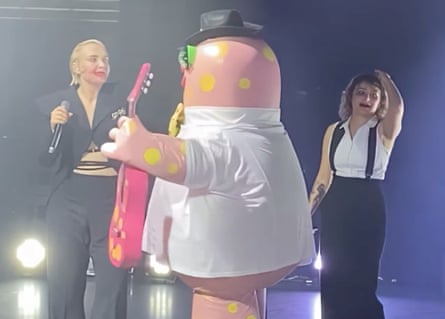
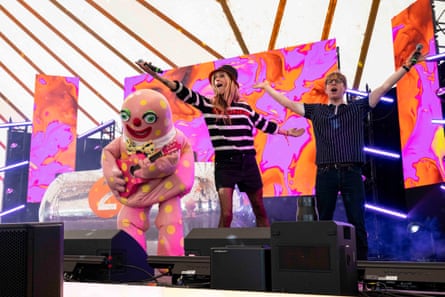
Singer and actor Self Esteem, AKA Rebecca Lucy Taylor, is a vocal fan who invited him to appear on stage at her Hammersmith Apollo gig. After they performed a surreal duet of her track The Best, she hailed the experience as “the highlight of my career”. Mr Blobby was even a GQ cover star recently, featuring in the style magazine’s selection of “modern British icons” alongside Emma Thompson, Ian Wright and Brian Cox. His contribution to the interviews was just saying “Blobby”, obviously.
For cultural historian Dr Matthew Sweet, his revival is a sign of idiotic times. “Mr Blobby is a creation of breathtaking stupidity,” he says. “His stupid name, his stupid appearance, his stupid voice and its ceaseless repetition of his own stupid name are unimaginative to the point of atavism. Somehow, his dumb relentlessness has allowed him to push through into some other territory. Maybe his blundering, lobotomised qualities strike a chord in a world that’s commonly said to be getting more stupid.”
The Pepto Bismol-coloured clown was invented by accident. He first stumbled on to our screens in 1992, as a one-off skit on Noel Edmonds’ Saturday night smash Noel’s House Party, pranking celebrities who’d been duped into believing they were appearing on kids’ TV. Roughly doodled in mauve felt-tip by the show’s co-creator Michael Leggo, he was 7ft tall and pear-shaped. Sort of the Honey Monster meets Mr Greedy. By the time the BBC costume department had knocked him up, the bulbous pink figure had a perma-grin, googly green eyes and yellow spots, communicating solely by saying “blobby” or “blob” in a Dalek-esque distorted voice.
Blobby was supposed to bow out at the end of the series. The BBC reckoned without the great British public clutching him to their hearts. Noel’s House Party received three bulging postbags of mail per week. Before long, most of the letters were about Mr Blobby, not Mr Edmonds. The fan favourite not only stayed but was promoted to the host’s full-time sidekick. His popularity further soared when he stared firing cream cakes into the studio audience with a catapult.
Down in the fictional village of Crinkley Bottom, Blobbymania was born. Like a tidy-bearded Dr Frankenstein, Edmonds had created a monster. Pop cultural dominance followed. There were Blobby dolls and cuddly toys, Blobby pasta shapes and bubble bath, Blobby lampshades and duvet covers, Blobby crisps and fizzy drinks (pink lemonade, naturally). The runaway success spawned a computer game, three Blobbyland theme parks and even a Christmas No 1, knocking Take That’s Babe off the top spot. Two decades later, Gary Barlow was reunited with his old chart nemesis on Alan Carr: Chatty Man. Clearly still smarting, Barlow pushed Blobby over and pulled his leg off.
When Noel’s House Party was axed in 1999, its folk hero faded from view. The 00s saw him surface only sporadically to gatecrash other TV shows, bringing his trademark mayhem to proceedings. The polka-dotted dolt would waddle on set, wave and say “blobby” copiously. In his clumsy enthusiasm, Blobby would fall over, drop props, break furniture and embrace-cum-wrestle unsuspecting celebrities. He popped up in Peter Kay’s (Is This the Way to) Amarillo video. He gunged Simon Cowell on Britain’s Got Talent. He rolled around with Loose Women’s Carol McGiffin and one of his eyes came off. He guested on The Big Fat Quiz of the 90s, where a panic-stricken Jack Whitehall compared him to a “fat, jaundiced baby”.
If you’re rolling your eyes at Blobby’s return, you’re not alone. He has always been a divisive figure, provoking as much annoyance as mirth. The New York Times once wrote: “Some commentators have called him a metaphor for a nation gone soft in the head. Others have seen him as proof of Britain’s deep-seated attraction to trash.” Michael Parkinson found him “far from amusing”. Bob Mortimer called him a “pink, spotty, rubber twat”. This newspaper once dubbed him a “widely despised irritant”.
Not everyone agrees, however.
“What’s funny about Blobby is that he was meant to be confusing,” says Morris. “The original joke was that he came from some nonexistent kids’ show. But because he was entirely invented, there’s nowhere he doesn’t fit. He’s always in the wrong place, which makes for powerful comedy. He’s a court jester but also looks like a pig’s bladder on a stick. The ultimate combo.”
As Dan Levy’s bewildered reaction demonstrated, the DayGlo doofus is a quintessentially British phenomenon. “To speak as a technician,” says Morris, “the comedy toolbox requires figures like Blobby – or Sooty or Zippy – as cultural touchstones, so they can be put in the wrong context for humorous effect. It makes me sad that future generations might have to rely on multinational brands such as Pokémon or Grogu as punchlines when Mr Blobby is right there, ready to be used. You can drop him anywhere, like a comedy bomb. If there was a British Avengers Assemble, he’d be the Hulk.”
Like Dan Levy or Jack Whitehall, some remain more spooked than tickled. “Many things from our childhoods seem, in retrospect, weird and haunted,” says Sweet. “Most are charming, amusing, dramatic or cleverly made. Mr Blobby is none of those things. Imagine waking up in the night and finding him at the end of your bed. How terrifying would that be?”
With renewed interest and rumours afoot of further Blobby antics, don’t be surprised to see more pink-and-yellow chaos coming our way. After all, 2026 is the year of the Blobaissance. Resistance is futile. We might as well say it: blobby, blobby, blobby.