.png) 3 hours ago
6
3 hours ago
6
Duncan is a good friend of mine. He looks like a Dickensian rock’n’roller: tall and skinny, long hair, retro clothes. He’s read the Flashman novels three times. We met in secondary school in west London in the early 1980s. We got drunk, smoked Rothmans and banana skin spliffs and played Dungeons & Dragons. At 14, we got into punk together and spent our teens playing music and seeing live bands. As we moved into our 20s, I trained as a journalist and Duncan, a talented songwriter and guitarist, carried on with music.
At the age of 23 he got involved in heroin. He found the lifestyle immediately seductive, his partner at the time, Lucy, told me. He would often befriend his dealers. “I remember more than once waiting in his car as he’d gone up some tower block to score, thinking where on earth is he?” Lucy said. “He’d be hanging out chatting. There were some genuinely fascinating characters with incredible stories to tell.”
We kept in touch. By the 2000s, after a few near fatal overdoses, it became obvious he had a long-term drug problem. But at the end of the decade, when Duncan was in his late 30s, his life changed when his then-partner gave birth to a boy. He was a natural father, becoming a full-time dad when his partner returned to work after maternity leave. Love and dedication to his son reduced Duncan’s drug use, but did not entirely dislodge it.
In 2013, he swapped the west London council flat he had been subletting for a nicer, ground floor studio apartment in a council estate in north-east London, near where his partner and young son now lived. By this time, Duncan was what drug experts call a “functioning” heroin user, managing his addiction with methadone while living a relatively stable life. He was working as a painter and decorator, played in a band that toured the US, and remained a dedicated dad. He got a job as a teaching assistant, helping some of the most troubled kids in the borough, which he loved.
His friends regularly spent time at his flat, which he had turned into his own, homely space. He had repainted his bedroom-lounge, and filled it with his collection of trinkets, retro furniture, artwork, vinyl record collection and a huge plant. His mother visited, his son regularly stayed the night and I crashed on the couch a few times.
By 2015, even while house prices were rocketing in trendy areas a few streets away, Duncan’s estate became neglected and scary at night. Families moved out and were replaced by single tenants leaving prison and care. Eventually, the estate was officially condemned by the council, which planned to decant tenants into a new estate being built a mile away. Duncan had watched as a group of noisy local kids had grown up into a gang of aggressive teenage drug dealers. They were made up of about a dozen boys and young men from the estate and the surrounding area, most aged around 15 to 17, and some as young as 12.
Coming home in the evening, Duncan would find the gang, dressed in black joggers and puffer jackets, hanging around the stairwell selling crack and heroin. “Sometimes, something, or somebody, would get thrown against my window,” said Duncan. “A couple of times I heard someone who got a really bad kicking from them, whimpering outside and I phoned an ambulance. They were horrible cunts.”
Within a year, Duncan’s home would be doubling up as the gang’s drug dealing base.
Over the past 30 years, the British “trap house”, slang for a place used as a drug dealing base, has evolved. Rather than derelict crack houses, drug gangs now prefer to operate from a hidden countrywide network of vulnerable people’s homes that they have taken over in a process known as “cuckooing”.
The origins of this shift go back to the 1990s, when a new wave of professionalised drug dealing crews spread out across the country. Their growth was fuelled by two products that were transforming Britain’s drug trade: crack and mobile phones. Blackberries and Nokias had enabled buyers and sellers to arrange transactions in less visible locations, and dealers now started to expand their operations, using a system of young runners who would call in orders and deliver the drugs.
In Brighton, a gang called the Londoners moved their drug sales teams off the streets and into the homes of local people, where they could more easily operate away from the prying eyes of police and rival gangs. When 10 of the Londoners were jailed in 2000, along with a man whose home they had taken over, a fresh gang from south London arrived to fill the gap. “I was buying crack and heroin from 15- and 16-year-old south London boys on BMXs in 2001,” Pete, a former Brighton street drug user told me in 2018. “I thought, fuck, you’re young. They would come down on the train and set up flats with heroin users.”
Over the 2000s and 2010s, wave after wave of gangs fanned out from Britain’s drug supply hubs – London, Liverpool and Birmingham – to set up shop in smaller towns and cities across the country. They took over the homes of drug users and young women who had been groomed by older male gang members. As early as 2008 Suffolk constabulary reported that more than a third of Class A drug dealers arrested in Suffolk were under 21, and the majority were from London. (Before this period, most crack and heroin dealers in towns and smaller cities were “user-dealers”, addicted heroin users in their 30s or older, who were not as “professionalised” as the big city drug gangs.) Gangs often used sex workers, who targeted male tenants and moved in, bringing the young dealers with them. Community safety teams, who rescued 80 tenants in London in 2005, were the first to call the tactic “cuckooing”.
In 2015, the National Crime Agency published an intelligence assessment that belatedly acknowledged “cuckooing” was part of “an emerging criminal business model”, whereby young people were being sent by drug gangs to sell out of town, which they dubbed “county lines”. By 2018, children who were described as “missing” in their local papers could now sometimes be found on Snapchat waving wads of notes, boasting to their classmates about their out-of-town moneymaking adventures “going country”. Rap lyrics, particularly drill music – where victims of cuckooing were denigrated as “fiends”, “cats” or “nitties” – soundtracked and glamourised the rise of the British trap house.
The reality was far more bleak: children hanging out in dingy flats with ageing drug injectors, earning far less than they had hoped and living in daily fear of being jumped by police, or worse, rival gangs. The whole system was reliant on grooming and exploitation. Over the years, reporting on Britain’s drug trade, I’ve spoken to several young drug dealers and cuckooed tenants about what it was like for them. One boy from Liverpool sold drugs from cuckooed homes in Devon, staying in a middle-aged crack user’s flat when he was 14. There was mould, “a plant growing out the wall” and the place was so dirty he ended up cleaning it himself. He smoked weed “to take the smell of crack away”. Another teenager from London, from a strict religious Nigerian family, worked 15-hour days from cuckooed flats in the east of England for three years. He told his parents he was on football trips or staying with friends; in reality he was holed up with drug users and armed with a machete.
A former sex worker and crack user I spoke to, whose home in Southend was cuckooed, actually felt sorry for the young dealers camped out in her flat. “They used to lie on my settee and sleep with the phone by their head, working 22 hours a day. They were putting on an act, trying to pretend they were the big boys, but they were young kids getting exploited.”
Cuckooing can involve sexual and financial grooming, the targeting of disabled and mentally ill people, people in private rented properties in affluent neighbourhoods, and even relatives and carers of gang members. In one case, said Insp Andrew Cameron of Operation Pantera, which was aimed at tackling the problem in London, a nephew cuckooed his aunt’s house for a south London drug gang. In another, a care worker cuckooed the home of a patient, who was tortured with cigarette burns and beaten by drug dealers. One particularly grim case involved William Algar, a 53-year-old jazz trumpeter from Barnes, south-west London, who had mental health and drug problems. In 2019, his home was cuckooed by a gang of drug dealers. He fell out with one of them over money, and the dealer threatened to kill his cat. After Algar’s sister reported him missing, police found his severed head and torso in the flat, and the rest of his body in a park. He had been stabbed to death with a zombie knife and dismembered in his own bath.
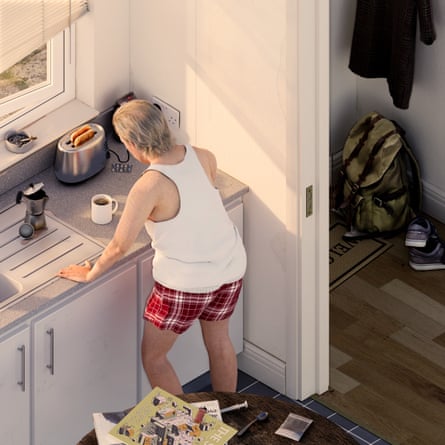
Jack Spicer, a lecturer in criminology at the University of Bath and author of Cuckoo Land, has interviewed many victims of cuckooing. What makes the practice so insidious, he says, is that for many victims there is nowhere to run. Yet Spicer also notes that in some cases, cuckooing can be a more complex scenario than is commonly understood: “From the perspective of an outsider looking in, cuckooing can take on a seductively simplistic appearance: the ‘evil’ drug dealer duping the vulnerable user of drugs, the naive local resident opening their door to the dangerous outsider. At best these tell only a partial story.”
That helps explain why Duncan, a musician, artist and father, ended up opening his doors to drug gangs – not once but twice – and why his two experiences turned out to be so different. The first brought him only misery; the second, in his telling at least, brought him a strange kind of friendship.
Life started unravelling for Duncan in 2016. His girlfriend left him and his close friend, the band’s singer, died of cancer. He was fired from his teaching job after his drug treatment service informed the school that he was in rehab. Losing his job made him particularly bitter. His drug use increased. He stopped returning his friends’ calls and saw less of his son.
Before, he had no reason to interact with the estate’s teenage gang. He bought his drugs – methadone, with a bit of heroin and crack on the side as a treat – from a trusted seller back west. But in January 2017, during a cold snap, Duncan offered shelter in his flat to two heroin users who had been sleeping rough in a tent in a nearby snow-covered graveyard. Patrick, a beggar from Bristol, took the kitchen floor and Josef, an unemployed Polish stonemason, took the living room sofa. “The estate was feeling more and more threatening during that time,” said Duncan. “I felt safer with those two around.” But his two lodgers bought drugs from the gang on Duncan’s estate, and he became a regular buyer, too.
Around this time, Chloe, a school teacher and friend of Duncan’s, began to worry about him. The two of them had been in a relationship for a period, and after they split, they remained friends. To her, he was “the loveliest person in the world – caring, kind and creative”. When they were together, she never saw him taking heroin, but she knew he did. So when he stopped returning her calls, she went round to check on him. The door was answered by a man she recognised as Patrick, the train station beggar, who nervously told her Duncan was out. When she later saw Duncan in the street, he ran off. “I was thinking, what is going on here?” she recalled.
One day, in the summer of 2017, one of the boys from the estate gang knocked and asked if his pregnant girlfriend could use Duncan’s toilet. From then on, said Duncan, the gang’s presence in the flat “escalated”. First it was repeated visits to charge phones or use the toilet. Then, as autumn approached and the weather got worse, the gang made Duncan an offer: £30 worth of crack and heroin a day for the use of his flat as a drug dealing base. He found himself agreeing.
“They had something to offer,” said Duncan, who had developed a debilitating leg wound from years injecting in his groin. “I’d wrecked my health and couldn’t work much so I needed the freebies. Heroin makes you quite fearless. It makes you feel as though you can cope with anything, but it also imbues a certain amount of recklessness. The strangest situations start to seem normal very quickly.”
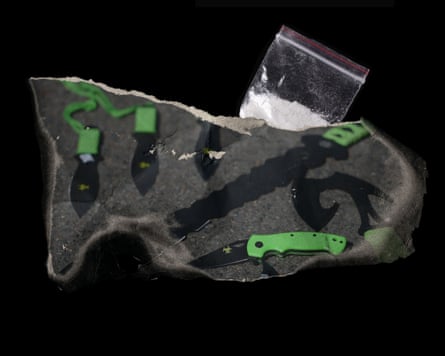
The gang – a mix of Asian, black and white teenagers – was in and out of his home from about 10.30 in the morning, when one of the senior members would drop off the drugs stash, until late at night. A trio of slightly older gang members, aged about 16 and 17, made him feel particularly uneasy. The younger dealers would all be paid at his flat by a senior gang member in the afternoon. Usually there were only one or two of them there at once, but sometimes his home was packed. They used the flat as a base for dealing crack and heroin, to relax, prepare drugs for sale and to stash their zombie knives.
Duncan said some of the younger dealers were respectful, and that “three or four of the little soldiers were alright to chat to”. He would shoot up while the young gang members were in his flat, trying to find a vein in his groin or his leg. “All that stuff frightened those kids and probably disgusted them, so it kept them at a distance,” he told me. One of the gang would use the bathroom after dropping off the stash in the morning, always leaving the toilet seat covered in carefully laid out layers of tissue.
Without work, and with a constant supply of free crack and heroin, Duncan’s life became dominated by getting high and waiting to get high. And as time passed, the cuckooing turned nastier. “Some of the younger ones were fascinated with knives, they liked to pretend to stab me. They thought it was funny,” he recalled. “Sometimes they poked me with the tips. They didn’t mean it, I don’t think. I got lots of small cuts, it wasn’t too bad. One time they were playing and one of them stabbed me quite deep in the leg. I don’t know why.”
One of the gang’s associates forced Duncan to register a car in his name that was then used to sell drugs. The car accrued a string of fines and was written off in an accident. The debts fell on Duncan.
After a string of complaints from other residents, in early 2018 the police warned Duncan that if he continued to let the gang use his flat he could lose his tenancy. By this time, he was too scared to stop them. According to internal local authority case notes, one housing officer messaged colleagues in February 2018 to say that council staff were themselves scared to visit Duncan’s flat: “Attended flat and went in for short while only … didn’t feel it was very safe. Duncan said he is desperate to move out as soon as possible as drug gang is using his flat whenever they want.” (The council later launched an investigation into its management of Duncan’s tenancy.)
In April, the police emailed the council to say that it was no longer safe for Duncan to stay in the flat because he was being cuckooed. “We are getting inundated with complaints from neighbours. He needs moving urgently in my opinion,” one email reported. “I’ll try and keep an eye on the address although it’s difficult to visit Duncan as he doesn’t like police being seen walking into his property, which I can totally understand. The gang in question seem to have eyes everywhere on that estate.”
That month, Duncan was talking to a housing officer at his front door about how he wanted to move off the estate because he was scared of the gang. Some of the gang were listening from the stairwell and wrongly presumed Duncan was talking to a police officer. They put the word out that they would kill Duncan. Later that week he was cycling near his home when someone jumped out of a car and shouted: “You fucking grass we’re going to kill you.” “I knew I had to get out of that flat,” said Duncan.
A few days later, a place in an emergency homeless hostel was found for him in the east of the borough. Duncan packed what possessions he could into one of his key worker’s cars and left the place he’d made home for six years. His flat, which contained the rest of his belongings, was secured with heavy duty steel panels.
The relief of escaping the gang did not last long. In the dingy, crowded hostel, Duncan’s mental health was already deteriorating, when one day he received a call from the council. They told him that, owing to a communication error, they had accidentally sent all the possessions he had left in his flat for incineration. This was not just furniture, but smaller things of great sentimental value, such as his son’s childhood drawings, his own artwork, treasured LPs and keepsakes. Duncan was heartbroken. He told his housing officer it was one of the worst things that had ever happened to him.
Duncan’s friends had no idea where he had fled to. “This cuckooing thing had obliterated his life, but he totally disengaged with us all during that period,” said Billie, a fellow punk musician who’d known Duncan since the early 1990s. It took her six months to trace him to the hostel. After hearing snippets of information about his perilous health, she left him messages there, but heard nothing. “That was the first time since I’ve known him where I thought: ‘Oh my God, the wheels have completely come off.’ I really think we could have actually lost him then,” she told me.
After 10 months in the hostel, in 2019 he was eventually rehoused in a decent one-bedroom flat in a low-rise estate in a quieter, more suburban part of the borough. But he found it hard to start anew. Debt collectors were chasing him for fines and damage to the cars the gang rented out in his name, and because of the threats to his life, he was scared to go to the part of the borough where his son lived, and where his drug treatment service was.
Worried about him, in March 2019, a friend and I drove to his flat to see how he was. Inside, it was a mess. A bowl filled with stinking, mouldy fruit sat on the table. Duncan seemed to be living on a diet of Shreddies and milk with jam mixed in. He was convinced he had parasites under his skin, in his hair, and in his blood, a feeling that can be triggered by long-term crack use. We took him to hospital for some check-ups, particularly on the large injecting wound on his leg, for which he started to receive treatment.
In between Covid lockdowns he was able to move more freely around the borough, after most of the teenage gang that cuckooed him were arrested. We met a couple of times as he started taking action against the council, with the help of a lawyer, for destroying his possessions. After several months of legal wrangling, he was awarded a good chunk of money, which he mainly spent on an array of beautiful guitars and drugs. He drifted away from his friends again.
Then, in November 2024, I got a call from Duncan. He told me he felt really lonely and he wanted to meet up. He explained that over the past three years, he’d built a close bond with someone, but that person had just been sent to prison. Anyone I know, I asked? No, he replied, it was a drug dealer who had been using his house as a base for his business for the previous three years. I couldn’t believe it. But this time, as Duncan explained over a fry-up in a local cafe, wasn’t like the last one.
Compared with the teenagers on Duncan’s old estate, the second gang, which I’ll call the T-Line, was a more professional outfit. It ran a sizeable chunk of the heroin and crack trade in this part of north-east London. It was led by an experienced dealer in his early 40s. A confident, charming east Londoner, Tony was a well-known figure in the borough’s drug trade. Duncan had bought drugs from him while he was living in the homeless hostel. “He’s a personable kind of bloke,” Duncan told me. “He’s ingratiating. He liked sharing recipes and he liked my artwork. We just clicked, I guess.”
The first time Tony had visited him at home, he noticed portraits Duncan had painted of his own family. Tony said he liked them, and paid Duncan to paint a picture of his own two young sons. There was another thing Tony liked about Duncan’s flat: it would make an ideal trap house. The estate was low key, plus Duncan was one of his calmer, more reliable customers. He could be counted upon to keep quiet. The few times Tony’s crew had been round Duncan’s flat, he had seemed unfazed.
Tony suggested a deal: free daily crack and heroin in return for the flat being used as the gang’s secret weighing and stash house. So in 2021, for the second time in the space of three years, Duncan opened his home to a drug dealing gang. And when Tony asked him if he wanted to help prepare the drugs for sale, in return for more crack. Duncan knew that, legally speaking, doing so would change him from a passive victim to a willing offender. If he was caught he could be kicked out of his council flat and sent to prison. Even so, he said yes.
Duncan’s coffee table was repurposed as a drug processing station. Every day Tony, who now had keys to the flat, arrived at about 11.30am on his scooter with kilo bricks of heroin and crack, usually leaving around midnight. They worked long days together at the flat. It was Duncan’s job to weigh out and line up hundreds of 0.1 gram “shots” of each drug, ready to be wrapped into bags for street sale. Duncan estimates he helped cut and weigh about 5,000 “shots” of heroin and crack every week. Surrounded by enough narcotics to get the whole neighbourhood high, Duncan would have a regular puff on his crack pipe, part of his daily drug wage. “It was therapeutic for me,” he said. “I’d do 100 shots and have a pipe and do another 100 and so on.” As Duncan sorted out the drugs, Tony would be shouting via speakerphone, bossing his underlings.
Members of Tony’s crew came and went throughout the day. The longer the T-Line was camped out at his flat, the more Duncan found himself involved in its day-to-day business. “I did quite a lot of stuff for him like you would do with a friend,” said Duncan. “I tested his gear for him, I opened bank accounts he could use.”
Tony’s world was full of risk and violence, yet amid this dark backdrop, grew a friendship “built through a kind of domesticity”, according to Duncan. Tony brought a packed lunch, usually Jamaican food made by his sister or mother, which he put in the fridge. Sometimes while Tony coordinated drug deals over the phone, and after Duncan had finished dividing up the crack and smack, Duncan painted pictures for Tony.
“I used to tidy the house for him,” recalled Duncan. “I felt privileged to be accepted, and proud he was friends with me. He would make me look after myself. On my own, I couldn’t be bothered, but he got me together.” Even though he provided Duncan with a constant supply of class A drugs, Duncan said Tony “tried to discourage me from using drugs so much”, and “encouraged me to eat better – he was always feeding me his mum’s food”.
As they weighed and bagged drug deals, with Duncan sat at the coffee table and Tony at the small dining table, they talked about everything from conspiracy theories and the causes of poverty in Britain’s black community to their hopes for the future, and their pasts. Tony liked to get involved in every conversation. “He would never shut up, so I went out of the room to make calls.”
Tony told Duncan he grew up in poverty with a “wasteman” dad and had been selling drugs since he was a teenager. His chief motivation was to give his children, who he said were both in private school and the only two black kids in their class, a life different from his own. “He told me he was always going to go a bit further, take more risks, than the police chasing him because he was doing it for his kids, and the cops didn’t have as much to lose as he did.”
But Tony had a plan. By Christmas 2024, he said, he would call time on his drug dealing career. He had prepared the ground by setting up a catering truck and a semi-legitimate transport business. Come the following year, he would start anew.
The problem was that in 2023, things had started to unravel for the T-Line. A rival drug crew started ramming T-Line scooter riders off the road. They responded by squirting their attackers with ammonia. The beef was halted only after Tony contacted a criminal associate who warned the rival gang that there would be lethal consequences unless they backed down. Then Kane, Tony’s lieutenant who distributed the T-Line’s drugs to street dealers, was arrested for running a drug network in Norwich. Tony took on more responsibility, including doing more of the “road work”, moving drugs around the neighbourhood himself by scooter.
“It made him more exposed,” said Duncan. “He was getting more abrasive, more anxious, shouting at people more on the phone. He was very stressed. I told him not to bring bad energy into my place. He said he would try to keep calm, but he couldn’t.” When Duncan discovered that Tony had been hiding bricks of crack and heroin in his flat, he started stealing bits for himself, reasoning it was in his house after all. When Tony found out, they had fierce rows. “I said, if you don’t like it, don’t come back. But he would come back because it was the perfect house.”
Within the space of a few months in mid-2024, both of them came within inches of death. Duncan collapsed at his flat. He had contracted septicaemia after his injection wound became infected, and doctors told him he was lucky to survive. Not long after, Tony confronted a gang of teenagers trying to steal his scooter and was stabbed four times. Lying in the street, bleeding heavily, Tony managed to call a friend, who came to the scene, lifted him into a car and took him to casualty. “When I saw him a few weeks later we hugged. I was really happy to see him,” said Duncan.
Tony was getting increasingly nervous about being caught. He had been in prison three times for dealing. He was getting too old for jail, he told Duncan. He “didn’t have the energy for it” and dreaded being separated from his boys. His retirement date was coming closer.
One day in November 2024, Tony didn’t turn up at his usual time. Later that day Duncan got a phone call from one of the gang to say he’d been arrested after a police helicopter pursuit. Duncan was gutted for him. He was also thinking that, if the police had been keeping Tony under surveillance, his flat would be next. Yet as the days went by, alone at home, it wasn’t fear that he felt, but an intense loneliness.
Before Tony’s arrest, Duncan had ended his “love affair” with crack. It no longer agreed with his body, he felt. He also cut down from two grams of heroin a day to half a gram. “For the first time, it felt like it was holding me back,” he said.
Today, a year and a half later, it seems like Duncan has never been better. He’s eating well and looking after his health. He’s ditched his sometimes curmudgeonly attitude, he has his addiction under control, and he’s seeing his family and friends more than he has done for a decade.
Duncan believes his friendship with Tony helped him turn his life around. “The most obvious way he helped me was by bringing food from home,” he said. “Good home-cooked food. So my diet improved and I got a taste for Caribbean food. Music too. We listened to a lot of music and he turned me on to stuff I’d not heard before. Having a guest come to my home made me look after the place and myself more, and the work, although pretty tedious, was something to try to be good at, so that was positive too. I felt part of something, and part of a team.”
It’s hard to comprehend how Duncan, who had helpful, open-minded friends with money in their bank accounts, would be aided most by someone most people considered his biggest threat. But, in Duncan’s telling, this is exactly what happened. Tony “helped me to pull my socks up, so to speak”, he said. Behind his day job as a drug dealer, according to Duncan, Tony was essentially a businessman, a family man, a nice guy. “Well, it’s an odd person who only has one side to their character, wouldn’t you say?” said Duncan.
There are indeed nice drug dealers, I’ve met many myself. I’ve met some nasty ones too. People do not like to see themselves as being exploited, and Duncan denies he was manipulated. He said the two of them had a genuine friendship, and that if he had wanted Tony to stop using his home, he would have complied. But some of Duncan’s friends have a different take.
Chloe, the teacher, met Tony by accident one day in 2024. After hearing that Duncan had been in hospital and having not seen him in two years, she called round to his flat to check he was OK. As they chatted over tea, the front door opened and Tony let himself in. Chloe was surprised, and so was Tony. She was scared, not because of Tony himself, but because she knew it was drug business. “Duncan really likes Tony,” said Chloe, “but if you’re storing your illegal drugs in someone else’s house, if you’re asking them to do something in return for a thing they cannot resist. There’s a power imbalance; you are definitely the boss”.
Cuckooing is now a specific criminal offence, after the Crime and Policing Act took effect this year. But experts say it will not be stopped so simply. A rise in “deep poverty”, tracked in the Joseph Rowntree Foundation’s 2026 report, has led to more people living highly precarious, marginalised lives in deprived areas. These people are easy targets for cuckooing.
Drug gangs are increasingly targeting people’s homes in cities such as London, Bristol and Leeds. Operation Pantera recorded 1,539 cases of cuckooing in the capital between May 2025 and April 2026. Two years earlier, cuckooing had been flagged by the Met in just 380 investigations. In Leeds, cuckooing is now a major cause of vulnerable people being evicted from their homes.
Tony was sentenced to three years in prison in early 2025, but he and Duncan still chat on the phone, mainly about local gossip. Now and then Duncan buys things online on Tony’s behalf, which a friend of Tony’s will pick up and deliver to him. Sometimes Tony sounds downbeat, says Duncan, but he also talks about his kids, and plans for a future outside the drug business. During a day release in August, Tony paid Duncan a brief visit. “He’d obviously been working out inside, he was huge,” said Duncan. “He told me I looked really skinny and to put on some weight. It was really lovely to see him, he was smiling and we hugged.”
Tony is due to be released in a year or so. I asked Duncan what he would do if Tony wanted to use his home again as a drug dealing base. “I’d say no. I’ve got other things to do in my life now,” he replied. “I couldn’t give him the time he’d need off me.”
Their friendship was partly a matter of timing. “What [Tony] gave me at that time was a purpose,” Duncan said. “There seemed to be more regard for me as an artist and musician within his community than I’d ever felt before and my experience and knowledge of drugs was valued too. It was flattering to be respected like that and to be accepted into that world. And it was exciting.”
Like many of his friends, Billie the guitarist is delighted that Duncan is doing so well. She thinks that his turnaround was more to do with his wound finally healing in 2024 than his friendship with a drug dealer. And she’s scared. “He’s very positive about this person, and they probably saw it as a mutually beneficial relationship, but to me this was complete parasiticism. Hearing that he’s going to come out soon actually worries me a lot. I want to just keep on telling him, think about your son.”
I asked Duncan if he and Tony would still be friends when Tony gets out of prison. He said yes, but only to a point. “As close as we were, there was always a distance he kept between us,” said Duncan. “He never acknowledged his real name, he never told me it or allowed me to call him it. He kept up this pretence that we never actually knew each other well, a bit like people having an affair.”
All names have been changed