.png) 3 hours ago
7
3 hours ago
7
The runners smiled and laughed, congratulating each other on finishing their 5km or 10km Saturday run, their foreheads glistening with sweat in the early morning sun. They helped themselves to water, instant coffee and sugary snacks, provided by waiting volunteers on the lawn outside a gated community of modern apartment blocks, and then stretched out together.
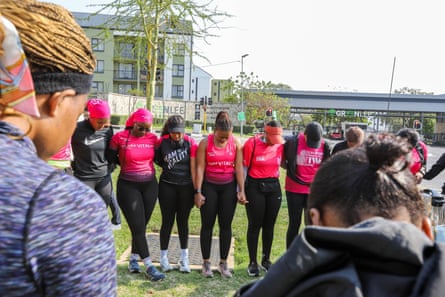
But there were sombre moments too, as they mourned one of their own, who had lit up their Saturday runs around Sandton, an upmarket area of Johannesburg. Elizabeth “Tsontso” Moselakgomo’s body had been found a week earlier, on Saturday 12 September. The 38-year-old went missing three days earlier, after going out for a run alone after work.
South Africa has been overwhelmed with shock, anger and grief at the discovery of nine women’s bodies dumped across Ekurhuleni, the municipality adjoining Johannesburg to the east, since 15 July. Six of the women were found in the last two weeks and two still have not been formally identified. Suspects have been arrested in two of the cases.
South Africa has one of the world’s highest rates of femicide. Women were killed at a rate of 12.2 per 100,000 people in 2022, nearly six times the global rate, according to the UN Office on Drugs and Crime.
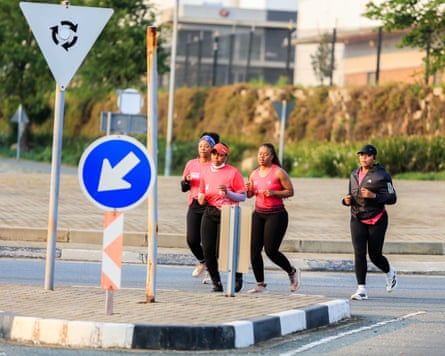
Across the country, protesters have marched and running clubs have gathered to demand that police and the national government, which declared gender-based violence a national crisis in November 2025, do more to protect women.
“This has really affected all of us,” Moselakgomo’s friend Sakane Mokoena said to her fellow runners, as they stood in a circle with their arms around each other’s shoulders. “I really want to thank each and every one of you for honouring Tsontso’s name. She really came and ran with us. She was an amazing lady.”
Mokoena then thanked the men who ran with the majority female club, acknowledging that some slowed their pace every week to make sure that no woman was left behind. The group then bowed their heads for a moment’s silence.
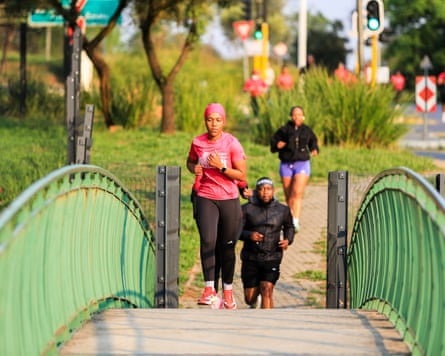
“It’s traumatic, scary, confusing,” said Sange, a female runner, who only wanted to share her first name. “Before I joined this group, I was running alone for years in this area … in the mornings, early winter mornings, late winter nights, and with music, earphones in my ears. You know, anything could have happened to me.”
“There’s no scenario where women are prioritised,” she said. “The government doesn’t take us seriously. The men of South Africa don’t take themselves seriously. They don’t take us seriously. It’s just dangerous to be a woman in South Africa and it’s very sad to be a woman in South Africa.”
The club first came back together to run on 15 September, after Moselakgomo’s body was identified by her family.

“I think we all needed that Tuesday run, because we were all sad,” said Nokwanda, who has been running with the group since February last year. “And then we met as a community. And after that, I think we are getting there.”
She called on all men to take responsibility for violence against women: “We as women have been fighting for our safety. I think it would be nice to see men fighting and not men saying ‘some men’, but standing up for women.”
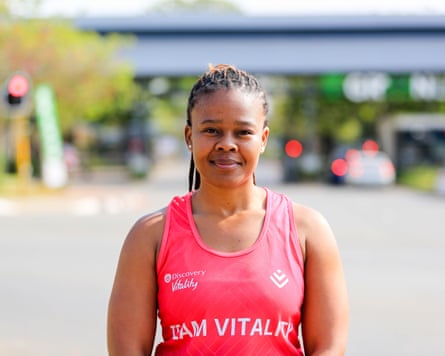
Thabiso, who had volunteered to provide the post-run refreshments instead of running, agreed. “If there’s a message that I can send out to other men is to be better,” he said. “I think as brothers and men, we need to really leave the animalistic ways behind us. There’s much better ways that we can build a society and we need to not be making these women feel like the country’s so bad.”
Meanwhile, the families of the murdered women found across Ekurhuleni are still struggling to come to terms with their loss. Ayanda Nano was admitted to hospital in shock at how her cousin, 38-year-old Dineo Motapane, who she had grown up with, was discovered.
“The state she was in is what put me in this hospital bed,” Nano, who is now raising Motapane’s two-year-old daughter, told the local Sunday World newspaper. “She was decomposed, like she had been dead for days. It pains me that she left us this way.”
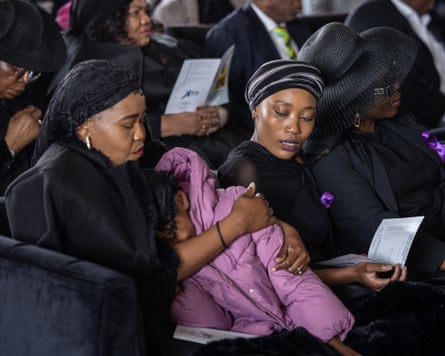
At Moselakgomo’s funeral which was broadcast by South Africa’s national TV news channels, her eight-year-old daughter, dressed in a pale pink padded jacket, took the microphone.
“Dearest mother, how heartbreaking that you left me,” she said. “The day feels quiet without your voice. But your love is still here, surrounding me with love … Your beautiful daughter loves you so much. She misses you every day. But I know that I have gained a beautiful angel in you. Love your beautiful princess, Khumo.”