.png) 3 months ago
58
3 months ago
58
Key events Show key events only Please turn on JavaScript to use this feature
Dozens injured after train crash in Czech Republic
Around 5o people were hurt after two trains have collided in southern Czech Republic this morning, with two people seriously injured, according to local emergency services.
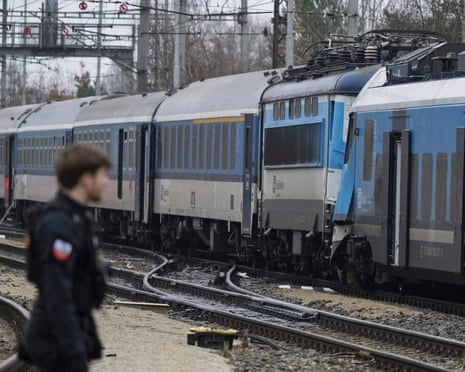
The crash took place near the city of České Budějovice after 6am, with authorities investigating the cause of the crash.
Transport minister Martin Kupka said on X the crash was still under investigation but preliminary information showed one of the trains likely passed a signal in the stop position.
Early reports say the track was not equipped with ETCS safety system, just like in a similar crash in Slovakia last week.
Dispute over chips supply from Nexperia not yet fully resolved, China says

Lisa O’Carroll
in Brussels
The Chinese ministry of commerce has said the dispute over the supply of chips from Nexperia, the Dutch-based Chinese-owed company, is still not fully resolved.
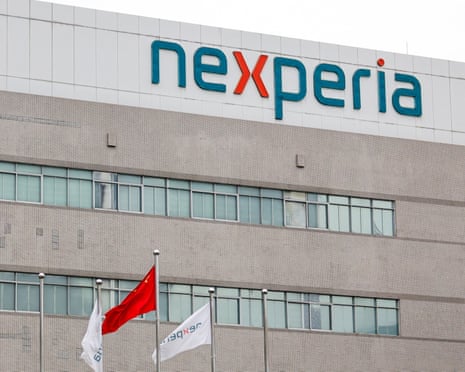
“There is still a gap to completely solve the problem,” the Chinese ministry of commerce, or Mofcom, said on Thursday.
Nexperia has been at the heart of a global slow down of chip supply after the Dutch government effectively took control of the company in the EU amid concerns the company was moving its intellectual and physical assets to China.
Mofcom said it hopes to “continue to see sincere cooperation” and an “early settlement”.
The car manufacturers trade body in the EU, ACEA, yesterday said that although the supply of chips had been restored following Beijing’s decision to lift a ban on chips, supplies remained “critical”.
Jonathan O’Riordan, director of international trade said a “bridging agreement” was still needed to secure long term supply to the sector, which a few weeks ago said it was “days away” from halting production.
Nexperia’s wafers need input from both the EU and China with the Netherlands producing the wafers which are then sent to the parent plants in China for finishing and global export.
Yesterday the Dutch economy minister Vincent Karremans said they would lift the order which imposed controls on Nexperia in the EU as a “gesture of goodwill” to the Chinese.
But Wingtech, the Nexperia Chinese, hit out demanding it permanently rescind the order that placed it under state control and insisting it had done nothing to warrant the Dutch action.
“Minister Karremans justified his actions by accusing Nexperia’s CEO of various acts of alleged mismanagement. Wingtech strongly rejects these accusations and points out that, to date, no proof has been provided,” a spokesperson for Wingtech said.
'Everything can be weaponised' in global trade, EU's trade chief Šefčovič warns
Lisa O’Carroll
in Brussels
Meanwhile, European trade commissioner Maroš Šefčovič has said the decades old global trading system with secure global supply chains is over.
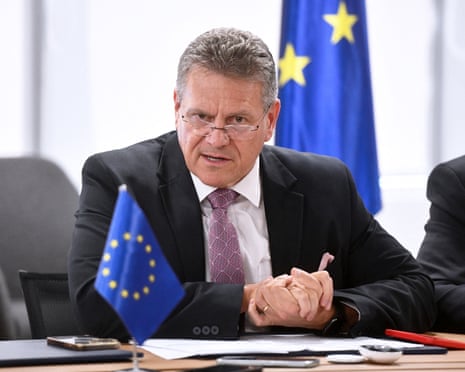
In the wake of the most recent battle between the EU and China over the supply of chips for the auto industry, he told a conference in Brussels “everything could be weaponised”.
Trade, he said, is the “new tool” in the trade wars now causing geopolitical waves between China and the US, Europe and the US with import and export bans being imposed at will by Beijing.
“Europe for years, kind of relied upon the reliable global supply chains; this is a new situation. And suddenly we might have new tariffs, might have new exports controls.
Simply, that system, which was built for decades, is not there any more. Everything could be weaponised. So unfortunately, it became the new tool in this, I would say, geopolitical competition.”
A “well functioning World Trade Organization” with reforms was vital for the future of free trade, he added.
Morning opening: EU meets to discuss the latest on Ukraine

Jakub Krupa
EU foreign ministers are meeting in Brussels this morning amid reported growing pressure on Ukraine to consider a secretive draft plan to end the war based on what effectively amounts to a capitulation from Kyiv.
The draft plan, which was reportedly developed by Donald Trump’s envoy, Steve Witkoff, and the Kremlin adviser Kirill Dmitriev, would force draconian measures on Ukraine that would give Russia unprecedented control over the country’s military and political sovereignty. The plan is likely to be viewed as surrender in Kyiv.
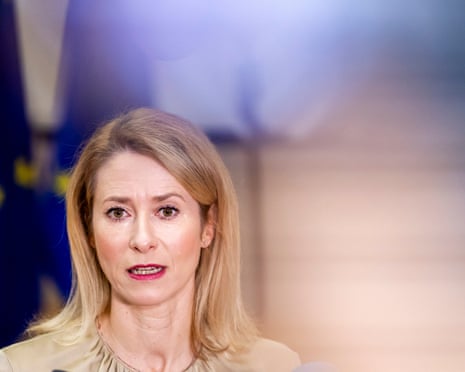
Arriving at the meeting, EU foreign policy chief, Kaja Kallas, said:
“What we as Europeans have always supported is a long, lasting and just peace, and we welcome any efforts to achieve that. Of course, for any plan to work, it needs Ukrainians and Europeans on board, so this is very clear.
Also, we have to understand that in this war, there is one aggressor and one victim. So we haven’t heard of any concessions on the Russian side. If Russia really wanted peace, it could have … agreed to unconditional ceasefire already some time ago, whereas we see again over this night bombings of civilians; 93% of Russian targets have been civilian infrastructure: schools, hospitals, apartment buildings, to really kill a lot of people and cause as much suffering as possible.”
Kallas also confirmed that, to her knowledge, no European leaders were involved in preparing the proposal.
French foreign minister, Jean-Noël Barrot, insisted that peace in Ukraine could not mean “capitulation” for Kyiv.
“Discussions are needed for us to reach a just and durable peace in Ukraine, they should start with a ceasefire on the contact line that allows for orderly discussions on the question of territories and security,” he said.
Spain’s José Manuel Albares also insisted that any peace plans for Ukraine must involved Kyiv and the EU.
But not all are equally supportive: Hungary’s Péter Szijjártó said that the EU should immediately stop any future payment to “a war mafia” in Ukraine, as he warned that “it’s an illusion to say that the time is on the side of Ukraine.”
The EU meeting comes as Ukraine mourns 26 people killed in a Russian strike on Ternopil, with 22 further people still missing.
I will bring you all the latest reactions here.
It’s Thursday, 20 November 2025, it’s Jakub Krupa here, and this is Europe Live.
Good morning.