.png) 3 months ago
59
3 months ago
59
It’s going to take some time to shake this feeling. Frankly, I don’t want to shake it. I don’t want the flare smell, akin to a thousand party poppers going off at once, to leave my skin, I don’t want the stream of content to subside and I don’t want this joy to leave.
When the final whistle blew in Manchester City’s 1-1 draw at Bournemouth the tears flowed, I pulled on jeans and trainers, told the lad to change out of his pyjamas and headed to the Emirates Stadium. Then, on Sunday, I was back, champagne in hand, for an emotional lap of the stadium and a pilgrimage to the old East Stand at Higbury to sit on the steps in front of the marble halls.
I was 17 when Arsenal had last lifted the Premier League trophy. I’m now 39, married and have a 12-year-old. A lot has changed, but one thing hasn’t: football’s capacity to produce emotion after emotion, from pain to euphoria. The idea that football can inspire such strong feelings may be alien to the uninitiated, but it is real, it is physical, it scars and it heals.
Football also provides a backdrop to moments in your life. It’s an escape and an outlet for emotions unrelated to football. It’s the fan sharing how watching Arsenal early in the season helped him to find precious mental space away from hospital as his newborn baby battled for survival, the fan hopeful an elderly relative may get to experience the joy of one more title or the fan going to Islington and St Pancras cemetery to put a scarf around a grave.
I’ve reflected a lot in the past two weeks on what brings joy to people’s lives and concluded nothing really compares to what sport provides. Football offers a collective experience that is religious without the religion or akin to being part of a mass political movement, but the unpredictability and longevity set it apart.
Plenty of other things have brought me joy and still do; my family and being a parent or being creative through drawing, painting and writing. Nothing, though, is capable of a twisted gut punch or tight embrace the way football does. It can also make you loudly and gutturally cry, in pain or with joy, with a freedom few other settings allow.
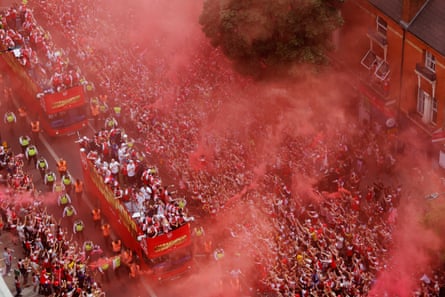
That’s why, when walking through the streets of Hackney and Islington on Sunday to and from the parade, the crowd spilling through sidestreets like slow-moving lava, I looked sorrowfully on those not part of the celebrations, but caught up in the flow.
I pity a void in their lives they probably aren’t aware of, which increasingly I don’t think anything else can fill. In the week before the title was won, I stuck on Fever Pitch for the first time in years and watched as Sarah, who is reluctant to get into football, hostile to it in fact, slowly has her interest more and more piqued, until she has the moment. She sees the beauty of shared collective joy on an epic scale when fans pour on to the streets after the 1989 title win.
The similarity to the spontaneous party when City handed Arsenal the title was striking and the joy electric, the baby thrust into the air as if it were a trophy prompting fans to cheer as if they were watching the trophy lift they were being denied.
That night, the Sunday after the final league game at Crystal Palace and the parade also gave Arsenal fans things this increasingly divided society is missing: connection and community. No one on the parade cared who they were standing next to and few things today have the power to bring people together in a shared collective feeling that nothing else matters. That is wonderful to experience and cuts across the selfishness and individuality that feel the dominant features of modern Britain.
Arsenal are far from the perfect club, though. The owner, Stan Kroenke, is experiencing a reputational comeback, but the billionaire, who made his fortune through real estate and his marriage to the Walmart heiress Ann Walton, is far from a pure antidote to the sovereign wealth fund football club ownerships of Abu Dhabi and Saudi Arabia, countries with questionable human rights records. Arsenal’s sponsorship deals with Emirates, the United Arab Emirates-owned airline, Visit Rwanda and Deel have provoked frustration and the decision to keep playing Thomas Partey while a police investigation was under way into allegations of rape, which their now former midfielder denies, also drew consternation.
You could be forgiven for wondering, in this context, how up to a million people took to the streets on Sunday to celebrate this club. These are extremely important issues that should be discussed, written about and, where necessary, protested against.
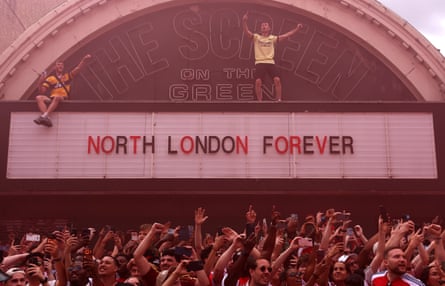
But the connection between fan and club runs deep. The club may belong to its owner, but the soul of the club is its supporters who, from generation to generation, will outlast each owner and sponsorship deal. Your relationship to your club may be eroded a little, or temporarily, but nothing can destroy your story, your connection or how the club’s highs and lows act as the backdrop to, or even shape, key moments in your life.
These connections, between club and fan and club and place, have felt to the fore in these two weeks, or even the past few years, for Arsenal supporters. Fans aren’t consumers; they don’t just want to watch a show, they want to feel the feelings and Arsenal have done a very good job at cultivating that, not least through the incorporation of the song The Angel, which most will know as North London Forever. It has been much mocked by rival fans, but it is not a song about Arsenal or football – it is about place and a celebration of working-class communities.
What we’re all looking for, overtly or otherwise, is community and Arsenal have provided the forum to give fans a reminder of what that feels like.