.png) 2 months ago
72
2 months ago
72
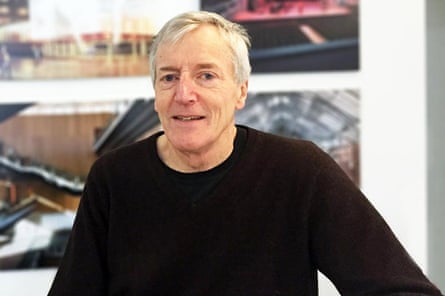
When men first walked on the moon in 1969, “space age” design began to percolate into mainstream architecture. One of the most literal and dramatic interpretations of this futuristic trend was the Royal Exchange theatre in Manchester, a heptagonal theatre-in-the-round contained in an ultra-modern structure of tubular steel and glass inspired by Nasa’s lunar lander. A key member of its design team was Axel Burrough, of Levitt Bernstein Architects, who has died aged 79.
The theatre module, which Burrough designed with David Levitt and Malcolm Brown, squats within the imposing neo-classical confines of the historic Royal Exchange. When the Exchange finally ceased trading in 1968, its grade two listed status ruled out conventional uses and refurbishment strategies, but it could be made to accommodate a building-within-a-building, conjuring a compelling visual and experiential contrast between old and new.
In an era of pre-computerised design, when everything was hand drawn, Burrough worked out the theatre’s challenging geometry on a Sinclair scientific calculator, the first to be able to cope with such complexity. Legend has it that he got through three Sinclairs in the course of the project.
Seating 750 people, all within 10m of the centre of the stage, the Royal Exchange theatre was opened in 1976 by Laurence Olivier. Over the years, despite being damaged in the 1996 IRA bomb attack in central Manchester, it has retained the affections of Mancunians and was recently voted their favourite building in the city.
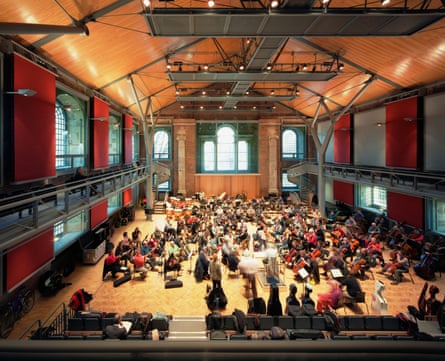
As a director of Levitt Bernstein, Burrough led a series of major arts and cultural projects, including the remodelling of the 18th-century church of St Luke’s in Old Street, central London, as a performance and rehearsal space for the London Symphony Orchestra.
Originally designed by Nicholas Hawksmoor, a contemporary of Christoper Wren, the church had been built on marshy ground and suffered from settlement problems. An especially dry summer in 1959 caused calamitous subsidence, leaving some columns hanging from the roof that they should have been supporting. The church was abandoned and its roof removed, but Hawksmoor’s distinctive obelisk spire, topped by a dragon weather vane, was retained.
The restoration project began in 1996. At the time, English Heritage considered it one of England’s most important buildings at risk. As well as being without a roof, its crypt was collapsing and vegetation growing through the walls. But the parlousness of its condition offered scope for a more imaginative architectural response. “It is a happy paradox that 40 years of dereliction and decay increased the potential for the radical reordering now on site,” as Burrough put it.
The restoration accentuated the church’s single volume by employing four massive steel columns spread out like tree branches to support a new roof, independent of the original walls. The columns describe a square within the rectangular plan, an oblique reference to a similar device in many of Hawksmoor’s churches.
No attempt was made to disguise the state of the original walls. Plaster, monuments and decoration had long gone, but their traces remain. “The new structure and galleries are an unashamedly modern intervention, so the layers of the building’s unique history will read like a palimpsest,” as Burrough described it. “And, by a happy coincidence, the rough texture of the walls is preferable acoustically to hard plaster.” When the LSO first played in the building in January 2003, he acknowledged that: “It was an emotional moment – the culmination of seven years’ hard work.”
Burrough was born in Frenchay, near Bristol, son of Thomas Burrough and his wife Helen (nee Dickson). His father worked as an architect in Bristol and previous generations of the Burrough family were small farmers, basketmakers, builders and carpenters.
Burrough studied architecture at Cambridge University, at a time when the focus was on “reliable” modern design, rather than more experimental pursuits. As a young graduate he joined the fledgling practice established in 1968 by David Levitt and David Bernstein.
He soon became involved in a succession of arts projects, honing his theatre design skills at the South Hill Park theatre in Bracknell and designing the beautifully understated Pier Arts Centre museum and gallery at Stromness in Orkney. Established in 1979, it houses an important collection of British fine art donated by the author, peace activist and philanthropist Margaret Gardiner and was sympathetically extended by Reiach & Hall Architects in 2007.
Burrough became a recognised expert in the design of theatres and performance spaces, and had a particular interest in Georgian theatres. This led to a commission for the refurbishment in 2006-07 of the Theatre Royal in Bury St Edmunds, Suffolk, originally designed by William Wilkins, architect of the National Gallery, and considered one of the most outstanding examples of Regency playhouses in Britain.
Between 1996 and 2002, he was a trustee of the Theatres Trust, the national advisory public body for theatres, and the first architect to be appointed to its board. From 2013 until 2022 he was also on the board of trustees of the Almeida Theatre, in Islington.
Later work included the King’s Lynn Corn Exchange, the Victoria Gallery & Museum in Liverpool, and the Theatre Royal, Stratford East, as cultural projects were boosted by National Lottery funding. His most recent scheme, the Bristol Beacon concert hall (formerly the city’s Colston Hall) was completed in 2023, and featured an entirely new 2,200 capacity auditorium set within walls dating from 1867.
A consistent theme was the reworking of existing structures, from a burnt-out Victorian school that became Birmingham’s Ikon Gallery, to the conversion of an art deco cinema into the Regent theatre in Stoke-on-Trent. Collaboration was also crucial, whether with other construction professionals, such as the American acoustician Carl Giegold on St Luke’s, or with artists, such as Rana Begum, whose exuberantly patterned upholstery for the Bristol Beacon resembles a piece of music unfurling.
Always finding thoughtful solutions to seemingly intractable problems, Burrough brought both rigour and flair to his practice, exemplifying the value of creative reuse and showing how historic buildings could have dynamic second lives.
He is survived by his wife, Jeni Walwin, whom he married in 1984, their three daughters, Eve, May and Dora, and two grandchildren, Kass and Skye.