.png) 2 months ago
62
2 months ago
62
Pat had been in trouble with the police before, when she was 16 and had been spat out of the care system with no qualifications, no housing and no support. Nearly 50 years later, she heard a knock on the door again.
There had been a fire in the estate where she lived, and another resident said she had seen Pat start it. “I was in the police station for nearly two days before I got to the magistrates court,” she said, worrying one finger over the top of her hand. “The magistrate said he was sending it to the crown court, and sending me to prison, basically.”
Pat, now 66, spent the next seven months on remand at HMP Bronzefield. When her case came to the crown court, she was acquitted. She struggles to walk but found when she came out of prison that her mobility car had been confiscated after the local authority stopped payments.
“Being in prison turned my life upside down,” she said. “Even now I still can’t get over the fact that I was in prison. Words just fail me. I’ve got no money, I had to get an emergency loan off universal credit so that I could live. And I’m still paying it back.”
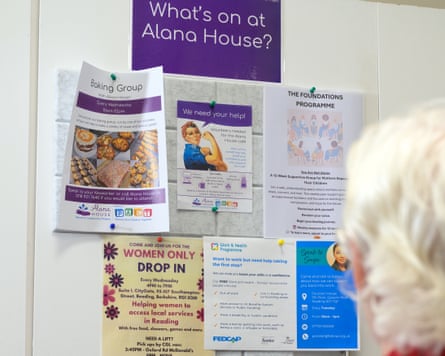
James Timpson, the CEO turned prisons minister of England and Wales, thinks women like Pat do not belong behind bars. During a visit last week to Alana House, a women’s centre in Reading run by the charity PACT, which provides support for women in the criminal justice system, Lord Timpson told former prisoners about his parents fostering 90 children during his childhood, some of them just babies who needed to be looked after while their mothers served time.
“What is clear is that there are far too many women in prison who should not be there,” he said. “Prison is needed for some women because of the crimes that they do, but there are far too many women who should be diverted away from prison and supported, and that’s what we want to try and do.”

Timpson, who was on the visit to trumpet £31.6m of new Ministry of Justice funding for women’s services, admitted that the transition from chief executive of his family shoe repair and key-cutting business to (unpaid) government minister had not been easy.
Having to immediately deal with an overcrowding crisis, the Labour peer was tasked with shepherding the Sentencing Act, which was passed in January and replaced most short sentences of a year or less with community sentences and allowed for some people to be released earlier.
“The first few months I will put down as a traumatic experience because we had the capacity crisis,” he said. “But now I feel the genuine green shoots across a huge amount of the areas that we’re responsible for, including from a women’s justice perspective.”
A longtime observer of the criminal justice system – Timpson has employed ex-offenders since 2002 – he said he was grateful for the chance to use the machinery of government to make a difference. “I feel very strongly that there are so many people who deserve a second chance in life and to be able to get the keys to drive change, it’s worth sacrificing all the other things,” he said.
Women form only about 4% of the prison population, their number having dropped slightly from 3,600 in October 2024 to about 3,300. But for those in it the statistics are unrelentingly grim. Half of female prisoners are victims of domestic violence and more than half have suffered a brain injury. While two-thirds did not commit a violent crime, female prisoners are nine times more likely to self-harm than men.
“There are many women who are, in my view, in the criminal justice system because they are victims,” Timpson said. “We need to help them.”
Last year Timpson set up the Women’s Justice Board with the explicit aim of reducing the number of women in prison. In its first report, released on Monday, it called for a change in the law so that pregnant women are imprisoned only in exceptional circumstances, and new laws to reduce remand and recall.
It also urged the government to incentivise police forces to keep women out of prison by using alternatives such as deferred sentences, which give offenders a grace period to tackle an issue that resulted in them committing a crime.
Pia Sinha, the CEO of the Prison Reform Trust and a member of the board, said successive governments had called for fewer women to be put in prison, without much changing. She compared the formation of the Women’s Justice Board to that of the Youth Justice Board in 1998, which is credited in part for vastly reducing the youth prison population in England and Wales, from 3,200 in 2008 to 445 in 2024.
“When everyone works together, you can actually really make a difference on the ground,” Sinha said. “We now have a team of experts influencing the government, saying: ‘We’ve been hearing this for 20 years, what are you going to do that’s different?’”
Speaking to Timpson at Alana House, Pat said the women’s centre had been her “lifeline”. Having left school at 15, in prison she took GCSE maths and English, getting the highest grade possible. Now she hopes she can pay off her debt, get her mobility car back and start volunteering to help other women who are getting out of prison.
“It’s like there’s a missing piece in me at the moment,” she said. “But I’m going to get that missing piece back.”