.png) 2 months ago
59
2 months ago
59
Months ago, the street was covered with dozens of bodies laid out on blue tarpaulins and black plastic sheets: victims of Rio de Janeiro’s deadliest day, when 122 people were killed in the bloodiest police operation in Brazilian history.
Now, however the asphalt and curbs of Saint Luke’s Square in the Vila Cruzeiro favela are drenched in the colours of the national flag after local artists and children repainted them, emblazoning the street with messages of support for Brazil ahead of the World Cup.
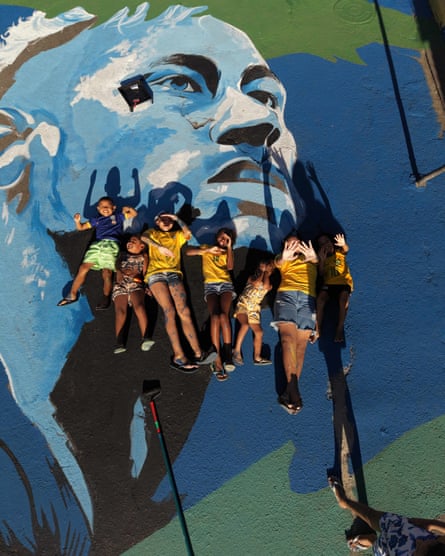
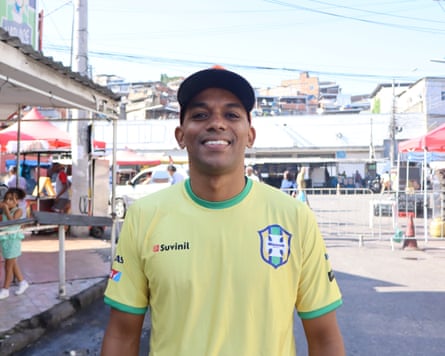
Sunday’s repainting was organised by the local artist and painter Luan Medeiros, 33, a former footballer who wanted to bring some joy back to Saint Luke square, which became indelibly associated with the trauma of the police operation last October.
“Everything that happened brought so much pain. I thought: paint transforms things, so why not transform this place and the community as well?” said Medeiros, who was helped by local businesses and many volunteers.
Aline de Souza Martins, 39, who lives a street away was one of those volunteers, along with her daughter, Ágatha, 15, who was soon covered in green, yellow and blue paint.
“I’ll be honest: I avoided this area for a long time,” said Martins. Since the massacre, she had taken different routes to avoid passing through the square, which is home to much of the favela’s commerce and its main public transport links.
It was there that the bodies of many of the 117 civilians killed in the operation were laid out by residents after they had been abandoned by police in a nearby forest. (Five police officers also died in the violence)
“It was horrific. Much worse than what people saw on television. We had the smell, the screaming, the sound of mothers crying,” said Martins.
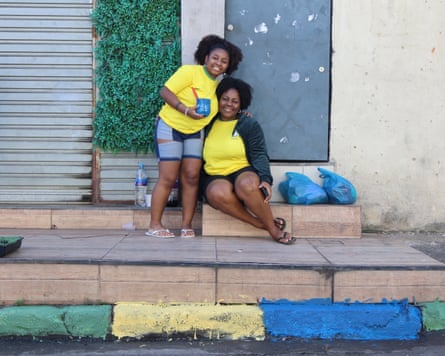
Last Sunday, her daughter was among the many children who, smiling and playing, had been given responsibility for painting the kerbs and the larger sections of the street, while the finer details – including a portrait of the superstar Neymar – were left to the adult artists.
“This doesn’t erase what happened, but the image today is completely different from what it was then, so it eases your heart a bit,” she said.
Just over seven months after the massacre, public prosecutors are still investigating how a police operation came to produce such a high death toll – unusual even by the standards of Brazil’s notoriously violent police forces. So far, 17 officers have been charged over alleged offences, including the theft of a rifle and car parts.
Marcelo Resende, a journalist whose doctoral research focuses on the politicisation of national symbols such as the national team’s shirt, sees the street painting as an attempt by the community to assert that, despite how it is treated by the authorities, it too is part of Brazil.
“Football is one of the few popular phenomena still capable of allowing vulnerable populations to feel that they belong to the nation … By painting a street, you create new meanings. Months ago, that same street had been the setting for one of the most powerful images of what Brazil does to Black people and favela residents,” said Resende, who was born and raised in the Jacarezinho favela, where a police operation killed 27 civilians in 2021.
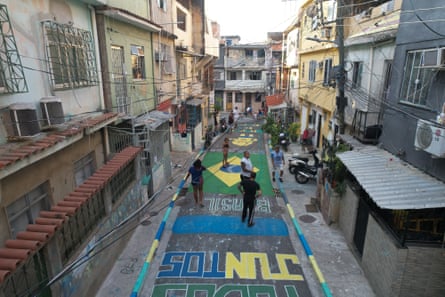
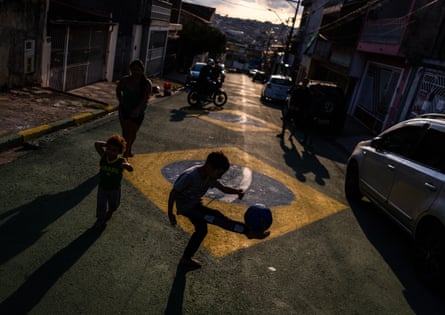
Resende also sees the repainting as part of a broader trend in which Brazilians appear to be reviving the decades-old tradition of decorating streets with flags and murals ahead of the World Cup. “After fading in recent years, my impression is that the tradition is coming back,” he said.
It is not known exactly when the tradition began, but another researcher traced it back to at least the 1970 World Cup, when Brazil won its third title. It then returned every four years and reached a peak when Brazil hosted the World Cup in 2014.
In the 2018 and 2022 tournaments, however, enthusiasm was far more muted. Resende believes that was due, respectively, to the humiliation of Brazil’s 7-1 defeat to Germany in the 2014 semi-final – a subject on which he wrote a book – and to the Covid-19 pandemic.
But now, “social media is flooded with images of painted streets from all over the country … It creates the impression that this is happening with greater intensity, and I think that is probably true,” said Resende. Municipal governments are holding competitions to choose the most beautifully decorated street.
The mural artist Hugo Silvério, 37, who designed the painting in Saint Luke square, believes much of the tradition’s resurgence is being driven by its trending on social media.
“Everything can become something Instagrammable these days, so some big companies are taking advantage of that to generate engagement. But what’s interesting is that it has also spread through communities and people are doing it on their own, so it becomes something positive in the end,” he said.