.png) 2 months ago
56
2 months ago
56
A robot magician called D4YRL was rejected as a member of the Magic Circle last week, for being insufficiently human.
While D4YRL’s tricks were exemplary, the august organisation decided “he” did not engage the audience’s emotions as a flesh-and-blood performer would.
With robotics and AI now advancing at breakneck speed, it was the latest example of an organisation forced to confront questions that were once the province of philosophy – such as what it means to be human.
In her enjoyable new book, We Are Not Machines, the FT journalist Sarah O’Connor takes a long, hard look at one pressing aspect of this problem: how AI is changing our jobs and perhaps, in the process, changing us.
She spends time with Amazon employees whose tasks are constantly surveilled, and with invisible staff thousands of miles away in India and Costa Rica, watching hours of mind-numbing video footage, to train the AI systems monitoring the warehouses.
“We think we’re robotising our work, but what if we’re robotising ourselves?” she asks.
She talks to translators who feel the joy has drained out of their work, now that they spend their days correcting mediocre AI-generated text for a fraction of the pay instead of exercising their creativity – a job known as machine translation post-editing.
“I want to have something creative, but I’m not sure that I can have a creative job that’s not endangered,” one translator, Petr, tells her. “Everywhere you step, there’s AI.”
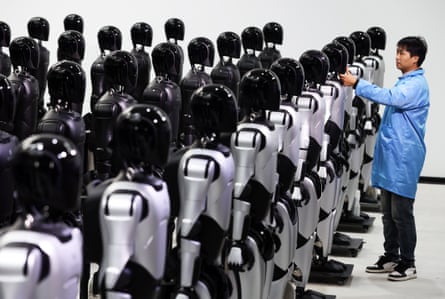
Importantly, O’Connor also reviews the growing evidence that we may be reading, thinking and understanding less as we lean on technological shortcuts – potentially changing the very nature of human intelligence.
Her conclusion is not that we should resist AI altogether but that we should think more carefully about which aspects of work should be automated – joining, as the book’s subtitle puts it, The Fight for the Future of Work.
Just because a robot may technically be able to perform a task, for example, we shouldn’t necessarily accept that it should. O’Connor makes that point powerfully as she watches a Dutch nurse caring for an elderly patient at home with a humour and empathy that a robot carer couldn’t provide, any more than D4RYL can master a magician’s patter.
“Technology is designed by people, made by people, and adopted by people. And it is perfectly reasonable for policymakers, business leaders, workers and consumers to say ‘yes’ to some uses of new technology, or workplace changes induced by technology, and ‘no’ to others,” she says.
Billionaire tech bros speak with disarming certainty about the coming dominance of AI, with knock-on effects for human workers, who demand to be paid, take holidays and gossip about their weekends.
In her reporting, however, O’Connor uncovers stark differences in the way technology is affecting people’s working lives, depending on their bargaining power over the way it is introduced.
In Sweden, where union-employer negotiation is deeply embedded in the country’s economic model, she visits a mine in Renström where staff and bosses worked together on bringing in the autonomous underground trucks that now whiz along 800 metres below the earth’s surface.
And she talks to organisers of the Hollywood writers’ strike, whose leverage over the studios allowed them to win considerable control over whether and how AI is deployed in the creative process.
For the majority of workers, who lack the writers’ clout, it may have to be governments that set the boundaries, though. In the UK the Trades Union Congress and the thinktank the Institute for Public Policy Research have called for employees to be given the right to negotiate before new technology is deployed in their workplace – although ministers may be cautious, given their enthusiasm for AI as a great hope for boosting productivity.
While it isn’t O’Connor’s main focus, the disproportionate influence wielded by the men behind the models is another cause to fret about our reliance on them.
Fighting back feels especially important this week, as the SpaceX IPO consolidated Elon Musk’s extraordinary economic power – days after he was accused of using his ownership of X to incite racist riots on the streets of the UK, claims that he rejected.
Musk’s power extends beyond Earth: an eye-opening paper co-authored by Alessio Terzi of the University of Cambridge, published to coincide with the IPO, showed that SpaceX has a market share of 75% of everything humanity sends into space.
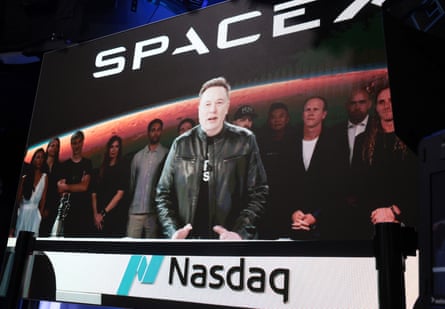
In the excellently titled Outsourcing the Final Frontier, Terzi argues that Musk’s market dominance of space may well exceed the stranglehold exerted over the world’s maritime commerce by the rapacious East India Company at the height of its power in the 1820s.
That comparison does not bode well. “History tells us that power and exploitation become so entrenched that states are finally forced to intervene, by which time the costs of doing so are vast,” Terzi warns, adding pointedly: “The East India Company took two centuries to bring under control.”
Back on Earth, Musk envisages a growing role for humanoid robots, and is certainly not a fan of worker power – he refuses to cooperate with unions, claiming they “create a lords and peasants kind of thing”.
All the more reason that, as O’Connor shows, policymakers and the public should not be prepared to accept without question his vision – broadly shared by other Silicon Valley billionaires – of the relentless march of AI and robotics into every aspect of our lives, including the workplace.
With the aid of technology, “the future of work can be more worthy of the human mind, more careful of the human body, more satisfying to the human soul,” she writes, “but not without a fight”.