.png) 2 months ago
55
2 months ago
55
Trying to unlock the secrets of Debussy’s opera Pelléas et Mélisande, based on Maeterlinck’s symbolist play, is a slippery task at the best of times. Doing so in a barely there staging, with the orchestra on the platform with the singers, is even trickier. For the opening performance of this summer’s Aldeburgh festival, that was the challenge that reunited the conductor Ryan Wigglesworth, a featured artist this year, with the actor and occasional opera director Rory Kinnear.
Apart from some industrial-style pendant lights and a single high stool, there were no props or scenery – unless you count the orchestra, through which the characters stumbled as if the instrumentalists were the forest surrounding the castle. Costumes, likewise credited to Vicki Mortimer, were low-key: dark suits for the royal men, tattered bridal white for Mélisande, drab boiler suits for the silent onstage extras, who also provided the brief offstage chorus.
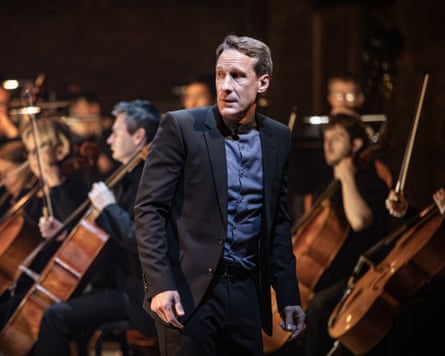
What mattered, visually, was the light. Working with the lighting designers Paule Constable and Imogen Clarke, Kinnear took his cue from the stream of references to shadow and luminosity in the text. Characters moved through spots or pools of light on the platform, or walked in the gloaming of music-stand lights among the orchestra behind. When Geneviève sang of the distant glint from the sea, it was the foyer light beaming in through an open door near the back as her son Pelléas made his entrance, singing from the aisle as he approached the stage through the auditorium. His eventual, inevitable kiss with his brother’s wife took place in a blaze of side lights.
Conducted by Wigglesworth, a featured artist in this summer’s festival, the BBC Scottish Symphony Orchestra often sounded glorious, especially in the interludes. Yet music that can sound ethereal when emanating, disembodied, from an orchestra pit here seemed solid, even earthy. This wasn’t a problem for the singers, whose voices came across with warm immediacy in the Snape acoustic, from Nicolas Testé’s cavernous Arkel through Sarah Connolly’s luxuriant-sounding Geneviève to Beth Stirling’s chirpy Yniold. There was a convincing sibling rivalry between Gordon Bintner’s Golaud, all velvet-wrapped forcefulness, and Jacques Imbrailo’s appealingly heartfelt, generous Pelléas. But where did mysterious Mélisande fit in? Sophie Bevan shone vocally in the role, her soprano silvery and fluid, but in this stripped-back context the character had little to do except gaze inscrutably out into the audience, arms by her side, blank rather than mysterious. This intelligent semi-staging was gratifyingly ambitious in what it set out to achieve, and nearly succeeded – but Debussy’s opera remains ever elusive.