.png) 1 hour ago
6
1 hour ago
6
Von der Leyen's State of the Union speech - summary
Jakub Krupa
-
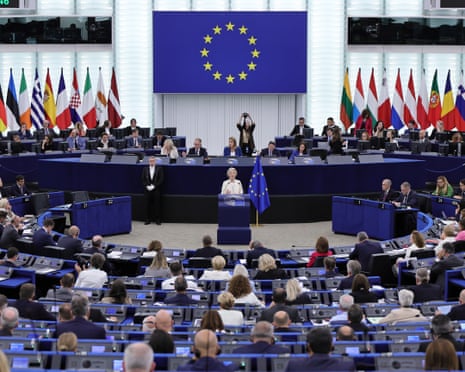
European Commission president Ursula von der Leyen has warned the EU is “the strongest” but “most precarious” (9:16) it has ever been as it faces “an openly hostile world” (9:18) as she delivered her annual State of the Union address in the European parliament in Strasbourg.
-
Von der Leyen outlined proposals for reforming the EU’s single market (9:21) and improving competitiveness and innovation (9:30), as well as electrifying its energy market (9:24), and rebalancing its trade relationship with partners, particularly China (9:27).
-
In one of the most eye-catching proposals, she suggested Canada could become an associate member of the European Union (9:54).
-
Von der Leyen also warned about the growing threat from Russia as she called for a “European Security Council” to help countries coordinate on security issues (9:58), as she pledged further support to Ukraine (10:04).
-
In her wide-ranging speech, she also discussed the issue of irregular migration (10:10) and criticised Israel for “unacceptable” plans for its illegal E1 settlement project (10:07).
-
She also called for urgent action on climate preparedness as she warned Europe faced “the hottest summer months ever, but the coolest of years to come” (9:34, 9:39).
-
Von der Leyen also confirmed plans to introduce tougher rules on social media to protect children online, including a ban for users under the age of 13, as she warned that highly addictive platforms are “depriving children of their childhood” (10:20).
-
The commission president also advocated for “AI with human agency,” and for Europe to explore “hidden” value where it can capitalise on its “big advantages” (9:45, 9:48).
-
In a pointed comment, she also criticised Serbia for last week’s funeral of convicted war criminal Ratko Mladić, saying “glorifying war criminals simply has no place in the European Union” (10:24).
Key events 18m ago Von der Leyen's offer to Canada 'cannot be underestimated in political and trade significance' - snap analysis 41m ago Von der Leyen's State of the Union speech - summary 1h ago EU's 'powerful promise' needs new generations to 'rediscover ability to think European,' von der Leyen says 1h ago 'Glorifying war criminals has no place in the EU,' von der Leyen says in criticism of Serbia and Mladić's funeral 1h ago Social media 'depriving children of their childhood,' von der Leyen says, as she confirms strict rules on social media 1h ago 'European democracy is being threatened' by disinformation, foreign interference, von der Leyen says 1h ago Von der Leyen says EU will draft tougher rules for emergency migration scenarios 1h ago EU's von der Leyen calls Israel's E1 settlement project 'unacceptable' 1h ago EU 'will give our strongest ever support to Ukraine over the toughest winter of the war,' von der Leyen says 1h ago 'Threats are mounting on our soil' with threat from Russia growing, von der Leyen warns, as she calls for 'European Security Council' 1h ago Von der Leyen proposes Canada to be associate member of the EU 2h ago 'Some people want to backslide on women's rights,' von der Leyen warns 2h ago 'We want AI with human agency,' von der Leyen says 2h ago Von der Leyen leads parliament in moving tribute to helicopter pilot who died when fighting wildfires in Greece 2h ago 'The hottest summer month ever, but the coolest of years to come,' von der Leyen call for urgency on climate 2h ago EU's trade relationship with China 'unsustainable' and need to be rebalanced, von der Leyen says 2h ago 'We need to electrify Europe,' von der Leyen says, to cut fossil fuel costs down 2h ago von der Leyen warns against anti-European ultranationalists and Russia who 'despise our values' 2h ago 'We are now dealing with an openly hostile world,' EU's von der Leyen warns 2h ago EU 'the strongest' but 'most precarious' it has even been, von der Leyen says 2h ago Watch von der Leyen's SOTU live - video 3h ago Morning opening: The state of the European Union
Worth remembering that Mark Carney is due to address the European parliament tomorrow, so will be definitely worth tuning in to hear his take on the “associate membership” idea.
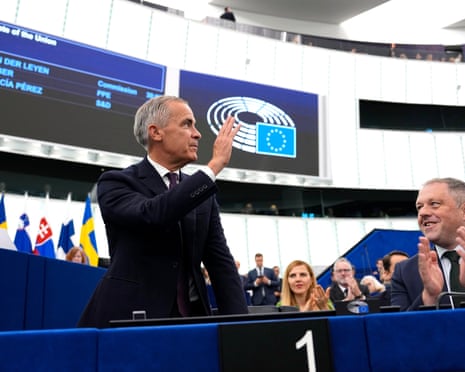
He is scheduled to speak 11:30 local time (10:30 UK) tomorrow.
Von der Leyen's offer to Canada 'cannot be underestimated in political and trade significance' - snap analysis
Lisa O’Carroll
Senior correspondent
Ursula von der Leyen’s dramatic offer to open the gate to Canada to become the EU’s first ever associate member (9:54) cannot be underestimated in political and trade significance.
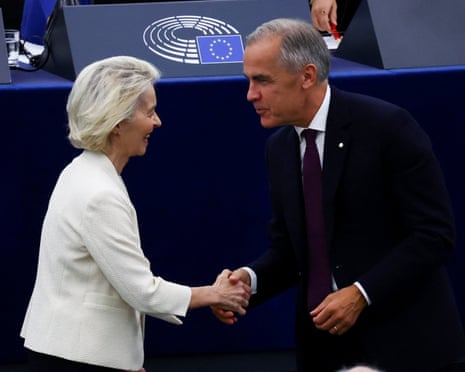
It, at once, aligns what Canadian prime minister Mark Carney called the “middle powers” in his Davos speech in January but creates an opening for a speedy enhanced trade deal particularly on critical raw materials and rare earths.
It also sets Canada apart from the UK which could, once upon a time, have some sort of associate membership with the EU were it not for the drive for a clean break Brexit.
Two points of realpolitik make it possible that the long winding road that typifies third country’s relationships with the EU could turn into a high speed motorway.
Canada has something the EU desperately needs: rich supplies of CRM and rare earths in a bid to diversify from China which has a stranglehold on both.
And Europe has something Canada urgently wants: new market for products it can no longer sell into the US in the face of a trade war with Donald Trump.
Looking at the bigger picture a new enhanced trade deal between the EU and Canada could leave the UK somewhat scrambling in a two speed race.
Keir Starmer talked about forging a CRM and rare earths deal with Canada but it never materialised.
If political energy in Brussels is now focused on Canada that could be bad news for Andy Burnham.
Von der Leyen's State of the Union speech - summary
Jakub Krupa
-
European Commission president Ursula von der Leyen has warned the EU is “the strongest” but “most precarious” (9:16) it has ever been as it faces “an openly hostile world” (9:18) as she delivered her annual State of the Union address in the European parliament in Strasbourg.
-
Von der Leyen outlined proposals for reforming the EU’s single market (9:21) and improving competitiveness and innovation (9:30), as well as electrifying its energy market (9:24), and rebalancing its trade relationship with partners, particularly China (9:27).
-
In one of the most eye-catching proposals, she suggested Canada could become an associate member of the European Union (9:54).
-
Von der Leyen also warned about the growing threat from Russia as she called for a “European Security Council” to help countries coordinate on security issues (9:58), as she pledged further support to Ukraine (10:04).
-
In her wide-ranging speech, she also discussed the issue of irregular migration (10:10) and criticised Israel for “unacceptable” plans for its illegal E1 settlement project (10:07).
-
She also called for urgent action on climate preparedness as she warned Europe faced “the hottest summer months ever, but the coolest of years to come” (9:34, 9:39).
-
Von der Leyen also confirmed plans to introduce tougher rules on social media to protect children online, including a ban for users under the age of 13, as she warned that highly addictive platforms are “depriving children of their childhood” (10:20).
-
The commission president also advocated for “AI with human agency,” and for Europe to explore “hidden” value where it can capitalise on its “big advantages” (9:45, 9:48).
-
In a pointed comment, she also criticised Serbia for last week’s funeral of convicted war criminal Ratko Mladić, saying “glorifying war criminals simply has no place in the European Union” (10:24).
EU's 'powerful promise' needs new generations to 'rediscover ability to think European,' von der Leyen says
Von der Leyen now talks about the EU’s “powerful promise” dating back from its foundation, as she calls for new generations to “rediscover this ability to think European.”
The EU will create a new “Congress for Europe,” drawing on its origins, to get “the brilliant minds from across our union and across our continent” to “inspire the new generation of Europeans.”
“We should never forget the origins of our union. So long at war, united to forge a common destiny, a destiny of peace and prosperity, of democracy and freedom.
They never wrote down where the destiny would finally lead. But each generation has built on the foundations of its predecessors. Step by step, brick by brick, of course, imperfections are diversity, and our differences remain.
But that is precisely what makes Europe, our Europe and our common home.”
And on that point, she ends her speech to some applause from the audience.
'Glorifying war criminals has no place in the EU,' von der Leyen says in criticism of Serbia and Mladić's funeral
Switching to French now, von der Leyen says “we also have to win back the hearts of Europeans.”
She also says the EU needs to look beyond its borders in the western Balkans.
She says the process “will continue on merit.”
But she says the adherence to EU values is “non-negotiable,” as she says she was “horrified by the pictured from Ratko Mladić’s funeral in Belgrade last week.”
“He committed the most atrocious crimes against humanity. Glorifying war criminals simply has no place in the European Union.”
Social media 'depriving children of their childhood,' von der Leyen says, as she confirms strict rules on social media
Von der Leyen then turns to the question of online safety, particularly for children.
She warns that “young Europeans now spend four to six hours a day on screens,” as they “are pulled ever deeper into feeds designed to keep them scrolling.”
“What we are witnessing is a great capture of our children. A capture of their attention, their focus, their minds. This is depriving children of their childhood.”
She references the death of a 14-year-old Belgian girl, Oléa, who killed herself as a victim of online bullying.
She quotes her mom who said: “I am convinced that had it not been for these omnipresent networks, my daughter would still be with us.”
Von der Leyen says “enough is enough” and confirms plans to bring forward “the Kids’ Act” with strict restrictions on social media usage by children.
“We will take a gradual and differentiated approach. Each age has its own sensitivities, and therefore each will have its own tailored protection level.
No social media under the age of 13. No personal account under the age of 15.
That means from 13 to under 15, only mini accounts set up and supervised by parents or guardians, with limited features and time restriction to one hour a day and between 15 and 18, safe design will be an obligation for the platforms.”
She says the EU “will not accept addictive features” and “children being drawn into ever more extreme content.”
“We are reversing the burden of proof: now platforms will have to prove to us that they are safe because this is not about our minors accessing social media. It is about when and how do we allow social media to access our minors. Europe has the power to act. It is us who decide the rules, not big tech.”
'European democracy is being threatened' by disinformation, foreign interference, von der Leyen says
Von der Leyen then turns to the issue of democracy in Europe.
She says “our European democracy is being threatened” with “disinformation and foreign interference seeking to divide us, seeking to erode trust in our democratic fabric and free media.”
She pointedly says “the threats to our democracies do not only come from the outside,” as Europe sees “the rise of anti-democratic, anti-European forces.”
But she says “nothing is inevitable,” as she celebrates the change in Hungary, with the new pro-EU government led by Péter Magyar after 16 years of Viktor Orbán.
“12 April will stay in our memory for a very long time,” she says, referencing to the election day in Hungary.
“Hungarian people took their future in their hands. They chose democracy. They chose Europe. They brought Hungary back to where it belongs, at the heart of the European Union.
Years of backsliding have started to be reversed. The fight against corruption and state capture is speeding up. There is real progress on fundamental rights, on academic freedom, and now billions of euros of investment in Hungary have been unlocked. There is, of course, much more work ahead.
But … this shows the hard work pays off.”
Von der Leyen says EU will draft tougher rules for emergency migration scenarios
Von der Leyen then turns to migration, and not surprisingly touches upon the migration crisis in Ceuta.
She says “vulnerable people are being exploited by callous traffickers and smugglers, by our adversaries.”
She addresses the Spanish people, saying “Ceuta border is a European border, because Ceuta is Spain and Ceuta is Europe – and Europe will be there for you.”
She talks about the EU’s pact on migration and asylum, which “needs to be fully implemented.”
But she says the EU needs new rules for emergency situations, “especially in scenarios when mass movements are engineered and weaponised.”
“This is why we will propose a new European Emergency Response instrument. It will only be triggered under a strictly defined set of criterias. And in those cases, it will allow for a time limited and strictly defined flexibility of standard procedures.”
She says the message is clear: “we will always comply with our values and fundamental rights, but we will never compromise on protecting our borders because it’s us Europeans who decide who comes to our union and under what circumstances.”
She also talks about the need to strengthen the EU’s border agency, Frontex, and proposes a new “Mediterranean Youth Skills and Jobs Initiative” to work with partners in third countries.
EU's von der Leyen calls Israel's E1 settlement project 'unacceptable'
Von der Leyen then turns to the situation in Gaza.
She says “the deep suffering in Gaza and unchecked settler violence in the West Bank have deeply affected Europeans.”
She says the Israeli government’s decision to go ahead with the illegal E1 settlement project is “unacceptable.”
“It is painful for many Europeans that member states have been unable to build the necessary majorities for a unified response. Some member states have moved ahead. Others are considering to do so. When Europe is divided, it cannot change the course of events,” she acknowledges.
She says the EU is “leading the way in supporting Palestinians,” and will continue to do so.
She says “Europe supports the right to self-defence for Israel, and the Palestinian people have an equal right to live in safety and dignity.”
“It is Europe’s role to keep the flame of the two state solution alive.”
EU 'will give our strongest ever support to Ukraine over the toughest winter of the war,' von der Leyen says
Switching to German, von der Leyen moves on to Ukraine.
She says “the coming winter will be tough for Ukraine,” but says nothing can break “the Ukrainian spirit of resistance.”
“Our task remains to support Ukraine as best we can,” she says.
She says the EU “will give our strongest ever support to Ukraine over the toughest winter of the war.”
She says the EU is now using its funding to help Ukraine buy air defence systems, and wants to work on developing “an affordable modular missile defence system,” made in Europe.
But she says “more is needed.”
The EU will work on “setting up a new programme for joint projects with Ukrainian companies,” and work to “tighten our sanctions on Russia.”
“What is needed is not necessarily new sanctions, but above all the enforcement of existing ones. Our sanctions … are putting enormous pressure on the Russian economy. Russia is doing everything it can to get around them. So we must close the loopholes.”
She goes back to English, talking about Russia’s indiscriminate attacks on civilian populations in Ukraine.
“This is a deliberate strategy of terror,” she says.
She talks about a story of a Ukrainian girl named Sasha and her resilience in returning to gymnastics after losing her leg in a Russian strike.
“Just seven months after the attack, she was back in the gym with her new prosthetic leg. She trained harder than ever. She started winning gold after gold. This summer, she travelled the world with her Dance of Freedom tour. Her aim is to tell the world about Ukrainian resilience and the fight for freedom," she says.
Sasha is in the audience and gets a standing ovation.
Von der Leyen says “there is no room for any kind of doubt: Europe will defend each and every single square metre of its territory.”
'Threats are mounting on our soil' with threat from Russia growing, von der Leyen warns, as she calls for 'European Security Council'
Von der Leyen then moves to security, as she references the recent incidents in Lithuania, Denmark, and Poland just this week.
“Russia’s war of aggression on Ukraine rages on and threats are mounting on our soil,” she warns.
“We need to be clear about what this was an attack using military grade material carried out by Russian operatives on European soil and attack not only on one member state, but against all of our union.”
She adds that “hybrid threats facing Europe are less and less hybrid and less and less threats.”
“Cyber sabotage, arson. Drone incursion. They are ramping up every day.”
Von der Leyen says the EU’s preparedness needs to be raised, with existing systems “made for a different world.”
She says the EU needs “its own counter-hybrid playbook,” and how it can respond to incidents just below the threshold of armed aggression.
She calls for the EU’s equivalent of Nato’s Article 4 (note: Article 4, not best known Article 5), “an emergency security protocol.”
“When triggered by one member state, all member states should convene to coordinate a European response to deter further escalation and to mitigate the impact,” she says, calling for the establishment of a “European Security Council.”