.png) 1 hour ago
5
1 hour ago
5
Orville Peck was in the middle of a soundcheck when he found out that his idol Dolly Parton had died. It was late August and the masked, pseudonymous country singer was due to perform an intimate set at London’s Rough Trade East in half an hour. The news hit him like a truck. With no chance to process it, he decided to grieve in real time, on stage, before a roomful of fans.
“I’m a little bit of a mess right now,” Peck told the audience, perched on a stool with an acoustic guitar. “Dolly was my hero,” he continued, his voice cracking. “As a gay man coming into country music and feeling sort of alone, I think the thing that always felt comforting is, like, just knowing Dolly existed in country. It made me feel like I had a friend there.” He then launched into a rendition of Parton’s iconic hit I Will Always Love You.
“It felt like an impromptu memorial,” Peck recalls on the sofa of his New York City hotel room three days later, having touched down the night before to promote his new album, Mule. “I had to work through it with 400 strangers. We all got to sort of mourn together. I definitely think everyone there will remember that forever.”
Mortality has been on Peck’s mind a lot lately. Mule is a brutally honest chronological account of what he describes as “the most important year of my life”, a period marred by profound heartache and self-destruction during which he split up with his partner of four years, overdosed and nearly died. Its opening track envisions his own memorial – what would have happened if he hadn’t come back from the brink. Prologue (Eulogy of a Man Turned Mule) is an a cappella hymn sung not by Peck, but by Emmylou Harris, Allison Russell and Noah Cyrus, a trio of country muses from different generations whom he compares to the witches of Macbeth or a Greek chorus. “Come walk through the fire, come stand with the few / Who break their own hearts to be saved,” they intone. “But the heart can’t be saved from the wretched and blue / Here lies a man turned mule.”
While country has been dominating the top spots of the Billboard Hot 100 this summer, Peck emerged from Toronto during 2019’s “yee-haw moment”, as artists like Kacey Musgraves and Lil Nas X were turning some pop listeners’ ears to the genre, injecting it with disco and hip-hop beats and a modern, queer sensibility. His face obscured, Peck kept his true identity a mystery, but he was open about his sexuality, and undeniably sexy, out of the gate (he recently posed for Playgirl). That he had a baritone croon that evoked Roy Orbison and Elvis Presley made his arrival all the sweeter. Over the next few years, Peck would duet with Elton John, Kylie Minogue and another one of his major inspirations, Willie Nelson, who dueted with him on a cover of the gay country classic Cowboys Are Frequently Secretly Fond of Each Other, score a No 1 album on the UK country charts and scoop up Glaad’s Vito Russo award for elevating LGBTQ acceptance and visibility. In 2025, he made his Broadway theater debut as the Emcee in the vibrant revival of Cabaret at the Kit Kat Club.
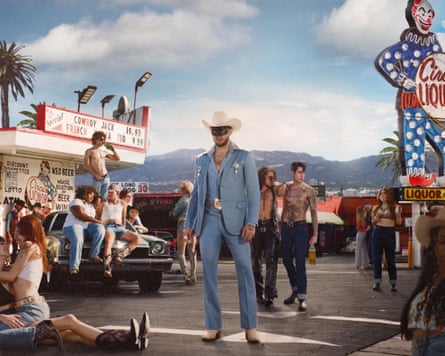
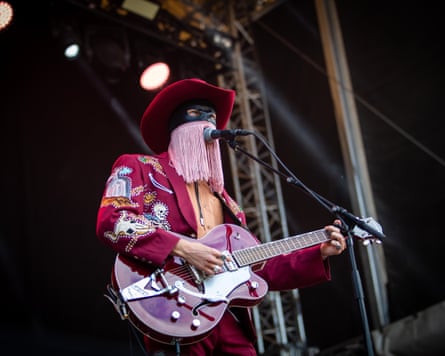
The 38-year-old musician’s previous records – 2019’s Pony, 2022’s Bronco and 2024’s Stampede – were laced with metaphor, at times unspooling like the dusty tales of an omniscient, enigmatic gunslinger. While the bluegrass-inflected Mule is more literal, like an unvarnished memoir, he couldn’t abandon the high drama completely. “I still wanted to add some kind of theatrical element,” says Peck. Today, he wears a white tank, chunky Wrangler x Cherry knit jacket, faded jeans, cowboy boots and a cream-colored Stetson. His penetrating blue eyes peek through a simple suede mask, but his trademark disguise, a black leather upper with a fringed veil, sits behind him on the bed, its golden tassels cascading over the edge of it. His right hand and wrist are wrapped in a thick bandage.
“I thought, We’ll start with the most bleak thing possible,” Peck continues. “If I had died in 2023, if that was my legacy, what would these three witches be singing about?”
Peck is not afraid to contemplate his own demise, nor is he afraid to be sitting now in the same hotel where he tried to take his own life. “It’s like when people ask me, ‘Oh, do you regret any of your tattoos?’” he says, chuckling at the slight absurdity of the analogy. “And I’m like, Well, I have some that are really shitty, but I would never get rid of them or wish I hadn’t gotten them, because I feel like it’s part of my story.”
He would not deny, however, that his overdose may be the darkest chapter of that story. The night it happened, in June 2023, he was preparing to kick off his tour for Bronco with a sold-out concert at the Theater at Madison Square Garden. He went out to celebrate, got hammered, bumped into his ex at a club and spiraled. His management found him the next morning and gave him an ultimatum: he would cancel the tour and get help, or they’d cut ties with him. After rallying to play the packed show that evening, he announced that he was postponing his remaining tour dates to focus on his mental and physical health. Then he flew back home to Los Angeles and checked into a rehabilitation center.
While he could acknowledge that he was leaning too much on booze, cocaine and prescription pills, he entered the facility begrudgingly. “I was like, I’ll be fine. I’ll play along with the parts that I don’t really think I need, and I’ll just kind of roll my eyes at the stuff I’m entitled to be annoyed about,” Peck says. “I believed that I had it under control.”
He details his dismissive outlook and resentment – which he now realizes was just blinding denial – in the first half of Mule. He refers to rehab as “the slammer” and deems it a waste of time in the mocking Already Gone. In the next track, the clever, ragtime-y Rehab Blues, the reality of his surroundings sets in: watchful eyes, sad sharing circles, stifling seclusion. “So catch me on the evenin’ news: Dumb fag dies from the rehab blues,” he sings sardonically, later confessing, “I hate it here, I don’t care and I wanna die.”
Peck left the center about a month later, knowing full well that he’d continue to use. He told himself that he wasn’t like the others he’d met there. He wasn’t an addict. “There’s a term for it: We call it terminal uniqueness,” Peck says. “Where a part of you is actually seeing that it’s totally you, but then a massive part of you is going, But I’m different. I can stop.”
The root of his resistance, he thinks, was an inveterate aversion to following the herd. Growing up queer and closeted in South Africa and Canada, he had supportive parents – his father was a glam-rock sound engineer and his mother is an artist and a seamstress – but he says he felt alienated from his peers. “That’s where this otherness came from”, he says. “At first, it was put on me … and it was unbearable.” To escape, he turned to ballet and musical theater. He discovered punk and the renegade country of Nelson and Johnny Cash. He found himself drawn to outsize characters like Parton and John Waters. His reaction, eventually, was to wear his outsiderness as a badge of honor. That is where Orville Peck, the masked lone ranger, was born.
“It’s hard for someone like me because it takes not just admitting to yourself that you have a problem – I also had to reckon with my phobia of conforming,” he says of his struggle to get sober. “In a situation like that, I choose to remove myself in a way that’s like, I don’t need this shit. I’m not the same.” He’d been carving out his own path for most of his life to protect himself. With his successful stage persona, he explains, a defense mechanism to shield his vulnerability had become his superpower. But by 2023, it had become his downfall.
After rehab, the partying and blackouts continued. He was still reeling from his breakup at the beginning of that year. Solo and shattered in his house in the Hollywood Hills, he tried filling the void with tricks and flings, including, as he reveals in the song Ring the Bell, an affair with a linebacker for the Las Vegas Raiders. (He remains coy when pressed for specifics, telling me only: “I snogged him and it was hot.”)
His recklessness escalated until he woke up one morning that November, after a particularly brutal night, terrified. “I was like, You are gonna lose any chance of getting your relationship back. You’re gonna lose your career. You could lose your life,” Peck recalls. “It scared the absolute shit out of me.”
He knew things had to change. “Finally, I was able to drop all of the traumas and the hang-ups and the defenses and the patterns, and all the things that we all walk around with all muddled up, and look at myself in the mirror and say, ‘Get your shit together.’” He pauses. “I have not taken a drink since.”
Sobriety brought clarity, and a desire to dig deeper. He came to understand that his battle with addiction stemmed, at least partly, from the pressures that accompanied newfound stardom, particularly the tug-of-war between Peck the performer and the man behind closed doors. Mule’s penultimate song, War of the Worlds, tackles this duality. “The dilemma I have on this album is not me versus this character that I’ve created, or whatever people think,” Peck says. “The dilemma is, I am an incredibly sensitive, hurt person who’s carrying around a lot of shit that I have to work on – and then my job requires me to also navigate thousands of people’s opinions of every single breath I take. That creates a dichotomous life, regardless of if Orville Peck is my birth name.”
Peck’s attempt to reconcile his two identities – the famous Orville he’d become and the pre-fame dreamer of his youth – gives the album its title, and the name of its closing track. Mules are half horse, half donkey, and they cannot reproduce, he explains. Perhaps they, like him, feel trapped somewhere in between, unsure where they belong, always a little alone. He is quick to clarify that he’s not looking for pity. He just knows he has to figure most of this out on his own.

When he was drinking and on drugs, Peck says, he had “pretty much no ability” to reckon with his past or cope with the bumps in the road. His relationships, friendships and wellbeing suffered because of it. “I had this insane fear of abandonment,” he says. He couldn’t fathom being unlovable or unwanted, so he’d stay in terrible, even abusive situations. He doesn’t do that anymore. “I was just so, so hurt,” he says. “I still hurt sometimes,” he adds, “but now I think I have the courage to face it.”
As he approaches three years of sobriety, Peck seems to be riding high. Despite its grim subject matter, Mule is often funny, knowing and buoyant. It’s his best album yet (or at least his catchiest). While he never got to meet or collaborate with Parton, a bucket-list item for him, he did achieve another one of his big career goals, making his Grand Ole Opry debut in July – the first song he performed that evening was, coincidentally, I Will Always Love You. He has become a hero in his own right, showing queer kids that Nashville’s once-conservative country scene may actually have a place for them. And he’s found love again.
As our interview wraps, I ask Peck why his hand is bandaged. He laughs, clearly embarrassed, and tells me that he punched his new partner’s mostly finished birthday cake as a joke and fractured his finger on the table beneath it. I look incredulous, but he laughs again and waves it away. “It’s a long story,” he says. His smile suggests it is ultimately a happy one.
-
Mule is out on 18 September
In the UK and Ireland, Samaritans can be contacted on freephone 116 123. In the US, you can call or text the 988 Suicide & Crisis Lifeline at 988 or chat at 988lifeline.org. In Australia, the crisis support service Lifeline is 13 11 14. Other international helplines can be found at befrienders.org