.png) 3 months ago
63
3 months ago
63
At the European Championship in 1996, elegant defender Gareth Southgate volunteered to take a kick in the semi-final penalty shootout against Germany, a task many of his teammates shied away from. He missed. England lost.
Dear England, James Graham’s adaptation of his own hit play, picks up the narrative 20 years later. With England further away than ever from international tournament glory after a string of humiliating failures, Southgate (Joseph Fiennes) steps forward again and is surprisingly hired as manager, largely due to a shortage of viable candidates.
Little is expected of him but, once in place, he instigates a quiet revolution, bringing in psychologist Pippa Grange (Jodie Whittaker) to help turn the squad from disaffected mercenaries into a band of brothers who protect each other’s mental wellbeing and reclaim what it means to wear the England shirt. At the 2018 World Cup, they go on a thrilling run to the semi-final, winning a penalty shootout along the way. The public’s cynicism evaporates, replaced by a collective pride and joy that contrasts with the rancorous politics of the time. Southgate has worked a miracle.

A man who bears the trauma of a famous failure becomes a leader who turns his pain into inspiration, bringing redemption to himself, the team and the whole country? To use the football commentator’s cliche, this real story is one that a writer would not dare to invent, and the first episode of Dear England emphatically boots the ball into the open goal, delivering a warmly emotional tale of victory against the odds. True events continue to be structured like a Hollywood script as the four-part series goes on: England are eliminated from the next two tournaments thanks to missed penalty kicks, but Southgate is equipped to offer his players the solace he was not given years ago. There is, however, adversity in the narrative’s second act, as the team’s expressions of support for inclusivity and diversity are met with waves of hatred, showing that society’s problems are too much for football to fix.
The play transfers to television smoothly enough, navigating the key problem of credibly recreating the football itself by using archive footage. When the actors playing the players have to appear in match scenes, the production leans into its stage origins, filming the cast spotlit against a plain black backdrop – a device that just about works, helped by so many important moments taking place within the static, limited spectacle of the penalty kick.
Also intact from the play is good work by a young ensemble who humanise the superstar players, from self-flagellating Dele Alli (Lewis Shepherd) to sturdy, friendly Harry Maguire (Adam Hugill). Most revelatory is Will Antenbring’s Harry Kane, seen here as a smart empath who is Southgate’s natural lieutenant, not at all the robotic professional the real Kane can come across as in post-match interviews.
Leading the team is Fiennes, reprising his acclaimed turn in the original National Theatre run – but the constant closeup of the small screen reveals his Southgate impersonation to be too much of a caricature. He looks eerily like him, and has many familiar eccentricities down pat: the extra blinks, the chin stroke followed by a knuckle dabbing the philtrum, the way Southgate never seems fully in control of his own lips.
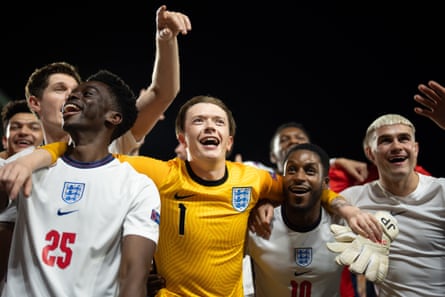
To these, though, Fiennes adds a bobbing head and a south London drawl out of the side of the mouth, creating a mass of tics that unfortunately pitch Gareth somewhere between Harold Steptoe and Captain Darling from Blackadder Goes Forth. He’s a sort of genius but seems perpetually wounded, squinting at a cruel world through a cringing flinch. The real Southgate is fascinating because he is reflective and erudite, qualities not normally associated with football managers – this is enough. There’s no need to make him a haunted savant.
Dear England somehow ends up not quite nailing the nuances of the man it celebrates. It doesn’t help that, in an understandable effort to be accessible to viewers who know little about the mechanics of sport, it brushes over truths that don’t easily fit. It only lightly touches on Southgate’s conservative instincts as a football tactician, manifested in team selections and in-game decisions that could be unimaginative and cautious: his underdogs repeatedly fell short against the world’s best. When England stink up the 2024 European Championship, Southgate’s last stand as boss, Dear England struggles to explain the regression.
A harder-edged drama might have seized on the final, cruel irony that the naysayers were right to say that Southgate was too nice, too soft, not born to win. Instead, Dear England remains in love with the fairytale summer of 2018, when English football made its fans believe again. If it’s not sure what to do beyond that, maybe that’s OK: the great Gareth Southgate didn’t know either.