.png) 1 month ago
87
1 month ago
87
The US military said it had launched a seventh consecutive night of strikes on Iran on Friday night as fighting escalated over the strait of Hormuz.
US Central Command, in a post on X, said the strikes, which began at 7pm GMT, were designed to “continue degrading Iranian military capabilities”.
Earlier on Friday US airstrikes hit bridges in Iran’s southern Hormozgan province, killing at least seven people, Iranian state TV reported. The bridges were a key transit point for Bandar Abbas, Iran’s main port. Further US airstrikes brought down a tower in Chabahar port on the Gulf of Oman that the US military claimed the Islamic Revolutionary Guard Corps (IRGC) used to facilitate attacks on vessels in the strait of Hormuz. The US also targeted key electrical infrastructure and Iranshahr airport.
Iran’s energy ministry told citizens to reduce their use of electricity and air conditioning after the power grid came under strain due to US strikes on energy facilities. The ministry said areas in the south were experiencing “extreme heat and attacks on power infrastructure” as temperatures soared.
Strikes on civilian infrastructure not being used for military purposes could constitute a war crime, human rights experts have said.
Renewed US strikes had killed at least 38 people and wounded more than 400 in Iran by Friday morning, said a spokesperson for Iran’s health ministry, Hossein Kermanpour.
The attacks appeared to be the follow-through of Donald Trump’s promise to expand strikes against Iran, including the targeting of infrastructure and power plants. The US president reportedly met senior department heads this week to discuss an expanded aerial campaign to force Iran to reopen the strait of Hormuz.
The current round of fighting has entered its seventh day and further undermined the interim deal between Iran and the US, which was meant to keep the strait open and give room for negotiations to lead to a permanent truce. Iran has shut the strait and the US reimposed its blockade of Iranian ports and ships on Wednesday.
After the US strikes on Friday, the IRGC threatened a “devastating price” for countries hosting US bases if American attacks against infrastructure continued.
“The American enemy and the hosts of its bases in the region should know that crossing red lines and attacking civilians and civilian infrastructure will have a very severe and devastating price to pay,” the IRGC said in a statement.
The Iranian military responded to US strikes by targeting Bahrain, Kuwait, Jordan, Oman and Qatar. Qatar, one of the mediators between the US and Iran, had been mostly spared from Iranian retaliation in the recent rounds of violence. Qatari authorities said falling debris wounded a child as air defences intercepted missiles.
In Kuwait, authorities said Iranian strikes hit a power and desalination plant, damaging the water facility. The country relies on desalinated water for about 90% of its drinking water. Officials said they were working to assess the damage and get the plant running again.
The renewed fighting has focused on the strait of Hormuz, which handled about a fifth of the world’s oil and gas supply before the war. Though the memorandum of understanding signed by the US and Iran last month said the strait should be open to traffic, both sides interpreted the deal differently.
Washington and Tehran advanced competing plans for ships to transit the strait, with Iran attacking some ships that took the US route. Shipping in the waterway has been drastically reduced over the last few days as violence escalated, though most ships that continued to transit used the Iranian route.
Iran’s Tasnim news agency later cited an informed source as saying that a Thai-flagged ship was targeted in the strait of Hormuz on Friday after it allegedly ignored warnings and attempted to pass without permission from Iran’s Revolutionary Guards navy.
Iranian state media also said the US struck an oil tanker that was empty and docked at Kharg Island, Iran’s main oil export terminal on the strait.
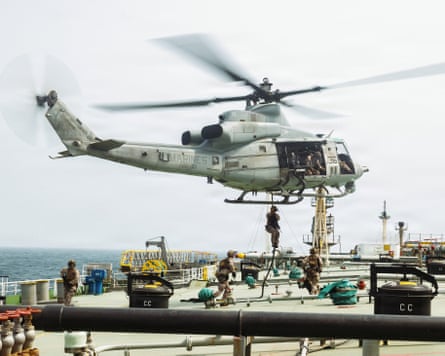
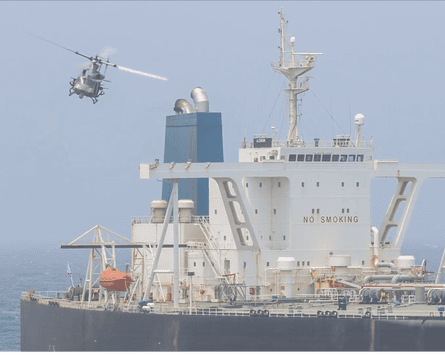
American forces boarded a ship in the Gulf of Oman on Thursday as part of the renewed blockade of Iran’s ports that began earlier this week, the US military said. US Central Command also said it had “redirected” three commercial vessels “trying to run the blockade” since it took effect at 8pm GMT on Tuesday. The previous day, a US aircraft fired on and disabled an unladen oil tanker that tried to break the blockade.
Iran has asked its allies in Yemen, the Houthis, to be prepared to close the oil route through the Red Sea if the US targets Iranian energy infrastructure, Reuters reported – a threat that, if followed through, could paralyse the global energy market.
The Houthi leader, Abdulmalik al-Houthi, also threatened that all Saudi oil and other critical facilities could be targeted by the group if Riyadh intervened in Yemen. The threat came after Saudi Arabia struck Sana’a airport, leading to retaliatory missile strikes from the Houthis on Saudi Arabia.
Week-to-week cargo shipments through the strait of Hormuz dropped by almost a quarter at the beginning of the month, according to the maritime data firm Lloyd’s List Intelligence. And that was before the recent rise in tit-for-tat attacks.
Given the risks, some oil shippers are sailing through the strait with their location devices turned off but many are just staying put, Lloyd’s said on Thursday. A growing amount of the region’s energy is being shipped through pipelines but not nearly enough to offset the decline in shipping through the strait.
On Thursday Pakistan’s foreign ministry said efforts were still under way to bring the US and Tehran to the negotiating table but acknowledged that was becoming increasingly difficult.
Despite the escalating conflict and interruption of trade, Trump said the war was going well for the US. “We are likewise winning big in Iran, and you will see the fruits of that labour very, very shortly,” Trump said in an address to the American public.
The Associated Press and Agence France-Presse contributed to this report