.png) 2 hours ago
5
2 hours ago
5
On a quiet street in western Sydney, Farhana Laffernis races her curious English staffy and boisterous three-year-old daughter in the front door.
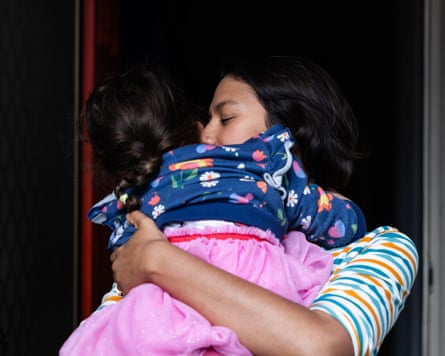
Inside, her three-year-old wears a pink tutu and excitedly babbles as she cuddles her toy doll. The family life Laffernis has built did not come easy.
The 34-year-old has experienced five miscarriages. For someone who “always wanted to be a mum”, the experience “completely shattered” her.
“Grief almost becomes practised or like a routine. You still feel the sting of it every time it happens,” she says. “It’s almost like your mind and your body know the drill.”
Laffernis isn’t alone. Three in 10 women who gave birth in 2022 had previously experienced miscarriage, meaning pregnancy loss before 20 weeks’ gestation, according to the Australian Institute of Health and Welfare. One in 10 had experienced two or more.
The data comes from a first-of-its-kind study in Australia, heralded for helping create better understanding of the prevalence of early pregnancy loss. The study came about after a years-long push by Isabelle Oderberg, founder of peak advocacy group the Early Pregnancy Loss Coalition (EPLC), who was concerned about substandard care for women who had miscarriages after experiencing seven losses herself.
Currently, there is no requirement for doctors to report miscarriage, meaning the data is not collected.
But while the new study has been welcomed, experts fear the data does not capture large groups of women, particularly those from multicultural backgrounds – like Laffernis. And they say the lack of data could mean diverse families are missing out on services they desperately need.
‘The worst thing that had ever happened to me’
Laffernis’s first miscarriage occurred eight weeks into her first pregnancy. It was during the height of the Covid-19 lockdowns, and she couldn’t have her partner with her at any of her appointments and scans.
“It was the first time in my life that I’d ever experienced anything like that, or felt real grief and loss before,” she says. “I was getting all of this terrible news pretty much on my own and having to kind of process that and figure it out.”
That was the first of two miscarriages Laffernis had before successfully conceiving her daughter through IVF. She remembers being “so terrified the whole way through”.
“It seems like everywhere you turn, someone is having this, like, blissful ignorant pregnancy where nothing can possibly go wrong … I could not have that, I just could not be that blissful, relaxed, unaware pregnant woman.”
Another three pregnancy losses after her daughter’s birth marked “the end of the road” in her attempts to have more children.
For Laffernis, who comes from a migrant Indian family, the pain of the miscarriages was exacerbated by a reluctance within her family to talk about what was happening.
“When I was talking to my own family about my losses, the first one was sort of ‘bad luck’, the second one was like ‘Oh, that’s a little bit of extra bad luck’… but then it happens like five times and you kind of just like stop telling people at that point.
“I think in a lot of migrant families, or at least in my experience … there is that sort of mentality in a lot of our communities where our parents have come over [to Australia] from less than ideal circumstances,” she says.
“Maybe miscarriage isn’t the worst thing that’s ever happened to anyone ever, but it was the worst thing that had ever happened to me.”
After years to trying to avoid conflict around the “deeply upsetting” interactions, she had to confront her family about the support she needed.
“I went for a long time just sort of trying not to have the argument before it all just honestly got to me. I did have to have some really hard conversations with members of my family about exactly what it was that I needed from them at this time in my life,” she says.
That reluctance to talk about miscarriage within migrant families is something Dr Fatima El-Assaad has seen many times before.
“It’s something that’s considered very icky to talk about,” says El-Assaad, who founded Sydney-based The Still Nest, a platform supporting diverse families affected by infertility, pregnancy loss, birth trauma and infant loss.
She says cultural and religious practices tied to a women’s fertility journey “may make them feel like it is not in the public arena” and “like it’s something that is meant to be kept behind closed doors”.
after newsletter promotion
While she is encouraged to see data on miscarriage come to light, she questions how representative it is of culturally and linguistically diverse families – and worries that a culture of silence, compounded by the way the data is collected, could be contributing to “a number of holes in the picture”.
The data was collected using existing surveys and clinical registries compiled by midwives and other birth attendants. El-Assaad says flaws in the system could be leading to significant gaps and inaccuracies in the data.
“Are [surveys] primarily in English? Is there a translator that is trauma-informed? … How was the survey conducted? … Where was it captured? Was it in a clinic? Was it at home on a personal device? Was the place safe?” she says, listing factors that can affect the process.
“And we’re also asking culturally and racially marginalised people, and culturally and linguistically diverse people, to just voluntarily answer a survey on top of all the other issues that they’re currently dealing with.”
The problems with the gaps
Although miscarriage is “the most common pregnancy complication”, there’s a lack of healthcare and social support – and Australia is “so far behind”, Oderberg says.
“We had no idea how many people in Australia were experiencing miscarriage, whether it was going up, down, sideways,” she says. There was also a lack of information about high priority groups, including Aboriginal and Torres Strait Islander women, newly arrived migrants people whose second language is English, people from lower socioeconomic demographics.
Oderberg says data directly helps governments understand what kind of support services the community needs and where.
Assoc Prof Jade Bilardi from Miscarriage Australia says efforts to be inclusive must “go beyond” simply translating resources into different languages.
“That’s a great first step, but it’s to work more with women, pregnant people, partners, family members, and support services that work directly with people from Cald backgrounds so that we can better understand what their needs are,” she says.
Laffernis says she hopes to see greater awareness filter through the medical system, normalising conversations about pregnancy loss.
“No one had really talked to me about the risk of miscarriage until it was already looking like that was what was happening. And then, once they had talked about the fact that it was likely to happen, it became about the fact that this happens to so many people and it’s so common,” she says.
She also holds hopes to see a dedicated focus on post-miscarriage support, including mental health services, for all women.
“I don’t think there’s really anything that can prepare you for what happens. I think it’s more what happens next that makes the difference.”