.png) 3 hours ago
7
3 hours ago
7
As Charlie Kirk’s family, friends, and colleagues barreled through the sky to Utah, one staffer kept throwing up in her mouth. Each time she quietly swallowed. She did not want to add to the distress of the others sitting in deathly silence on the jet – especially Kirk’s 36-year-old wife, Erika. She was already a widow.
Those who work at Turning Point USA – the ultraconservative activist organization based in Phoenix, Arizona, that Charlie Kirk founded – believe deeply in a Christian God. Many also believe that Satan and his deputies vie for influence on Earth. Earlier that day, on 10 September 2025, those forces had seemingly persuaded an angry young man to hide on a roof at Utah Valley University, where Kirk was speaking to 3,000 people, with a loaded rifle.
Since Kirk started Turning Point as an 18-year-old high school graduate in 2012, the organization had become a big operation. It employed more than 400 staff, boasted an operating budget of greater than $100m and hundreds of chapters at colleges and high schools, and had launched a political arm, Turning Point Action, that endorsed candidates and mobilized Republican voters. Although Kirk, now 31, told confidants that he had no interest in office, some political observers thought he might one day be the Republican nominee for president.
As an attack dog for the Trump administration and an organization that has often framed political disagreements as civilizational struggles, Turning Point promoted the dangerous and destabilizing idea that Democrats stole the 2020 election; the organization has also often adopted stances that contradict Kirk’s own stated commitment to free speech.
To Kirk’s fans, however, his willingness to calmly debate people who disagreed with him, often in venues hostile to conservatives, modeled political courage and intellectual integrity. Along with the daily Charlie Kirk Show, ubiquitous viral videos of Kirk jousting with leftwing students about socialism, abortion, and other heated topics made millions of young Americans who had never met him feel as if he spoke for them.
Although he had heavy organizational duties as well as two young children, Kirk still relished and painstakingly prepared for the debate tours. The Utah event was to be the first in an expanded program that would see him speak to audiences of thousands. At the university’s outdoor auditorium, his staff walked a line of waiting students, encouraging those who disagreed with him to come forward.
Wearing a white T-shirt emblazoned “FREEDOM”, Kirk had just started answering a question when he suddenly collapsed. A gunshot echoed.
The crowd began to scream and flee. Some of Kirk’s friends and bodyguards wrestled his six-foot-five-inch body into an SUV. As the car sped to a hospital, they gave frantic first aid, and prayed.
Erika Kirk was sitting in a hospital in Arizona, where her mother was receiving medical treatment, when she got a phone call from her husband’s chief of staff, Mikey McCoy. She was gripped by a bad feeling, she later said, even before she heard him screaming: “He’s been shot!”

Andrew Kolvet, a close friend of Kirk’s and a spokesperson for Turning Point, was at home when his phone started convulsing. Hundreds of calls and messages were pouring in – from reporters, the White House, members of Congress. His phone was soon unusable. At Turning Point’s headquarters, staff raced to secure additional security for the buildings and scramble chartered planes, then ran to board without luggage or spare clothing.
No one initially knew if Kirk had survived the gunshot, if the shooter had been caught, or if the attack were part of a larger plot. A senior staffer remembers telling his wife to follow 20ft behind as they stepped off a plane on to open tarmac. As he walked, he prayed: “Lord, protect me. And if this is my moment, cover me in your blood.”
By the time Erika Kirk got to Utah, her husband was long gone. A sheriff advised her against viewing his body, she has said, but she insisted on kissing him goodbye. After a 30-hour manhunt, police arrested the alleged shooter, a 22-year-old gamer who objected to Kirk’s views.
Although political violence is not new in America, we seem to have entered a cycle of new horror. In addition to mass shootings, the past few years have seen the assassination of the Democratic state legislator Melissa Hortman and her husband in Minnesota, multiple assassination attempts on Donald Trump and his cabinet, the killing of two members of the National Guard, the bombing of a fertility clinic in California, the killing of two Israeli embassy staffers, and an arson attack on the Democratic governor of Pennsylvania.
The shocking facts of Kirk’s death were soon eclipsed, on the left, by a debate over what gravity was due a man who had denounced multiculturalism, LGBTQ+ rights, feminism, Islam, the Black Lives Matter movement, and the separation of church and state. Yet many progressives and liberals missed the political significance of what was, in the eyes of half of America, an assassination that killed a man and made him a modern martyr.
To understand Kirk’s death as conservatives understood it, I spoke to 35 people. After months of requests, I was granted unusual access for a reporter at a left-leaning publication.
Kirk’s widow and successor, Erika Kirk, agreed to meet me and answer questions off the record. I also interviewed eight other senior staffers, who gave their first-hand views on Kirk’s legacy and candid and emotional memories of what many described as a year from hell. Beyond Turning Point, I interviewed movement conservatives, sources familiar with the organization, historians and sociologists of the right, and leftwing critics.
Martyrdom is a powerful force, and not easily controlled. It galvanizes and divides, anoints and condemns. When Kirk died, some people worried that his void might trigger a “Game of Thrones scenario” inside Turning Point, its chief field officer, Andrew Sypher, told me.
“Hardship reveals everyone’s true character,” he said. “You just don’t know how the trauma is going to impact everyone. And here’s the incredible part. Rather than turning on each other or leveraging that vacuum … people came together.” Everyone, he said, had each other’s back.
He inhaled. “Where the Game of Thrones happened was in the movement.”
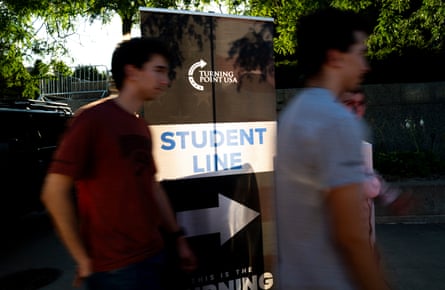
The headquarters of Turning Point cover six buildings in a corporate campus, edged by desert and highway, in south-east Phoenix. A huge American flag flies overhead. Since the day that staff refer to as “9/10”, anyone entering must pass through a security gate. Flanking it are memorial portraits of Charlie Kirk.
This August, the buildings were beginning to bustle with staff getting ready for the fall academic year. Employees leaned young – most looked to be in their late 20s – and white. They also tilted female, with a noticeable number pregnant or accompanied at work by toddlers.
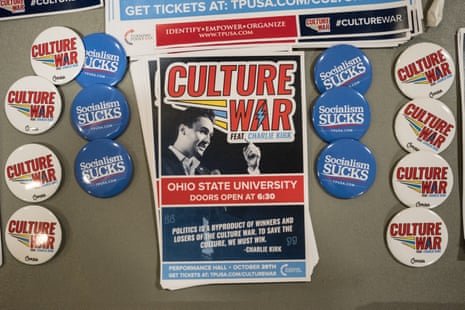
The walls of the offices were decorated with Turning Point merch (“GET MARRIED. HAVE KIDS. GO TO CHURCH. BE A REBEL.”), framed news clippings about Kirk, and, in one case, a cardboard cutout of Joe Biden sniffing a woman’s hair. One person’s desk had a picture of Trump and a pennant reading: “COMFORT IS A SLOW DEATH.”
Everything looked different in 2012, when Kirk had just graduated from a left-leaning high school in the Chicago suburbs. He had a reputation as a contrarian conservative, according to the journalist Kyle Spencer’s 2022 book Raising Them Right: The Untold Story of America’s Ultraconservative Youth Movement and Its Plot for Power. His father was an architect and the family were considered affluent in their rapidly diversifying town.
His parents were center-right Republicans who donated to Mitt Romney. Charlie was more militant: he loved Rush Limbaugh and was excited by the nascent Tea Party movement. Since elementary school, he had also been a believing Christian – and, according to Spencer, once told a friend that he planned to abstain from sex until marriage – but he preferred to make political arguments from secular principles.
He was a dynamo whose ambition and energy were, and still are, remarked on by every person who ever met him. (Tyler Bowyer, the chief operating officer of Turning Point Action, recalled Kirk as a “a nice Steve Jobs”, meaning he had Jobs’s drive and vision without his mercurial difficulty.) Even at 18, his precocious activism – against the ballooning national debt and Obamacare – won him an appearance on Fox News and some speaking gigs.
A local Republican activist, 71-year-old Bill Montgomery, persuaded him to forgo college and to instead work with him on an educational non-profit that would introduce young adults to conservatism and put universities, which they viewed as expensive leftwing indoctrination centers, on defense. They called it Turning Point USA.
Kirk and Montgomery traveled the country soliciting money. Kirk was lanky, badly dressed, and had an occasional facial tic. But he proved a savvy pitchman who understood a perennial anxiety of rich rightwing donors: that the Republican party was too old, too white, too uncool, and losing younger generations to the seductions of the left. In an episode that became organizational legend, he secured a seed donation from Foster Friess, a Wyoming millionaire he passed in a stairwell at a conservative conference. Kirk had memorized his photo beforehand.
“Charlie was extraordinary,” Allie Hanley told me by phone, recently, over the clatter of a dinner party. Hanley and her late husband, the conservative business magnate and art collector Lee Hanley, were early donors. “He was spectacular to the ultimate, really. Almost any superlative you can name, you could apply that.”
More established conservative groups tended to regard Turning Point as a splashy boondoggle, lacking intellectual rigor, or just too youthful, pushy, brash. Yet the organization’s profile continued to rise. Kirk understood social media in a way that older conservatives did not. He also seemed to have his eye on a ball that others could not see.
Sypher recalls him making a point about debates: “He said, ‘You’re never debating to win over the person that you’re conversing with; you’re debating to win over the audience.’ It was always about the audience.”
Perhaps Kirk understood that underlying the leftwing hostility he often faced on campuses was a certain sublimated curiosity. And regardless of how the debates went, rightwingers online would rally to defend what they saw as besieged conservatives exercising their free speech.
Turning Point’s work also began to find eyes in even higher places. Kirk had not been in the absolute first wave of people on the right to embrace Trump, but once he did, he did hard. He worked as an assistant to Donald Trump Jr during the 2016 campaign, and Kirk and Turning Point threw themselves into becoming what the New York Times later described as the Maga movement’s “youth whisperer”.
That entailed a simple rule that he and Turning Point never violated: although Kirk often lobbied Trump in private to change his mind, multiple people told me, he never publicly contradicted him.
A senior executive at Turning Point, who asked to speak on background to talk candidly, told me that people often ask where Kirk would have stood on Trump’s decision this February to go to war on Iran. “I personally believe – and nobody knows, because he’s not here – that he would have probably advocated like heck behind the scenes to stop it, but then ultimately had the president’s back, regardless of the decision that he made.”
After Trump’s election in 2016, Turning Point moved its headquarters from Illinois to the redder state of Arizona. The organization also leaned into opportunistic culture warring that exploited the kinds of cancellation campaigns that conservatives decried in the left. It started an online watchlist of professors across the US who were advancing “leftist propaganda”; as a result some professors have said they suffered a “living hell” of death and rape threats, racial and sexual harassment, and professional pressure. A schoolboard watchlist was later added, as well.
(The watchlists have since been taken down. Turning Point says that these sites aggregated public information, that they were never an “invitation to harass anyone”, and that threats or harassment are “unacceptable”.)
Recognizing the power of online influencers, Kirk worked to build a bench. In November 2017, he was astounded by a panel discussion featuring a young black woman, Candace Owens, who brought blistering attacks on political correctness, identity politics, and the Democratic party’s exploitation of minority voters. Owens had a natural newscaster’s ease. She also seemed to have bizarrely little fear of offending. He signed her immediately.
Alex Clark, who hosts Turning Point’s wellness podcast Culture Apothecary, remembers Kirk once telling her: “You need to want to be famous as much as Candace does. Because it helps the organization to want to put yourself out there. Take every news hit, do every interview, post whatever your most controversial view is – it’s OK, just share it.”
In words that would later seem like an omen, she said, he told her that Owens was so successful because “she wants fame more than anything”.
On air, Kirk liked to challenge young men to spend less time drinking and video-gaming, to marry young to a nice churchgoing woman, and to “have more kids than you can afford”.
A frequent theme of his show was the idea that conservatism was not only the best political ideology but the best way to conduct your life. Kirk had the wit, warmth and relatability to impart that message without sounding stodgy. Some fans drank it like water in the desert.
“People nowadays are really looking for guidance,” said Spencer, who spent hours with Kirk while researching her 2022 book. “And I think that one of the legitimate complaints that you can lodge against progressives is that they have been very reluctant to offer clearcut guidelines, ethics, morals, advice to young people – that theirs can be an anything-goes ethos, which, in its best sense, is an all-inclusive openness, but in its worst leaves people kind of hapless and flailing.”
But the Maga right demanded more than self-help advice. When Trump lost in 2020, Turning Point Action bussed protesters to Washington DC “to fight for the president”, as Kirk wrote in a later deleted tweet. He also helped lead a “stop the steal” rally at a vote-counting center in Phoenix. On his show, he put pressure on Vice-president Mike Pence to overturn the election results.
(Turning Point says that Kirk was “outspoken in questioning the integrity of the 2020 election and believed allegations of irregularities deserved to be fully investigated … Turning Point Action helped students travel to Washington for President Trump’s January 6 rally at the Ellipse. It did not bus protesters to the Capitol, organize the march to the Capitol, or participate in any violence there. Turning Point condemned violence at the Capitol, and continues to oppose political violence of all kinds.”)
By the time he married Erika, in 2021, Charlie’s life had considerably transformed. For one thing, his income – from books, podcasting and speaking engagements, as well as his work for Turning Point – was making him a millionaire, according to the New York Times. By 2023, he began donating his Turning Point salary back to the organization.
For another, he either grew more religious or more willing to combine his religious and political zeal. During the early pandemic, he had become close to several megachurch pastors who were furious about mandated church closures. Erika, who was more vocal about her Christian beliefs, may also have influenced him.
A conservative who met Kirk early on and was close to several of Turning Point’s early megadonors, who asked for anonymity to avoid jeopardizing professional relationships, was “taken aback” to see Kirk at meetings of the Council for National Policy, the influential and secretive organization of the religious right, around 2021 or 2022, speaking in ways that seemed “focused almost exclusively on religion”.
“His speeches went from being 90% about economic issues,” this person told me, “to being 90% about Christianity, salvation, the culture war.”
Where Kirk had once said, in 2018, “We do have a separation of church and state, and we should support that,” he told an audience at the Conservative Political Action Conference, in 2020, that Trump was working to conquer the “seven mountains of cultural influence”, a concept associated with a radical strain of the Christian right.
Matthew Boedy, a professor of rhetoric at the University of North Georgia, has been a critic and observer of Turning Point since 2016. That year he learned that he had been added to the organization’s professor watchlist as retaliation, he believes, for publishing an op-ed supporting gun control. He began getting harassing emails.
His 2025 book, The Seven Mountains Mandate: Exposing the Dangerous Plan to Christianize America and Destroy Democracy, argues that Kirk was a leading figure in popularizing Christian nationalist ideas among millennial and gen Z audiences. “I think Charlie Kirk has been very good at pivoting to things that bring him opportunity,” Boedy told NPR in 2024.
Coming from the opposite political direction, Steve Bannon, the former Trump strategist, partly concurred. “Charlie Kirk was more spiritual leader – with a vision and purpose – than simply a political operative,” he told me in a text message. “As such, I always considered him the real head of the ‘Christian nationalist’ movement in our country.”
(Turning Point believes that Christian nationalism is an imprecise term that is often used to smear conservative figures, and that “[b]elieving that America has a Christian foundation and that faith should inform public life is different from advocating an established national church”.)
At the same time, Kirk was trying to hold together a rightwing coalition that was beginning to fray over the US-Israel alliance: younger conservatives were dramatically more skeptical of Israel than their reflexively Zionist predecessors. A more nationalist “America First” wing, associated with people like Bannon, Tucker Carlson and Marjorie Taylor Greene, was growing frustrated at a Trump administration that they believed was betraying the isolationist spirit behind the Maga movement.
One of Kirk’s greatest sources of heartburn, in his final years, was Nick Fuentes, a popular 28-year-old online pundit known for his Holocaust denial, misogyny, white nationalism and hatred of Israel. Kirk considered Fuentes unwelcome in the coalition, so Fuentes encouraged his far-right, mainly male fans – known as “Groypers” – to heckle Turning Point events and accuse Kirk of being insufficiently rightwing and a sellout to Israel.
Kirk was walking a tricky line: trying to keep the extreme right out of the Maga movement while also proving himself radical enough to satisfy a heavily online gen Z male audience that was itself growing extreme.
His own stances became, in turn, more extreme. Until 2022, he had often criticized identity politics as an offense to the memory of Martin Luther King, whom he praised as someone who fought for a society where all groups were equal; by 2023, he was referring to King, citing his adultery and leftwing politics, as “awful”, and saying that he refused to celebrate Martin Luther King Day.
In one of his last posts to social media, the day before his death, he wrote: “Islam is the sword the left is using to slit the throat of America.”
The Utah medical examiners finished their autopsy sometime before the early morning of 11 September 2025. JD and Usha Vance – who had been close to the Kirks since Charlie encouraged Trump to choose Vance as his running mate – personally flew to Utah to accompany Erika, and her husband’s casket, home in Air Force Two.
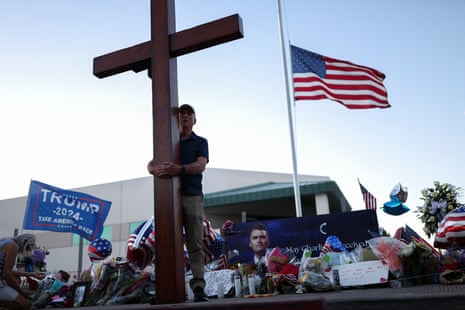
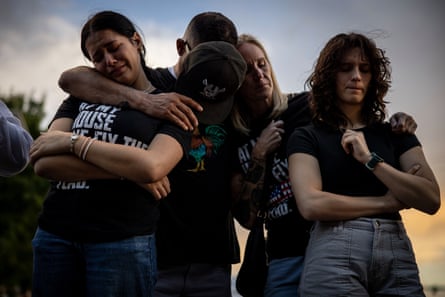
A senior executive remembers trying to make his way through a crowd of some of the thousands who spontaneously gathered outside Turning Point’s headquarters to mourn. He was swamped by people reaching out to hug him, cry against him, or hand him tributes. A man drove a wooden cross, 10ft tall, from Michigan, then stood with it outside Turning Point’s headquarters. Some on the right had already proclaimed Kirk a modern martyr.
In the days that followed, Clark, the podcaster, walked up to every co-worker she saw to tell them that she loved them. Nearly a year later, when I interviewed her, the animated, hyperspeed talker spoke expressively but calmly about the aftermath of Kirk’s death until I asked her about the vigil.
“It was just …” she said. “It …” She heaved with sobs.
After recovering, she said, “Here’s how I’ll put it. I was a huge fan of true crime my whole life. I love-love-love scary movies, I love all those things.” Seeing the crowd of mourners outside, she said, she suddenly realized: “This is one of the biggest true crime stories in American history, and this is somebody I know.”
She added: “It changed forever how I think about and consume true crime content. Now I understand the feelings of the people involved. When conspiracy theories are coming out or whatever, I understand how excruciatingly painful and honestly abusive it feels.”
In the past, she said, she “probably would have thought, like, there’s no harm in this type of stuff. It’s just fun, it’s just dumb.”
When certain topics come up – particularly her faith, or her husband’s legacy – Erika Kirk’s register can switch, in an instant, from a polite and chatty warmth to hypnotic intensity. Talking of his death, she radiates cold fury.
“My husband was assassinated,” she has said. “He didn’t die in a car accident.”
That intensity was on display at Kirk’s public memorial, which filled a stadium with 75,000 people. Wearing a St Michael’s medallion, still stained with her husband’s blood, that medics had torn from his neck while trying to save him, Erika Kirk praised his love of God and said that her faith had sustained her in the 11 days since his death.
She also discussed the biblical gender roles in their marriage in a way that underscored her antifeminism but also seemed to get ahead of any potential criticism of a woman taking over: “Your wife is not your servant. Your wife is not your employee. Your wife is not your slave,” she said. “I was Charlie’s confidant. I was his vault. His closest and most trusted adviser.”
Her eyes blazed out from her dark eyeshadow like accusing blue laser beams. But then, at the climax of her speech, she said: “My husband, Charlie, he wanted to save young men just like the one who took his life … On the cross, our savior said: ‘Father, forgive them, for they know not what they do.’”
Choking out the words, she said: “That man – that young man – I forgive him. I forgive him because it’s what Christ did. And it’s what Charlie would do.”
Kirk seems unshakeable in her religious conviction. She tried to read a book about grief by CS Lewis in which Lewis, a devout Christian, rages at God for taking his wife’s life. She could not relate, she has said: she could never feel angry at God.
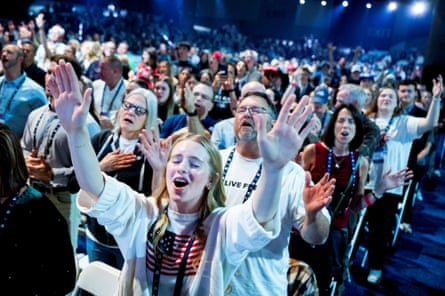
Her response to her husband’s death made her a model of conservative womanhood. “She’s holding herself with so much grace,” an 18-year-old college student told me as we sat in the audience of a Turning Point event at George Washington University in April. “And just being very inspiring to people,” she said. “Even after losing her husband in a gruesome, horrible way.”
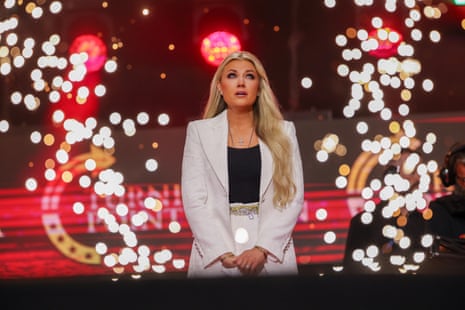
But the role she was assuming required more than exemplary widowhood. Less than a week after Kirk’s assassination, she had held a virtual meeting with 1,500 staff and volunteers to assure them that no one was going to lose their jobs. Then, on 18 September, three days before the public memorial, the board of Turning Point revealed that Erika Kirk would replace her husband as CEO.
The announcement was extraordinary and, to many observers, perhaps confusing. Instead of fading into the background, dressed in black, to grieve in private, Kirk would be Jackie Kennedy and Lyndon Johnson at the same time. Almost overnight, she transformed from a semi-public figure – an entrepreneur, a prolific Instagram poster of Bible verses, an occasional foil for Charlie’s podcast banter – into a national political figure in her own right.
In the world that Kirk came from, however, the apparent contradiction between traditional womanhood and public ambition was less unusual than it might seem. She belongs to a generation of conservative women who have worked to perfect a balance between assertion and reassuring femininity, and are often highly driven even as they, in theory, reject feminism and embrace “complementarian” marriages grounded in biblical gender roles. She has multiple degrees, ran a small business, and married a younger man.
Katie Gaddini, a sociologist who grew up in a conservative Christian household, spent years interviewing women for her recent book Esther’s Army: The Christian Women Who Power the American Right. The women she meets “want to be married, want to have children, but they are very ambitious and skilled and well-trained”, she told me. “And they want to be in DC. They want to run for office.” Their ideal is to be both a mother and a fighter for the conservative cause.
Kirk is a “really potent symbol of the powerful roles that rightwing Christian women are inhabiting – I mean, largely thanks to feminism”, Gaddini said. “And I’m very curious to see how she’s going to use the role, because role models like her and Amy Coney Barrett really do make a difference with the gen Z women I interview.”
Like many prominent women in the Maga world – including former secretary of homeland security Kristi Noem, rightwing activist Carrie Prejean Boller, and deputy White House press secretary Anna Kelly – Kirk is a former beauty pageant contestant. (She was crowned Miss Arizona USA in 2012.) Pageants are an odd anachronism: sexist, silly, or simply bizarre in the eyes of liberal America, they remain a reliable way for ambitious conservative women to build a public profile, meet useful people, practice public speaking and perhaps lay groundwork for a political future.
“You’re learning to present yourself. You’re learning to have a stump speech, for lack of a better word … You’re learning to be media-savvy,” Hilary Levey Friedman, the author of Here She Is: The Complicated Reign of the Beauty Pageant in America, told the Wall Street Journal last year.
In naming Erika, Turning Point was sidestepping any painful – and potentially tawdry – internal succession fight, while anointing a person whose widowhood and relation to Charlie would theoretically put her above reproach.
Donald Trump Jr, personally told the Daily Mail, in May, that he and Charlie had spoken “about the death threats we both constantly faced”, and that Kirk “made it abundantly clear [that] if anything ever happened to him, he wanted Erika to be left in charge”. Even then, Erika has often felt the need to emphasize that Charlie – a prodigious journal-writer – left behind notebooks of ideas that she reads for inspiration.
“I genuinely think – removing myself of any personal attachment to the Kirk family or to Turning Point – that there is nobody else that could have replaced [Charlie] as CEO,” a staffer, who asked for anonymity to avoid drawing online harassment, told me. “She did not step into this role because she wanted to.”
On the right, the memorial – and especially Erika Kirk’s eulogy – was a sensation. The New York Post led with a picture of Erika crying on Trump’s shoulder and the headline: “I FORGIVE HIM: Erika Kirk’s mercy for Charlie’s killer.” She later said that she had kept that section of the speech blank because she wanted to decide, in the moment, whether to forgive the assassin.
Yet the vision of Charlie Kirk’s martyrdom that Turning Point had worked to promote and protect – and which the Maga right had seemed wholeheartedly to embrace – was already starting to show subtle signs of fracture.
David Engelhardt, a pastor and a member of Turning Point’s board of directors, wryly recalled to me the story of the apostle Paul: “When he leaves Jerusalem, he says, ‘I’m going to go away. And when I leave, many savage wolves will come, not sparing the sheep.’”
For one thing, different factions in the Maga coalition began claiming Kirk for themselves. Since he had been a public figure for years, people could usually find evidence, in his public utterances, that he supported their point of view. And since he was no longer around to help hold the coalition together, it began to splinter.
Figures such as Marjorie Taylor Greene, Tucker Carlson and Thomas Massie, the congressman from Kentucky, seemed to become bolder in their willingness to break with Trump over Israel, his handling of the Epstein files, and eventually his war on Iran.
And other narratives began challenging Kirk’s legacy.
The first came from the left. Initially, many left-leaning pundits – such as Ezra Klein – had described Kirk’s killing as a tragedy, condemned political violence, and earnestly praised his willingness to debate people with whom he disagreed. But a different frame soon took over. On social media, Kirk’s most shocking remarks – about affirmative action, Zohran Mamdani, crime, transgender people – resurfaced.
It is Turning Point’s strong opinion that “[m]any of the clips and quotes that circulated after Charlie’s death were selectively edited, shortened, or stripped of the broader context in which he made them”. One viral quote suggested that Kirk believed that gay people should be stoned to death, when he was mocking people’s tendency to pick and choose Bible verses; another suggested that Kirk viewed black airline pilots as unqualified, when, Turning Point says, he was actually arguing that affirmative-action initiatives risked creating that perception.

Nonetheless, most of the quotes were real, and some were ugly. Nor were all his most controversial remarks merely provocations; some expressed deeply held positions unfathomable to many Americans. Arguing that the circumstance of conception did not change the moral calculus, Kirk said in 2024 that if a 10-year-old daughter of his became pregnant by rape he would tell her to have the baby.
As those statements came rushing back into circulation, some on the left – noting that Kirk had also fiercely opposed gun control – invoked those views to suggest that he had brought his death on himself, or mocked his killing.
To people at Turning Point, it felt like the left was kicking a murder victim – after one of their own killed him. They still get angry recollecting it. The reaction of some on the left “didn’t actually really surprise me, because I knew how much they hated Charlie”, Kolvet, the spokesperson, told me as he reduced a tin of nicotine pouches to pulverized pellets. “And you can quote me on that.”
In response, conservatives drove a social media campaign to name and shame people – mainly teachers, academics and journalists – who said critical or callous things about Kirk’s death. Many lost their jobs, although some have since won settlements or been reinstated.
Other conservatives, however, were genuinely surprised. The warm and loyal man they had known did not seem reflected in the picture that some factions of the left were painting. More than that, they were confused: hadn’t Charlie done what you are supposed to do? Hadn’t he gone out to civilly argue his point of view?
“When he died, people would ask me about him,” Spencer, the journalist and author, said. “And I said that there were two kinds of people in Charlie’s world. There were the people that Charlie supported and loved, and gave a lot of warmth to.” But many outsiders, in communities on the wrong end of Kirk’s politics, received his views and policy prescriptions as “cruel and nasty” or simply cynical.
The second narrative sprang from parts of both left and right, and from a suspicious internet id of no particular politics.
In its softer form, this narrative, expressed in YouTube comments and Reddit threads, suggested that something about Erika Kirk was “off”, “phoney”, “fishy”, “fake” or “sus” (suspicious): she did a lot of press for a bereaved widow with two young children. She did not seem sad enough. Her grief felt performative. Perhaps she was a grifter who was, at some level, milking her husband’s death for personal and political profit.
In its harder form, it became an outright conspiracy. Had the man arrested for killing Kirk really acted alone? What if he’d been a patsy, or had not done it at all? Did this guy – described by prosecutors and some media accounts as a maladaptive gamer furry dating a roommate-slash-lover who was transitioning to female – really seem like a criminal genius?
The theories raced across the internet. In his final months, Kirk had seemed to be moving away from his previously ironclad support for the state of Israel; was Israeli intelligence involved? And what if Erika was in on it?
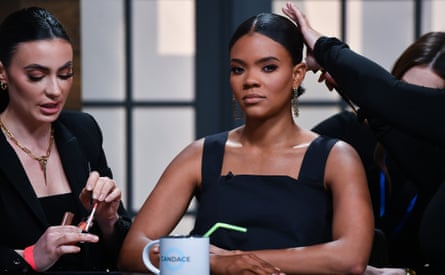
The theories originated, in large degree, with a disgruntled former Turning Point employee named Candace Owens.
In late 2018, while taking questions at a party in London to celebrate the launch of Turning Point UK, Candace Owens argued that Hitler’s nationalism might have been acceptable if he had kept it within Germany.
At the time she was Turning Point’s director of communications. She later said she was misconstrued – that Hitler was “a homicidal maniac” with “no excuse” – but a group of Turning Point’s campus chapters in the US protested, and, in May 2019, she resigned.
In November 2020 she joined the Daily Wire, Ben Shapiro’s conservative media platform, and debuted an online show called Candace. She was fired in March 2024, after arguing with Shapiro about the Israel-Gaza war – “No government anywhere has a right to commit a genocide,” she wrote on X – and making antisemitic comments. Kirk was also trying to put her at a distance, according to people familiar.
A couple months after leaving the Daily Wire, Owens launched her own show independently. Her growth has been explosive. She has 6m subscribers on YouTube alone – despite, or perhaps because, of the fact that she was recently sued for defamation by the president and first lady of France for asserting that Brigitte Macron is secretly a man. (Her motion to dismiss the lawsuit is pending before a Delaware court. I repeatedly contacted a representative of Owens to ask her perspective; noting that she is pregnant with her fifth child, he said she was unavailable.)
Within a week of Kirk’s shooting, Owens – adopting an I’m-just-asking-questions stance – began raising doubts about the official narrative of his death. She followed up with a multipart documentary, Bride of Charlie, that focused the locus of conspiracy on Erika Kirk.
A number of online media personalities – most of them on the anti-Israel side of the Maga coalition – have also cast doubt on prosecutors’ account of Kirk’s assassination, though without necessarily implicating Erika.
During a eulogy at Kirk’s memorial, in a speech that many Jewish organizations accused of antisemitism, Tucker Carlson seemed to insinuate that Israel was involved in Kirk’s death. Comparing him to Christ, he said: “Jesus shows up and he starts talking about the people in power and he starts doing the worst thing that you can do, which is telling the truth.” And “I can just sort of picture the scene, in a lamp-lit room with a bunch of guys sitting around eating hummus, thinking … we must make him stop talking. And there’s always one guy with the bright idea … ‘Why don’t we just kill him? That’ll shut him up.’” (Carlson denies that he is antisemitic.)
Joe Rogan recently said: “The more time goes on, the more I’m leaning towards Candace Owens … I don’t think any story that you hear in the news is accurate; there’s always some spin.” Fuentes has suggested that Israel tried to bribe Kirk, shortly before his death, to boost support for Israel.
Megyn Kelly has negotiated a fine line, neither endorsing nor quite disavowing Owens. Expressing her distress at how the issue was fracturing the conservative movement, she said in December that she has prayed “so many times to Charlie – and to God – to give me the right guidance on how to handle this whole thing”.
The reach and power of the conspiracy theories is such that there are accounts online of couples on the brink of divorce because they cannot agree about Kirk’s death.
Even Turning Point’s staff has not escaped the tentacles of conspiracy. Earlier this year, the organization fired seven employees, many of whom appear to believe in the theories. (Turning Point says that the staffers were terminated for unrelated work reasons, and that it was unaware of their beliefs at the time.)
In an astounding example of the horseshoe theory of politics, some of these ultraconservatives now work with Democratic-aligned organizations to battle Turning Point, Zee Cohen-Sanchez acknowledged to me. She founded the campus activism organization National Ground Game as leftwing counterprogramming to Turning Point.
Aubrey Laitsch, who was fired as a subcontractor of Turning Point this January, told me that she supports Owens’s work. “I believe her when she says that she won’t rest until this is figured out. And I really admire that.” She added: “Charlie taught me and so many others to always question everything, and I’m just going to continue to do so.”
Needless to say, that is not how Kirk’s friends, family, and colleagues see it. If anything, some of them have experienced a double trauma: while still reeling from the shock of his killing, they were already getting messages accusing them of involvement. The people who personally witnessed his shooting, and tried to save his life, have it the hardest because they also figure most deeply in the conspiracy theories. No one close to Kirk has avoided online harassment or, worse, personal confrontation.
“I’ve had family members turn on me,” Sypher told me. “All of us have.”
“It’s hard to be surprised today, but I have been,” Larry Arnn – a mentor of Kirk’s and the president of Hillsdale College, the conservative Christian school in Michigan – told me. People he considered level-headed, he said, have raised the theories to him. “I said, ‘You think [Erika] may have been involved in the murder of her husband, the father of her children, in order to get his job, or perhaps as an agent of the Mossad?’ They sort of quailed. I’ve had two or three conversations like this.”
Talking of the conspiracy theories as well as the more general vitriol against Erika Kirk, Doug DeGroote, a Turning Point board member, seemed simultaneously furious, sad and resigned.
“I feel sorry for those people,” he said. “That’s what I feel. The people that are online doing that stuff are really empty souls … They need love, they need attention, they need something. To hate somebody the way these people hate is just pure evil, and I don’t know where that comes from.”
Boedy, the professor of rhetoric who found himself on Turning Point’s professor watchlist, believes that the organization is learning that a revolution always eats its children. One of the problems of building a Maga movement on the backs of podcasters, influencers, conspiracy theorists, and other content creators unshackled from the traditional ethical and editorial obligations of journalism is that they eventually run out of content – and create more, by whatever means possible, even if it means cannibalizing their own.
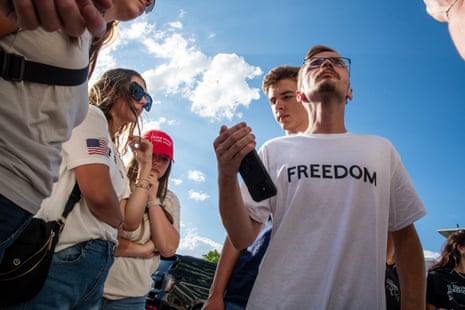
Turning Point has promoted ideas – about the 2020 election, vaccines, the pandemic – that critics have described as conspiracy theories. One of its best-known contributors is Jack Posobiec, a far-right pundit once dubbed “the king of fake news” and the author of a 2025 book that praised Franco and Pinochet.
(Turning Point says that “challenging claims made by public officials and institutions” is not “the same thing as embracing conspiracy theories”, and that the “same principle applies to TPUSA contributors, who are independent commentators with their own platforms, views, and perspectives”.)
“It’s sad, obviously, that Erika is being attacked,” Boedy said. “But when you are a conspiracy spreader, and your organization is built on creating new conspiracies to keep your audiences engaged, and you become the victim or the target of conspiracy theories, you don’t know how to respond.”
Most people I spoke to seemed skeptical that Owens really believes the theories she has promoted.
“It’s a carnival act,” Howard Polskin, an analyst who tracks rightwing media, told me. “It’s outrage as a business model – and business is very good.” Her growth may be slowing, however, suggesting either that viewers are tiring or that her audience has reached its mature size.
Others seemed genuinely unsure to what extent Owens believes her theories, or have given up trying to determine the line.
“It’s hard to keep a charade up like that for a year if you don’t believe it,” Clark said. Owens seemed genuinely distressed by Kirk’s death, she said, though as one of Turning Point’s early stars she may have felt passed over.
Clark, who described herself as “pretty far right” and a skeptic of vaccine mandates, said that Kirk’s assassination also happened at a time when Maga audiences were already primed – by Covid, the Epstein files and later the Iran war – to be suspicious of everything, even the Trump administration.
“You have this conservative voter base who has repeatedly been told they’ve been lied to, and then you have somebody who – at least at one point, [a] long time ago – was close with Charlie, worked closely with Charlie, saying, ‘Don’t trust any of this. Everything is a lie.’ They have been conditioned partly by the Trump admin.”
She thinks that much of the conspiracy theorizing is just antisemitism (“Jew-hatred”), though she also suspects, from anecdotal observation, that Owens has a “massive grip” on stay-at-home mothers who are fairly apolitical but consume a lot of true crime and reality TV. She added: “Her ability to brainwash is – I mean, Jim Jones probably would have been like, ‘Can I have your autograph?’”
Psychologists and sociologists who study conspiracy theories believe they are often attempts to rationalize shocking or distressing events by giving them structure and meaning. Kolvet, the Turning Point spokesperson, put it another way in an interview earlier this year: “I have trained myself to see the conspiracy theories as a testament to the love for Charlie.”
Almost every conservative, inside or outside Turning Point, told me that it was only after Charlie Kirk died that they saw his full importance. “The real lesson, the dangerous lesson people will take,” Bannon told me, “is that assassinations work – that there are certain people like Charlie that are in fact irreplaceable.”
It can take years for the legacy of a martyr to settle – for the story told by his followers, about the meaning of his death, to become history. Kirk has no single obvious heir of any age. Erika Kirk is by all accounts a capable and driven leader. But she is not and can never be him, and much of the hatred she receives probably has its roots in that fact.
Carlson has a big following and recently expressed interest in starting a third party to challenge the Republican party from the right. But he is undisciplined, and probably too far in the fever swamps. Some observers have wondered if Fuentes, who hated Kirk, might actually inherit a significant share of his audience. But, even in a movement with vanishingly few guardrails, he remains toxic.
Kirk’s closest proxy is probably someone who already has political power, close ties to Turning Point, and ambitions far beyond campus activism: JD Vance. And Turning Point, before and after Kirk’s death, has made little secret of its hope that Vance succeeds Trump.
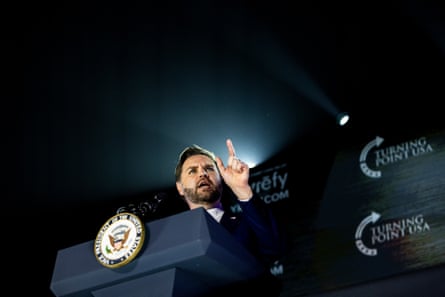
In December – a staggering three years before the 2028 election – Erika Kirk endorsed Vance for president. Whether American voters agree is a different question.
Despite occasional reports of tension with campus chapters or lower-than-expected turnout at events, Turning Point is adamant that the surge of support after Kirk’s assassination continues unabated. “In my role, I see all the metrics. I see all the fundraising,” Justin Streiff, Turning Point USA’s COO, told me. Measured by donations, student interest, number of employees, social media reach and other factors, “there is no slowdown. Like, I don’t even mean a little slow.”
This year Turning Point has announced a number of new programs. Its political arm, Turning Point Action, also continues to aggressively intervene in Republican politics, particularly in its back yard of Arizona, to the point that some conservative strategists and politicians there complained to me that Turning Point was elevating fanatical pro-Trump candidates who do poorly with the general electorate.
Bowyer, the COO of Turning Point Action, disagreed with that tactical analysis. “The people that you’ve talked to, whoever you talked to, they’re wholly uneducated, haven’t looked at the numbers, haven’t looked deeply into it,” he told me in his office, as I listened from across his desk, in a significantly lower chair.
Those who knew and loved Kirk face a difficult few weeks. In addition to the anniversary of his death, which Turning Point is marking with an event at Utah Valley University, initial hearings in the trial of his alleged killer are under way. Erika Kirk can sometimes be seen crying in the courtroom. She walks out whenever footage of her husband’s death is shown.

Any videos of Kirk online are flooded by comments by people who doubt her motives. Perhaps it is simply aesthetic: with her glittery pants and cheerfully chunky diamond rings, she does not look as we expect a political widow to look.
Nothing in my reporting gave me reason to think her grief was anything less than devastating. Similarly, nothing made me doubt that her public messaging, no matter how stage-managed and sometimes overcommunicated, reflects a very real determination to continue her husband’s project.
At Turning Point’s headquarters, I could see her moving around the office, talking to staff. She looked slightly tired, but full of mission.