.png) 3 months ago
75
3 months ago
75
Earlier this week we published an investigation that found hundreds of UK peregrine falcon nests have been raided in the past decade, in order to feed a growing appetite to own prized birds for racing and breeding in the Middle East.
This piece has been a year in the making, working with a great team of reporters from Arab Reporters for Investigative Journalism (ARIJ) to shed light on a multimillion-dollar industry that stretches around the world.
But first, this week’s most important reads.
Essential reads
-
Germany’s dying forests are losing their ability to absorb CO2. Can a new way of planting save them?
-
The LA wildfire victims still living in toxic homes: ‘We have nowhere else to go’
-
‘Just an unbelievable amount of pollution’: how big a threat is AI to the climate?
In focus
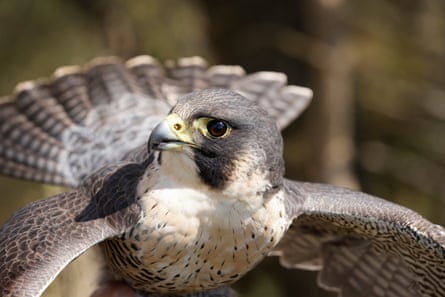
I stumbled across the illegal peregrine falcon trade while out reporting on an unrelated story in rural Yorkshire back in 2023. We were in a quarry and someone mentioned falcon thieves were scaling remote cliffs like the ones surrounding us to steal chicks – peregrine falcons are highly sought after as the planet’s fastest bird.
Police Scotland had been investigating this issue since 2021 after reports of a man bragging to his mates about how much he was making from taking peregrine falcon chicks from the wild. They were being trafficked into the captive bird trade, driven by demand from the Middle East.
For these protected birds, swapping views of Ribblehead viaduct for the sprawling glass cities in the United Arab Emirates was an intriguing life trajectory, and a troubling one for conservationists who have seen chicks vanishing around the country.
The most sought-after falcons in the UAE are given royal treatment. They get Emirati passports, jet around the world and have entire hospitals that specialise in their healthcare. They travel in Range Rovers and Bentleys fitted out with a perch between the front seats.
An undercover reporter from ARIJ attended an Abu Dhabi exhibition where traders will happily discuss their desire for wild-caught birds (although they are not formally advertised, as the practice is illegal). One employee of a high-profile Emirati falconry body told our reporter they particularly value birds from Britain because of their record in winning races, the purity of their bloodline and their speed.
A preference for wild-caught British falcons was echoed by four other farm owners and sellers, as well as two falconers interviewed at the exhibition.
In the 90s, the UK trade in peregrine falcons was domestic, but it is now almost exclusively geared towards serving the market in the Gulf states. The UK exports more live raptors than any other country, and the UAE is the largest importer. “Over the past 10 years there has been significant growth in the falcon breeding industry,” said DC Steven Irvine, who has been investigating this trade.
Trading captive falcons is entirely legal, but what is not legal is the trafficking of wild birds into the captive trade. It is not known how many of those exported birds are wild caught, but police have identified at least some that are.
Exclusive data shared by RSPB investigations shows that from 2014 to 2023 there were 126 reports of nests being raided, 21 of which have been confirmed using camera footage, DNA work or eyewitness accounts. All are believed to be linked to the peregrine falcon trade.
Freedom of information requests revealed that there were 27 physical inspections of facilities breeding peregrine falcons in 2023 and 2024. During those checks, 15 wild birds were discovered. “The DNA work shows there are a number of wild birds within captive breeding centres up and down the country,” says PC Gavin Ross from the National Wildlife Crime Unit (NWCU).
The majority of facilities that NWCU has investigated are non-compliant in some way, with offences ranging from non-registration of birds and false declarations of parentage to selling birds that have been taken from the wild. “Most often when we’re throwing stones, we’re hitting something,” says Ross.
These findings have been disputed by some experts in the industry, who argue that the trafficking is minor or nonexistent. Julian Mühle, CEO of the International Association for Falconry and Conservation of Birds of Prey (IAF), says the discovery of wild falcons in breeding facilities “should not be interpreted as evidence of widespread criminality”. He says instances of chicks being taken from wild nests “while serious, are extremely rare and, crucially, not linked to the legitimate falconry community”.
Nonetheless, wildlife crime matters. It is the fourth largest illegal activity globally, behind only arms, drugs and human trafficking.
In 2024, a UN report found more than 4,000 species around the world are being targeted by wildlife traffickers, causing “untold harm upon nature”. The trade is active in more than 80% of countries, with seizures representing a small fraction of overall crime.
Many readers in the UK might believe wildlife trafficking is something that happens elsewhere, but this investigation shows it’s rife on our own doorstep, stretching deep into some of the country’s most remote landscapes, with potentially worrying impacts on our most protected species.
Read more: