.png) 3 hours ago
5
3 hours ago
5
Not many family photo albums open with images of the twin towers on fire. But for Nick Haymes, it made perfect sense. “When 9/11 happened,” he says, “I realised life was very short.” At the time, he was living in New York, trying to forge a career, while his friend, colleague and future wife Lina was dealing with the fallout of her previous marriage. “It made us realise we should probably get together and have a family. It was this huge historical event, but on a very micro level, it also shaped my relationship with my wife and children.”
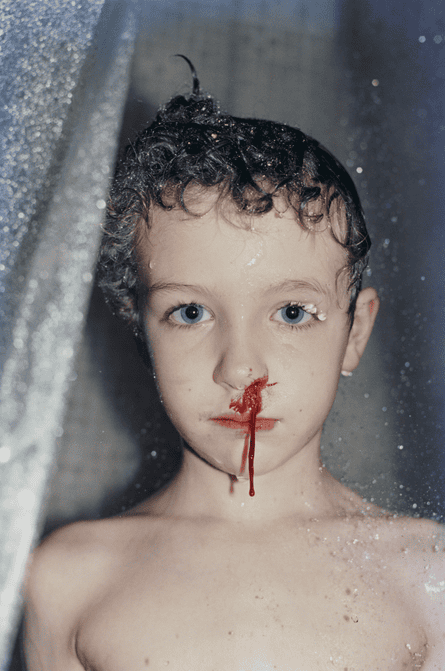
Chronograph is a photography book that runs from those terrorist attacks to the present day, tracing the journey of Haymes’s two sons, Philipp and Lawrence, as they grow from drooling babies into young men. We are given a ringside seat as arms get broken, beloved pets die and hairs start sprouting from armpits. The mundane side of life – verrucas, messy kitchens, Lina cleaning out an ear with a cotton bud – is captured in the same way as birthday parties and rites of passage.
“Because we lived in this tiny, 800 sq ft apartment in Manhattan, you don’t miss a thing, all the ups and downs, all the mood swings,” says Haymes. “There was no door slamming, because there was nowhere to go!”
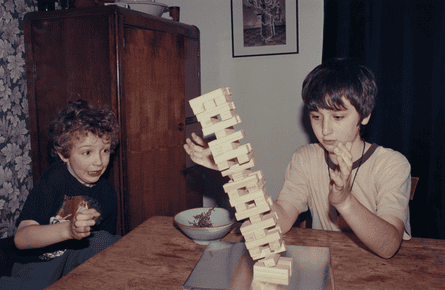
Indeed, we are not spared from seeing the children at their least flattering: “We used to have a running joke where Lawrence would say: ‘You’re the only parent that would photograph me when I’m crying rather than deal with the issue straight away,’” admits Haymes, “but I like to think I was attentive. It was a funny balance because the camera was always around, but it seemed to work.”
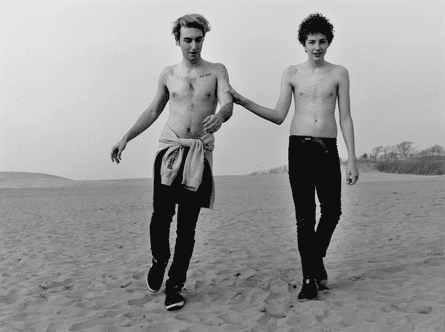
There are also multiple shots of the boys naked – not just running around the house as young children but as they transition into adulthood too. I suspect most teenagers would not be cool with this, but Haymes insists he had their approval. “They don’t have an issue,” he says. “I’ve been lucky enough to have some very nice photographers in my household at various times, so they’re aware of the creative process.” He shrugs: “There are bigger themes in the book than child nudity. That was just a part of our daily life.”
Besides, when Philipp and Lawrence reach their teens – all bleached hair, tattoos and stubble – they work out an ingenious method of rebellion. Instead of sulking or turning away from the camera, Haymes says his kids smiled and put their thumbs up, knowing that the last thing their dad wanted was a posed family portrait. “That was basically their way of telling me to clear out of their lives,” he says.
Born in Stratford-upon-Avon, Haymes hoped to study art but ended up dropping out. “I took way too many drugs in my 20s and had a bit of a breakdown,” he says. After couch-surfing in London for a bit, he found work in a photo studio, eventually assisting Jürgen Teller. In 1999, he packed two cameras into a bag and decided to try his luck in New York. It was here he met Lina, a Jewish refugee who, as a teenager, had moved to the US with her parents from Ukraine – then part of the Soviet Union. She was working on a magazine and gave him a commission that allowed him to get a visa and stay.
Haymes’s own difficult transition from youth to adulthood is perhaps what draws him to his subjects. Between Dog and Wolf captured his road trips across California and Oklahoma with a group of young skateboarders. Follow-up Gabe TM unfurled over many years hanging out with Gabe Nevins, the teenage star of Gus Van Sant’s Paranoid Park. Unexpectedly, Haymes found himself chronicling Nevins’s homelessness and addiction in the wake of making the movie. Dancing on the Fault Line, published in 2024, was another mammoth excursion, following teenager Love Bailey and her extended queer family right up to her decision to transition in her 30s.
Haymes is still in touch with his previous subjects: he shot Bailey’s wedding; Gabe is living a “normal life” now in Oregon; the skaters have children of their own. Haymes doesn’t intend to foster such deep relationships with his subjects. “I always think, ‘Oh, I’ll just do a nice quick shoot.’ But then I get attached to everybody, they become part of my life. You can become a father figure to them, or a therapist maybe. That’s part of it, and that’s part of the educational process for me, just to be with people and understand them.”
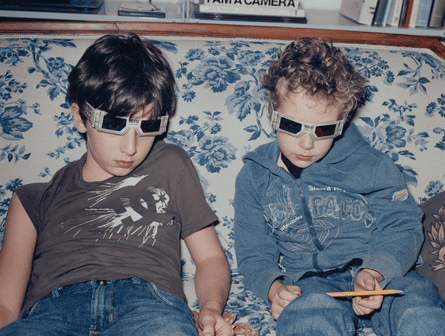
It was during Covid that Haymes found the time to go through all his family negatives and work out what to do with them. “It moved me pretty heavily,” he says. “I also had to try to be as impartial as I could because I didn’t want it to be saccharine.”
Did he know, as he took them, that the photos of his children would end up in a published book? “I suppose, as a photographer, yes. But I really did it for personal memory, and as a little self-analysis. To think about how I was as a parent. Also, I shoot on film and at the time, in the early 2000s, digital photography had kicked in so I was finding myself more and more unemployable. I thought, ‘OK, I am becoming a house husband.’ But I wanted to be a photographer still, so the family life around me is what I photographed.”
Besides Lina and the boys, the other key figures in the book are Lina’s parents Nadia and Mikhail. “They were big characters,” says Haymes. “I had to learn how to become a little more emotional and a little more warm and compassionate.”
One striking image is of Mikhail sitting with wrapping paper on his head. He’s in a full tracksuit, giving off a slightly intimidating Paulie Walnuts vibe. “He was a very loving person,” says Haymes, “but yeah, maybe a bit of a rogue. Whereas my mother-in-law had her issues and I think maybe undiagnosed bipolar disorder. She also became a victim of prescription medication in the US, and we had to deal with that. She was certainly a tough mother-in-law, but at some point you fall in love with her anyway.”
There are some portentous images in the book. Scars on Mikhail’s stomach mirror Lina’s caesarean scars, although we can only guess why he’s been cut open. Then there is the pet hamster, who we see being held, adored and then grieved for as it rests in its cardboard coffin.
The book’s closing passages are extremely moving, as we see Nadia and Mikhail in hospital together, their conditions slowly deteriorating. “We were bringing two people to dialysis every day, which was two pretty gruelling years.” At some point, Haymes converted the home art gallery into a hospice.
In the book, it appears as if the couple died at the same time. In reality it was a year apart and the couple had gone through a divorce by that point. “There are things that don’t need to be known,” says Haymes of the story his book tells. “Everybody has a family album, and through those you only remember certain parts.”
Despite their divorce, Nadia and Mikhail were buried together in Los Angeles. “I’m not sure if Lina’s father is enjoying that right now, but that’s what happened,” says Haymes with a smile.
He says he had been asked to make a photography book of his family for 15 years but it was only when the grandparents died that he realised the project was complete. “The book starts with death and ends with death,” he says. “It’s gone full circle.”
Interspersed with beautiful, closeup images of flowers received at the funeral, we see Philipp and Lawrence standing by the graveside with the urn. “For them to be able to communicate those emotions and to speak at a service, for me that felt like, ‘OK, they’re on their own now. They’ve become men.’”
He pauses, then laughs like only a father can. “Having said that,” he adds, “they’re still on my Uber account.”